AgentOnto: How Ontology-Guided LLM Agents Are Revolutionizing Enterprise Data Analysis

AgentOnto uses enterprise knowledge ontologies to guide LLM agent analysis, improving reliability and adaptability.
AgentOnto is an ontology-guided LLM agent framework that addresses knowledge fragmentation in enterprise data analysis. It integrates database schemas, business documents, and example tasks into a structured enterprise knowledge ontology that directly guides analysis planning and is iteratively updated through feedback and self-generated tasks. The architecture comprises ontology construction, ontology-guided analysis, and ontology update modules, validated by module-level evaluation. It significantly outperforms representative methods on two public data sources and has been validated in real enterprise deployments. Limitations include unquantified ontology maintenance costs and unverified cross-industry generalization.
Enterprise data analysis is complex because analytical requests often require connecting knowledge scattered across databases, business documents, and past task examples. Traditional LLM agents lack an explicit representation of this knowledge, making them prone to erroneous results and unable to effectively incorporate feedback. AgentOnto proposes an ontology-guided agent framework that significantly improves the reliability and adaptability of analysis by constructing, using, and updating an enterprise knowledge ontology.
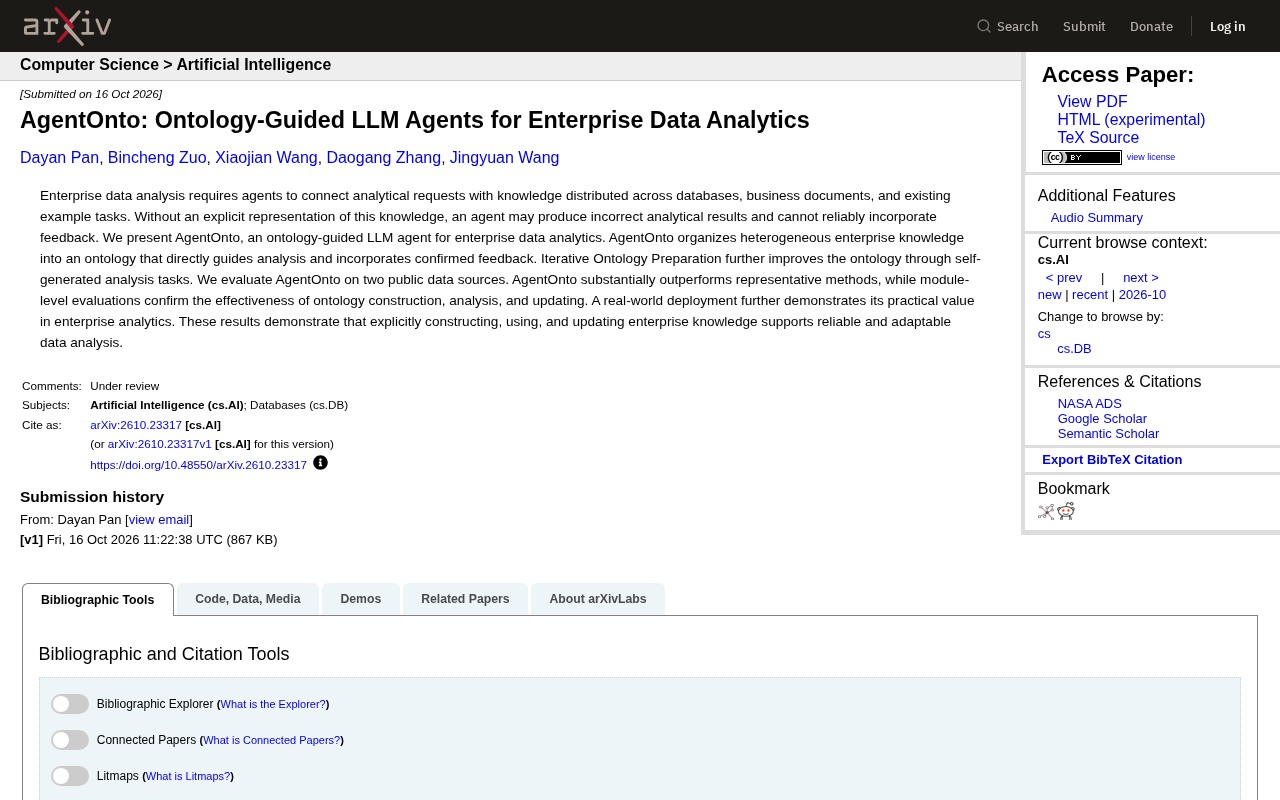
Pain Points of Enterprise Data Analysis and AgentOnto's Breakthrough Approach
In enterprise environments, data sources are heterogeneous and knowledge is fragmented. An analytical request may involve sales databases, product documentation, and historical similar analysis cases. If an agent cannot explicitly organize this knowledge, it is difficult to ensure consistency in analytical logic. AgentOnto's core innovation lies in organizing enterprise knowledge into an ontology that directly guides the analysis process and incorporates confirmed feedback. This explicit knowledge representation enables the agent to trace the basis of its analysis and reduce hallucinations.
The paper points out that AgentOnto employs an "iterative ontology preparation" mechanism, using self-generated analysis tasks to continuously refine the ontology. This means the system not only uses the ontology but also self-improves in practice, adapting to the dynamically changing needs of enterprises.
Ontology originates from the fields of knowledge engineering and the Semantic Web, referring to a formal, explicit specification of concepts, properties, relationships, and constraints within a domain. In an ontology, entities (such as "Customer" and "Order") are defined as classes, associations between entities (such as "Order belongs to Customer") are defined as relationships, and business rules (such as "Order amount must be positive") are expressed as constraints or axioms. Unlike database schemas, which only describe data structures, ontologies also carry semantics and business logic, and can therefore be reasoned over and queried by machines. Enterprise knowledge ontologies are typically represented in standard formats such as RDF/OWL and support SPARQL queries. AgentOnto leverages this explicit semantic representation of ontologies to unify knowledge scattered across database schemas, documents, and example tasks into a traceable knowledge graph, enabling LLM agents to ground their analytical planning steps rather than relying solely on parametric memory.
Modular Design for Ontology Construction, Analysis, and Update
AgentOnto's architecture can be broken down into three key modules: ontology construction, ontology-guided analysis, and ontology update. In the ontology construction phase, the system integrates database schemas, business documents, and example tasks into a structured ontology, clarifying entities, relationships, and constraints. In the analysis phase, the agent plans analytical steps based on the ontology, ensuring that each step is knowledge-grounded. In the update phase, the ontology is refined through user feedback and self-generated tasks, forming a closed loop.
Module-level evaluation confirms the effectiveness of each component. For example, the quality of ontology construction directly affects analysis accuracy, while the update mechanism continuously improves the alignment between the ontology and real business needs. This modular design also facilitates customization and debugging by enterprises as needed.
Ablation study is a commonly used experimental design method in machine learning and system evaluation. By removing or replacing key components of a system one at a time and observing changes in overall performance, it quantifies the contribution of each module. In the context of AgentOnto, module-level evaluation constitutes an ablation study: disabling ontology construction, ontology-guided analysis, or the ontology update mechanism separately and comparing against the full system. If performance drops significantly when a module is removed, that module is indispensable. This approach provides internal consistency evidence, helping to distinguish which design choice is responsible for performance gains rather than attributing them broadly to the entire framework. Compared with reporting only end-to-end metrics, ablation studies better help researchers and enterprises determine which components are worth investing in, and facilitate subsequent reproduction and debugging.
Experimental Results: Significantly Outperforming Representative Methods
AgentOnto was evaluated on two public data sources. Results show that its performance substantially outperforms representative methods. Although the original text does not disclose the specific dataset names or quantitative metrics, it emphasizes "substantially outperforms" and validates the effectiveness of ontology construction, analysis, and update in module-level evaluations. Furthermore, a real enterprise deployment further demonstrates its practical value, indicating that the framework is applicable not only to academic benchmarks but also to the complexity of production environments.
Regarding multi-source cross-validation, current information mainly comes from the paper abstract, lacking independent third-party reproduction. However, the modular ablation experiments provide internal consistency evidence, enhancing the credibility of the conclusions.
Multi-source cross-validation refers to validating the same conclusion through multiple independent sources (such as different datasets, different evaluators, different experimental environments, or third-party reproduction) to reduce bias from a single source. In AI system evaluation, common practices include testing on multiple public benchmarks, reproduction by independent teams, and validation through deployment in real production environments. Current information on AgentOnto mainly comes from the paper abstract and the authors' own account, lacking independent third-party reproduction. Therefore, its conclusion of "substantially outperforming representative methods" relies primarily on internal ablation experiments and real enterprise deployment as supporting evidence. When citing such results, readers should distinguish between author-reported performance and independently verified performance, and pay attention to details such as dataset scale, baseline selection, and statistical significance.
Implications and Limitations for Enterprise AI Applications
AgentOnto's practice shows that explicit knowledge representation is a key path to improving the reliability of LLM agents. For enterprises, building and maintaining an ontology requires upfront investment but yields a more interpretable and feedback-friendly analysis system. Especially in high-risk decision-making scenarios, ontology guidance can reduce the risk of error propagation.
In terms of limitations, the cost of ontology construction and maintenance has not been quantified, and the speed of adaptation to dynamic business needs requires further study. In addition, current evaluations focus on public data sources, and cross-industry generalization capability needs more case validation. Future work could explore automated ontology evolution and multi-agent collaboration.
Overall, AgentOnto provides a new approach to enterprise data analysis that balances flexibility and reliability, and is worth the attention of AI application developers and enterprise data teams.
One-line Summary
AgentOnto uses enterprise knowledge ontologies to guide LLM agent analysis, improving reliability and adaptability.
Paragraph Summary
AgentOnto is an ontology-guided LLM agent framework designed to address the fragmentation of knowledge in enterprise data analysis and the lack of explicit knowledge representation in agents. It integrates database schemas, business documents, and example tasks into a structured enterprise knowledge ontology that directly guides analytical planning, and iteratively updates the ontology through user feedback and self-generated tasks to form a closed loop. The architecture consists of three modules: ontology construction, ontology-guided analysis, and ontology update, with module-level evaluation validating the effectiveness of each component. On two public data sources, AgentOnto significantly outperforms representative methods, and a real enterprise deployment demonstrates its practical value. The article also notes limitations such as the unquantified cost of ontology construction and maintenance and the need to validate cross-industry generalization capability.
Related articles

Chain of Thought Isn't Just for AI: How Humans Can Use CoT to Improve Thinking Quality
Chain of Thought isn't just a prompt trick for large models. Starting from a Hacker News discussion, this article analyzes why CoT works for human thinking too, breaks down actionable ways to transfer it, and highlights the key differences between human CoT and machine CoT.
Cloudflare Teams Up with OpenAI: Closi…
Cloudflare Teams Up with OpenAI: Closing the Loop from Vulnerability Discovery to Defense with AI
Cloudflare uses OpenAI Daybreak to investigate security vulnerabilities and generate reviewable remediation plans, while developers use Codex to boost coding efficiency and quality.

Orca Multi-Agent Orchestration in Practice: A Guide to Parallel Collaboration with Claude and Codex
Orca is Stable AI's free open-source agent workbench supporting 34 agents like Claude Code and Codex in parallel. Learn its Git worktree isolation, multi-model orchestration, and mobile management.