AgentR 3.0: A Hiring Evaluation Agent Designed for the AI Cheating Era
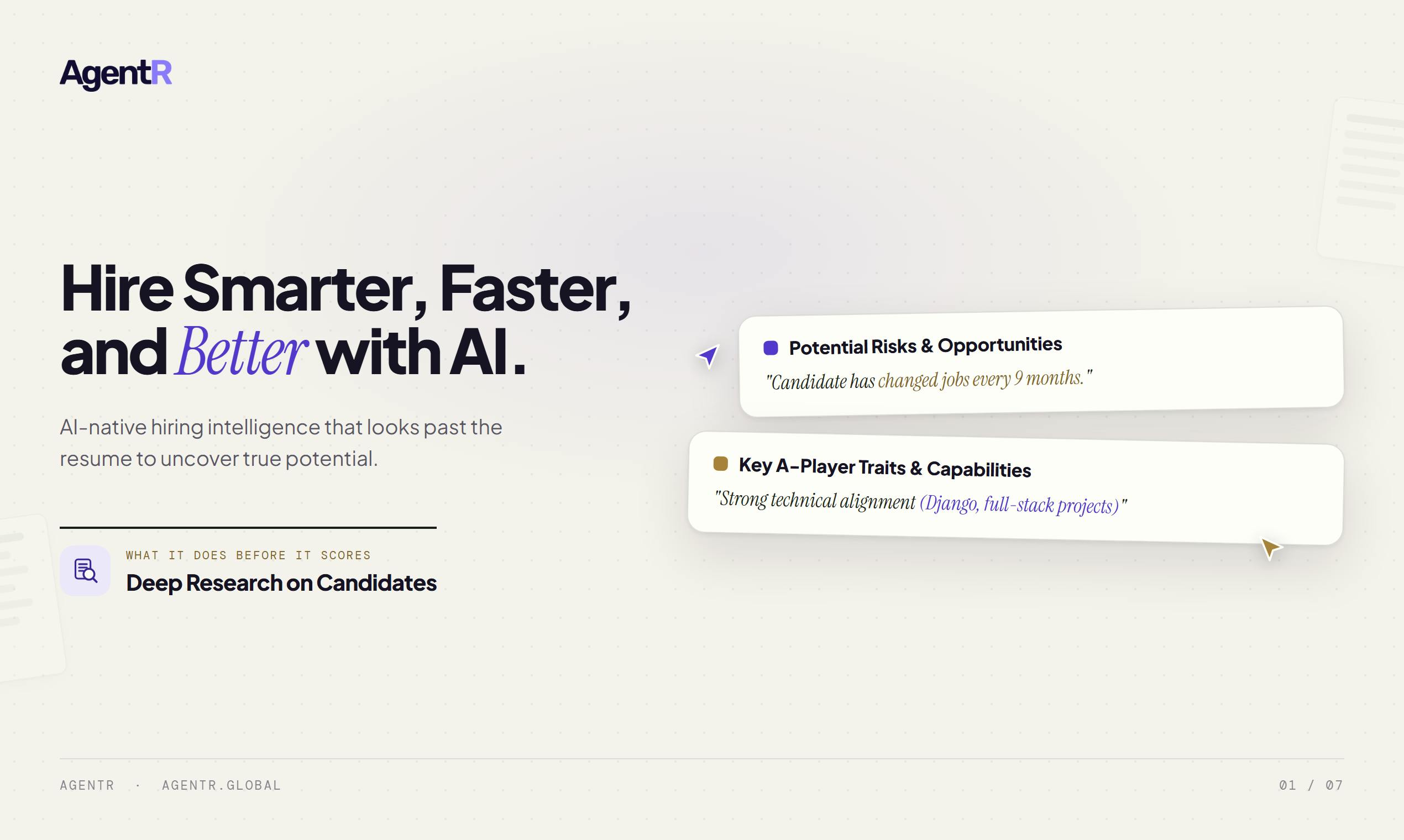
AgentR 3.0 uses autonomous AI interviews to combat candidate cheating in the generative AI era.
AgentR 3.0 is an AI Agent designed to restore trust in hiring evaluation amid widespread AI-assisted cheating by candidates. Its Phase 3 update introduces fully autonomous first-round interviews that are structured, adaptive, and built to resist AI cheating. By replacing resume screening and gut feelings with evidence-driven assessment, AgentR helps hiring teams make confident decisions while navigating the arms race between AI-powered candidates and AI-powered evaluation.
When Hiring Meets AI Cheating: An Overlooked Pain Point
The proliferation of generative AI is reshaping every aspect of recruitment. Job seekers can use large language models to polish resumes, generate perfect cover letters, and even leverage AI to produce real-time answers during remote technical interviews. For hiring teams, traditional evaluation methods that rely on resume screening and subjective interview judgment are becoming increasingly unreliable — it's nearly impossible to tell whether the candidate on the other side of the screen genuinely possesses the skills they claim, or is simply a skilled "prompt engineer" operating ChatGPT.
AgentR 3.0, which recently appeared on the Product Hunt leaderboard, targets exactly this pain point. Its tagline is blunt and sharp — "Hiring evaluation built for the AI cheating era." The product currently ranks #14, with 80 upvotes and 3 comments, categorized under Hiring, AI, and Career.
What Is AgentR: An AI Agent That Runs the Complete Evaluation Process
Unlike the many "resume screening tools" on the market, AgentR positions itself as an AI Agent capable of running the complete hiring evaluation process. According to official descriptions, it covers four key stages: evaluation, judgment, real work scenarios, and verification.
Its core philosophy is that every candidate shortlist should be built on evidence, not a resume and a gut feeling. This statement serves as perhaps the most direct critique of traditional hiring methods. Resume screening has long been heavily dependent on keyword matching, while first-round interviews are often swayed by interviewers' subjective impressions, daily mood, or even biases. AgentR aims to replace this "empiricism" with a systematic, traceable evaluation process.
The Shift from Tool to Agent
You might not have noticed, but AgentR emphasizes that it is an "Agent" rather than simply a "tool." This means it doesn't just assist at a single step — it can autonomously execute tasks end-to-end, make judgments, and deliver conclusions. This shift in product form from "functional tool" to "autonomous intelligent agent" is one of the major trends in the current AI application landscape.
From a technical architecture perspective, AI Agents are fundamentally different from traditional AI tools. An Agent possesses a complete closed-loop capability of perceiving its environment, autonomous planning, executing actions, and adjusting based on feedback. In terms of implementation, Agents are typically built on large language models (LLMs) as the reasoning core, combined with memory systems, tool use, and planning modules. For example, a hiring Agent can not only generate interview questions but also adjust its follow-up questioning strategy based on a candidate's real-time responses, ultimately producing an assessment report autonomously. This paradigm has evolved rapidly during 2023-2024, with representative frameworks including LangChain's Agent module, AutoGPT, and Microsoft's AutoGen. AgentR is the product of applying this technical paradigm to the hiring evaluation domain.
Phase 3 Core Upgrade: AI Autonomously Conducts Cheat-Proof First-Round Interviews
The most significant update in AgentR 3.0 (Phase 3) is enabling AgentR to conduct the entire first-round interview on its own. The official description characterizes this AI interview system with three features:
- Structured: The interview process is standardized, ensuring every candidate is assessed against consistent criteria, reducing randomness and subjective bias;
- Adaptive: It can dynamically adjust the direction of questioning based on a candidate's responses, rather than mechanically following a script;
- Built to hold up against AI-assisted cheating: This is the product's key differentiator — the interview design specifically targets scenarios where candidates use AI tools to cheat in real time.
It's worth noting that "structured interviews" have a deep academic foundation in organizational behavior and human resource management. Extensive meta-analytic research shows that structured interviews have significantly higher predictive validity than unstructured interviews, more accurately predicting candidates' future job performance. Core principles include: all candidates receive the same question set, predetermined scoring criteria are used (such as Behaviorally Anchored Rating Scales), and multiple assessors score independently. AgentR combines this validated methodology with AI adaptive capabilities, preserving the fairness advantages of standardization while breaking through the rigidity limitations of traditional structured interviews.
The Technical Logic Behind Anti-AI Cheating
Although the company hasn't disclosed detailed technical implementation of its "anti-cheating" measures, logically speaking, such systems typically identify cases of "perfect answers lacking genuine understanding" through hands-on tasks simulating real work scenarios, probing follow-up conversations, and cross-validation of response consistency. When a candidate cannot explain the reasoning process behind their answers, traces of AI generation become exposed.
From a broader technical perspective, detecting AI-assisted cheating is a shared challenge across multiple domains. Mainstream anti-AI cheating approaches include several categories: First, temporal analysis — monitoring response time patterns, since the time signatures of human thinking before answering versus copy-pasting AI-generated content are significantly different. Second, probing — requiring candidates to explain the reasoning behind their answers and provide specific details from personal experiences to verify authentic understanding. Third, hands-on task design — requiring candidates to complete real work tasks in controlled environments rather than merely answering knowledge-based questions. Fourth, consistency cross-validation — logically comparing answers across different stages to identify contradictions or unnaturally perfect consistency. AgentR's "adaptive" feature likely employs a combination of these strategies, constructing a verification network within dynamic conversations that is difficult for AI-generated answers to penetrate.
Empowering Hiring Decision-Makers with Confidence
The product's ultimate value proposition comes down to one statement: enabling hiring decision-makers to "walk into every decision with the confidence to make the call." In other words, AgentR doesn't attempt to completely replace human final decision-making authority. Instead, it helps hiring teams reduce decision uncertainty by providing sufficient, evidence-based evaluation results.
Industry Observation: The "Sword and Shield" Battle in AI Recruitment
AgentR's emergence reveals a fascinating phenomenon: AI is both the problem and the cure. On one hand, job seekers arm themselves with AI, blurring the true boundaries of their capabilities; on the other hand, hiring teams are forced to use more powerful AI to rebuild evaluation credibility. This is essentially a "sword and shield" technological arms race.
From a market landscape perspective, AI recruitment technology (HR Tech/Recruitment Tech) is a rapidly growing sector. According to Grand View Research, the global recruitment software market is projected to exceed $4 billion by 2030. Several mature players already exist in this space: HireVue focuses on AI analysis in video interviews (though its facial expression analysis feature was discontinued due to ethical controversies); Pymetrics (now acquired by Harver) assesses candidates' cognitive and emotional traits through neuroscience games; Codility and HackerRank specialize in online coding assessments for technical roles. AgentR's differentiation lies in its explicit positioning of "anti-AI cheating" as a core focus, which remains rare among current competitors and reflects new market demands emerging since the widespread adoption of generative AI in 2024.
From a broader perspective, these AI recruitment products also raise thought-provoking questions:
- Fairness boundaries: Does fully delegating first-round interviews to AI introduce new algorithmic biases? How can we ensure evaluation criteria are consistently fair across candidates from different backgrounds?
Algorithmic bias in AI hiring systems has notable precedents. In 2018, Amazon was revealed to have an internal AI recruiting tool that, because its training data was dominated by male resumes, learned systematic discrimination against female candidates — the project was ultimately scrapped. This incident became a landmark case in AI ethics. Subsequently, New York City passed Local Law 144 in 2023, requiring companies using AI hiring tools in New York to conduct annual bias audits and publish the results. The EU's AI Act further classifies AI systems in recruitment as "high-risk" applications, imposing strict transparency and compliance requirements. These regulatory trends mean products like AgentR must embed fairness audits into their product architecture from the design stage.
- Candidate experience: How do job seekers feel about facing an AI interviewer in terms of acceptance and experience? This could directly impact a company's employer brand.
- Validating the validator: When AI claims it can identify AI cheating, who verifies the accuracy of that judgment itself?
These questions remain unresolved, but they will determine whether such products can truly evolve from "novelty tools" to enterprise-grade, scalable applications.
Conclusion
AgentR 3.0 represents a clear direction within the AI recruitment space — using systematic AI evaluation to combat the information distortion caused by AI. With "evidence-driven hiring" as its core philosophy, it leverages end-to-end Agent capabilities — particularly autonomous, cheat-proof first-round interviews — to address the trust crisis in hiring evaluation during the AI era.
Although its technical details and actual effectiveness still await validation through more user feedback, as a direct response to the genuine pain point of the "AI cheating era," AgentR's product positioning undoubtedly strikes at the core anxiety of today's corporate hiring. As AI continues to permeate work scenarios, finding the balance between efficiency and fairness, automation and humanization, will be a long-term challenge that AI hiring evaluation products like this must continue to explore.
Related articles

Chain of Thought Isn't Just for AI: How Humans Can Use CoT to Improve Thinking Quality
Chain of Thought isn't just a prompt trick for large models. Starting from a Hacker News discussion, this article analyzes why CoT works for human thinking too, breaks down actionable ways to transfer it, and highlights the key differences between human CoT and machine CoT.
Cloudflare Teams Up with OpenAI: Closi…
Cloudflare Teams Up with OpenAI: Closing the Loop from Vulnerability Discovery to Defense with AI
Cloudflare uses OpenAI Daybreak to investigate security vulnerabilities and generate reviewable remediation plans, while developers use Codex to boost coding efficiency and quality.

Orca Multi-Agent Orchestration in Practice: A Guide to Parallel Collaboration with Claude and Codex
Orca is Stable AI's free open-source agent workbench supporting 34 agents like Claude Code and Codex in parallel. Learn its Git worktree isolation, multi-model orchestration, and mobile management.