AgentReach: An Open-Source Capability Layer for AI Agents to Access Social Platforms Without Paid APIs

AgentReach is an open-source capability layer that unifies tool selection, health checks, and routing for AI agents across social platforms.
AgentReach is an open-source project that addresses the fragmented engineering challenges AI agents face when connecting to multiple social platforms. It acts as a capability layer rather than a wrapper: handling tool selection, health checks, and routing at install time by writing decisions into a skill.md file, while agents call upstream tools directly at runtime with no middleware in the data path. Access barriers vary widely across platforms — web, YouTube, and RSS require no credentials, while Reddit completely blocks anonymous access. The Doctor command provides live backend probes with tiered remediation advice. The documentation explicitly acknowledges ban risks for cookie-based platforms like Twitter and Xiaohongshu, and a Bilibili backend was already invalidated by platform risk control upgrades. This type of tool can save significant engineering effort for multi-platform agent development, but compliance and account safety must be fully evaluated before production deployment.
Why Social Platforms Have Become Walls for AI Agents
Every social platform erects a different set of engineering barriers against automated access: some charge steep API fees, some block by IP, and others require mandatory login sessions. For AI agents that need to read, search, or post content, this means rebuilding authentication, routing, and fault-tolerance logic from scratch every time a new platform is added.
AgentReach is an open-source project that attempts to abstract these scattered barriers into a unified layer. Its positioning is clear — it's not a "bypass tool" for circumventing paid APIs, but a capability layer responsible for tool selection, health checks, and routing. It answers the question of "which path to use and whether that path is currently available" — not "how to scrape data in violation of platform terms."
Capability Layer, Not a Wrapper
AgentReach repeatedly emphasizes that it is a "capability layer" rather than a "wrapper." This distinction matters architecturally.
A typical wrapper intercepts calls between an agent and upstream tools, reformatting data in transit — it always sits in the data path. AgentReach does not. Once installed, your agent calls the underlying tools directly, with no intermediate process in the data path.
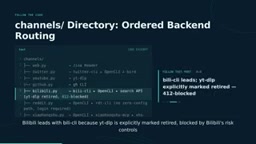
So what does AgentReach actually handle? It manages four things: tool selection, installation, health checks, and routing. Routing is implemented by writing a skill.md file into the agent's skills directory — at install time, it tells the agent which command to invoke for each platform. Each platform maps to an ordered backend list; the system tries each candidate backend in sequence, and the first one that's fully available becomes the active path.
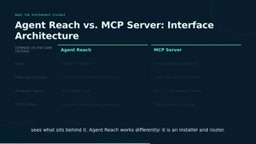
This stands in contrast to a standard MCP server. An MCP server exposes a unified protocol endpoint — the agent calls this single interface and never sees what's underneath. AgentReach is an installer plus router: it selects an upstream tool, installs it, runs health checks, writes skill.md, and then the agent calls the upstream tool directly, with no wrapping layer in between.
MCP (Model Context Protocol) is an open protocol championed by Anthropic to standardize how AI models interact with external tools and data sources. An MCP server acts as a middleware layer, packaging various capabilities into a unified protocol endpoint that the model calls through a single interface, without needing to know the underlying implementation. The advantage of this architecture is thorough abstraction and stable interfaces, but the tradeoff is that every call must pass through the middleware, which can become a performance bottleneck or single point of failure. skill.md is a descriptor file written to the agent's working directory — it functions like a "capability manifest," telling the agent which specific command to invoke for a given task. AgentReach writes routing decisions into this file during installation, and the agent then calls upstream tools directly based on it. AgentReach itself plays no role in the data path at runtime — this is the key distinction from the MCP server architecture.
Access Barriers Vary Significantly by Platform
AgentReach's core value lies in accurately mapping out the access landscape for each platform — and the differences are substantial. The key dividing line is whether an anonymous access path exists.
Platforms That Require No Login
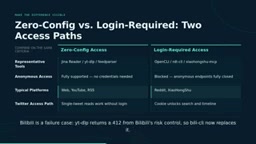
Sources like the web, YouTube, and RSS require no credentials. GitHub public repositories are currently readable and searchable. Reading individual tweets on Twitter also requires no login — but search and timeline access require exported cookies.
Platforms That Require Credentials
Reddit has harder constraints: there is no zero-configuration path. Anonymous endpoints are completely blocked, every approach requires a login session, and the official API requires manual approval.
For Reddit, Facebook, and Instagram, AgentReach connects to your already-running Chrome process via a browser extension, reusing your existing active sessions — it does not extract credentials, and cookies never leave the browser. Twitter takes a different approach: you manually export cookies from x.com using Cookie Editor, save them locally, and set file permissions so only the owner can read them.
The mechanism by which a browser extension connects to an existing Chrome process technically relies on Native Messaging or the DevTools Protocol, allowing external processes to communicate with in-browser extensions and reuse already-established login sessions. The core security assumption of this approach is that credentials (cookies) always remain within the browser process and are never extracted to disk or transmitted to a third party. Cookie Editor's export method works the opposite way — cookies land on disk as a file, which is why AgentReach requires setting file permissions to owner-read-only (chmod 600) to reduce the risk of the local file being read by other processes. The two approaches address different threat models: the former avoids the risk of credentials leaving the browser but requires the extension to run persistently; the latter is simpler to set up but puts the user in charge of file security.
Health Checks: The Doctor Command Performs Live Probes
Running AgentReach Doctor doesn't just check whether command files exist — it performs live probes against every backend.
Output is presented in layers: the top layer lists capabilities that are ready right now, such as GitHub public repos being readable and searchable, or Twitter tweets being readable without credentials. It also clearly tells you what a given cookie unlocks (e.g., search and posting), so you know exactly what you gain from configuring it. Broken backends appear in a lower tier, accompanied by fixed "prescriptions" — telling you what you need to provide and where to put it. This layered feedback with diagnostic recommendations is highly practical for real-world deployment.
Four Limits You Must Know Before Deploying
AgentReach's documentation explicitly calls out four constraints to weigh before going live — a reflection of its honest stance toward platform barriers.
- Twitter and Xiaohongshu carry real account ban risks. Cookie-based scripted access may trigger platform detection systems, and the README explicitly warns that such operations can result in account suspension.
- Reddit has no zero-configuration path. All anonymous endpoints are blocked, and the official API requires manual approval.
- Backends can break when platforms update their risk controls. For example, one Bilibili backend was confirmed blocked in June 2026 and has since been replaced by a new one.
- Some backends are no longer maintained. One Xiaohongshu-related backend has been abandoned by its upstream maintainer since March 2026; new projects should not rely on it.
These limitations also reveal an underlying reality: access to social platforms is a continuously adversarial, dynamic process. Risk control rules change at any time, which means AgentReach's routing list requires constant updates.
Platform anti-automation mechanisms typically operate across multiple dimensions: request frequency and behavioral pattern detection, device fingerprinting and User-Agent validation, IP reputation scoring, and anomaly analysis of cookie usage patterns (e.g., the same cookie being used across multiple IPs or unusual time zones). Cookie-based scripted access carries higher risk precisely because its request characteristics often differ from normal browser behavior — no mouse movement events, abnormal page load patterns, mechanical API call cadence. The case of Bilibili's backend being blocked in June 2026 illustrates how platforms can upgrade their risk control strategies at any time, rendering previously viable access paths unusable. This is the fundamental reason AgentReach uses an ordered backend list rather than a single backend — when one path fails, the system can fall back to the next candidate, and the entire routing list must continuously track platform changes to remain viable.
How to Think About This Kind of Tool
AgentReach turns the tedious task of "which platform to access, which path to take, and whether it's available right now" into a maintainable layer — and for agent developers who need multi-platform information access, it genuinely saves a significant amount of repetitive engineering. Its restraint is also worth acknowledging: it clearly distinguishes between login-free safe paths (web, YouTube, RSS) and cookie-based paths that carry ban risks (Twitter, Reddit, Xiaohongshu).
But one must be clear-eyed: the account ban risks on cookie-based platforms are real and documented. Before deploying in production, compliance and account safety must be thoroughly evaluated. AgentReach itself only handles selection, installation, health checks, and routing — not the read operations themselves. The real risk still falls on the end that calls the upstream tools.
Related articles

Chain of Thought Isn't Just for AI: How Humans Can Use CoT to Improve Thinking Quality
Chain of Thought isn't just a prompt trick for large models. Starting from a Hacker News discussion, this article analyzes why CoT works for human thinking too, breaks down actionable ways to transfer it, and highlights the key differences between human CoT and machine CoT.
Cloudflare Teams Up with OpenAI: Closi…
Cloudflare Teams Up with OpenAI: Closing the Loop from Vulnerability Discovery to Defense with AI
Cloudflare uses OpenAI Daybreak to investigate security vulnerabilities and generate reviewable remediation plans, while developers use Codex to boost coding efficiency and quality.

Orca Multi-Agent Orchestration in Practice: A Guide to Parallel Collaboration with Claude and Codex
Orca is Stable AI's free open-source agent workbench supporting 34 agents like Claude Code and Codex in parallel. Learn its Git worktree isolation, multi-model orchestration, and mobile management.