AgentRun Open-Sourced: A Self-Improving Managed Agent
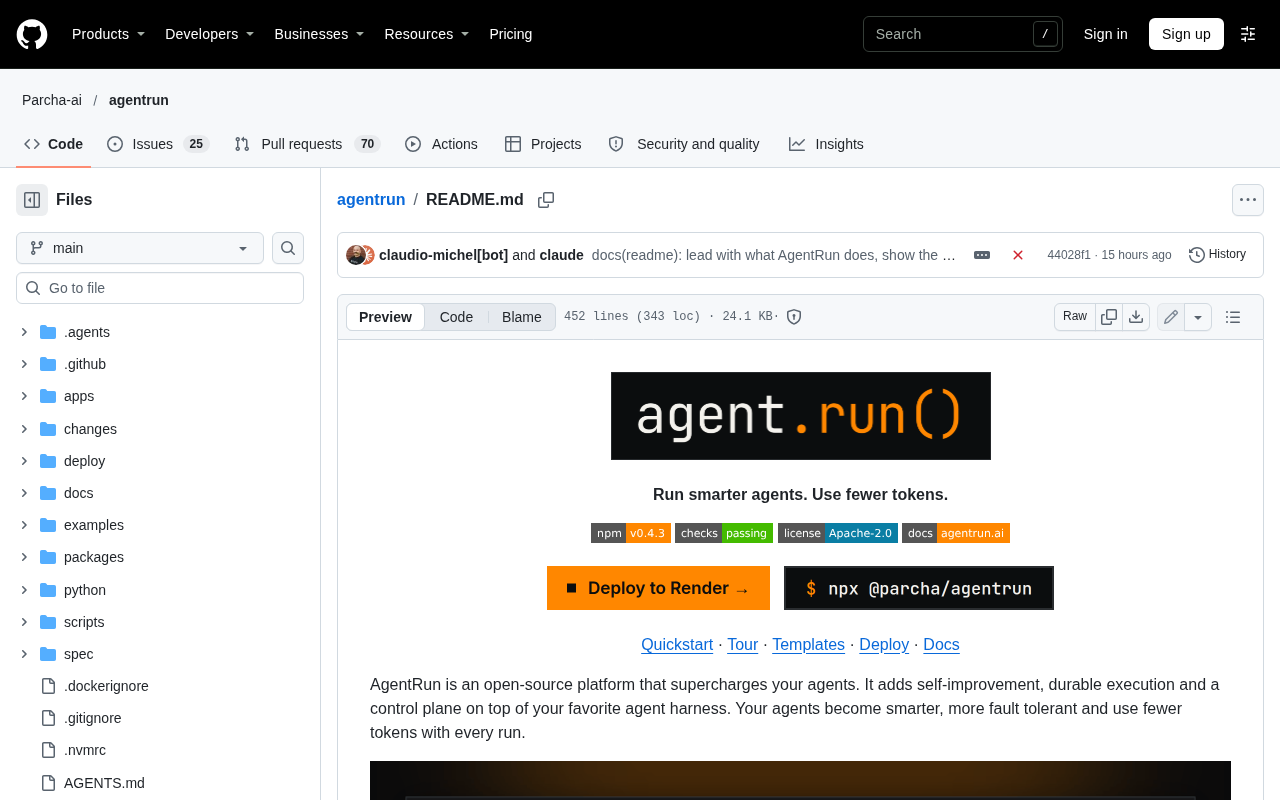
AgentRun enters the agent infrastructure layer with a trifecta of open source, self-improvement, and managed services.
AgentRun is an open-source managed agent project on Hacker News Show HN, highlighting open source, self-improvement, and managed agents. The article unpacks each: open source enables self-hosting and auditing; self-improvement lets agents adjust strategies via feedback, though safety boundaries are unclear; managed services bundle lifecycle, scheduling, and retries into the framework. With only a title and engagement data available, it's a watch-list project rather than a production choice.
On the Show HN section of Hacker News, a project called AgentRun quietly launched. Its title is just one line: Open-source, Self-improving Managed Agents. There's no lengthy marketing copy, no overwhelming promotion, but that line contains three keywords that carry considerable weight in today's AI engineering landscape: open source, self-improvement, and managed agents.
Three Layers of Meaning Behind One Title
Open Source: Lowering the Barrier to Agent Infrastructure
Agents have rapidly moved from proof of concept to engineering deployment over the past while, but when it comes to agent runtime, scheduling, state management, and observability, most mature solutions remain in the hands of a few closed-source platforms. AgentRun's choice to open source means developers can inspect, modify, and self-host the underlying implementation of this managed agent system, rather than binding core business processes to a black-box service. For teams that need data compliance or deep customization, this is often more appealing than a feature list.
Self-Improving: From Static Workflows to Dynamic Optimization
"Self-improving" points to the agent's ability to adjust its own behavior during operation. Traditional agent systems typically rely on manually pre-orchestrated prompts and tool-call chains; once the task distribution shifts, re-debugging is required. Self-improving agents attempt to build the feedback loop into the runtime itself, letting the system continuously refine its strategy based on task outcomes. This is also the most imaginative—and most cautiously regarded—part of AgentRun: the boundaries, evaluation methods, and safety constraints of self-improvement determine whether it's a practical engineering capability or a conceptual gimmick.
Feedback Loops and Strategy Optimization
In the agent context, "self-improvement" typically refers to the system using signals generated during operation (such as task success/failure, user corrections, scoring feedback) to adjust its own behavior. There are roughly three implementation paths: first, automatic prompt-level optimization (e.g., rewriting system prompts or tool descriptions based on failure cases); second, memory and experience reuse (summarizing historical trajectories and injecting them into subsequent decisions); third, parameter-level fine-tuning or reinforcement learning (higher cost, greater engineering complexity). Regardless of the path, the key lies in the source and reliability of the "evaluation signal"—if the signal itself is noisy or vulnerable to reward hacking, self-improvement devolves into self-degradation. Therefore, mature self-improving systems typically come with rollback mechanisms, offline evaluation sets, and change audit logs to ensure every strategy adjustment is traceable and reversible. This is also the core yardstick for judging whether a self-improving project is engineering-grade.
Managed Agents: Absorbing Operational Complexity into the Framework
Managed Agents emphasizes the managed aspect: agent lifecycle management, concurrent scheduling, failure retries, context maintenance—these tedious but critical engineering problems are handled uniformly by the framework. Developers only need to focus on what task the agent should accomplish, not how to keep it running stably in production.
Typical Capability Boundaries of a Managed Runtime
"Managed" in agent frameworks typically corresponds to a set of runtime capabilities: session and context state persistence (avoiding lost progress after long tasks are interrupted), concurrent task scheduling and rate limiting, tool-call timeouts and failure retries, structured logging and distributed tracing (observability), and isolated management of permissions and secrets. These capabilities are not complex individually, but combined they constitute the main gap between demo and production. Analogous to serverless functions, managed agent frameworks attempt to abstract the "agent process" into a standard workload, letting developers declare only task objectives and available tools while the framework handles scheduling and fault tolerance. When evaluating such frameworks, it's worth checking whether they provide idempotent execution, checkpoint-resume, and human-in-the-loop approval nodes—these directly determine whether they can support real business processes.
Why This Direction Is Worth Watching
Judging from the discussion heat on Hacker News, AgentRun received 21 points and 1 comment—a typical early-stage project exposure phase. This data itself shows it's far from mainstream visibility, but this is precisely the observation window when such projects are most worth watching.
A core contradiction in the agent field today is: demos are easy to build, production-readiness is hard. There's a vast amount of engineering detail between an agent that can complete a single task and an agent system that can run continuously in real business, self-correct, and remain observable. By putting "self-improvement" and "managed" together, AgentRun is actually trying to answer a question—can agent operations also be abstracted into standard capabilities like an application runtime?
The open-source strategy acts as an amplifier here. Self-improvement mechanisms involve a great deal of decision logic related to model behavior, and closed-source implementations make it hard for external developers to build trust; open source allows the community to audit its evaluation and rollback mechanisms, which is almost necessary for a system claiming to be self-improving.
How to Interpret the Show HN Exposure Signal
Show HN is the section of Hacker News dedicated to showcasing new projects, and its engagement data (points and comment counts) can serve as a rough indicator of early attention, but does not equate to technical quality. A project receiving 20-odd points and single-digit comments shortly after launch typically means it has reached some interested parties but hasn't yet generated discussion heat; low points may also be related to posting time or insufficient information in the title. What's truly valuable for reference is the technical scrutiny in the comments—for example, whether anyone probes architecture details, safety boundaries, or differences from similar projects. Therefore, treating Show HN data as an "observation window" rather than a "quality endorsement" is more reasonable; subsequent judgment should combine the project repository's commit activity, documentation completeness, and issue response.
Points That Warrant Caution
The information disclosed about the project so far is very limited—the original content contains only the title and basic engagement data, with no architecture description, performance data, or usage documentation details. Therefore, several questions cannot be answered from the available material: What signals does self-improvement specifically rely on (task success rate, human feedback, or model self-evaluation)? What deployment forms does the managed capability cover? Where are the differences from existing agent frameworks? These questions are precisely the key to judging whether an agent project has long-term value.
For developers interested in AI programming and AI applications, AgentRun is worth adding to a watch list, but before more technical details emerge, it's better suited as a directional reference than a direct production choice.
Final Thoughts
AgentRun's emergence reflects a trend: agents are shifting from "what can they do" to "how to reliably keep doing it." The combination of open source, self-improvement, and managed points to competition at the agent infrastructure layer. Whether such projects ultimately gain a foothold depends on whether they can turn self-improvement from an attractive description into verifiable, reversible, observable engineering capability.
One-line Summary
AgentRun enters the agent infrastructure layer with a trifecta of open source, self-improvement, and managed services.
Paragraph Summary
AgentRun is an open-source managed agent project posted on the Hacker News Show HN section, with a title that encapsulates three keywords: open source, self-improvement, and managed agents. The article unpacks each layer—open source lets developers self-host and audit the underlying implementation, avoiding black-box lock-in; self-improvement refers to the agent adjusting its strategy based on feedback during operation, though evaluation signals and safety boundaries remain unclear; managed services absorb lifecycle management, scheduling, retries, and context maintenance into the framework, lowering the barrier to production deployment. The author notes that in the agent field, demos are easy but production is hard, and the project attempts to abstract operations into standard capabilities, with open source acting as a trust-building amplifier. However, since the material contains only a title and engagement data—lacking architecture, performance, and documentation details—the project is better placed on a watch list than chosen directly for production.
Related articles

Gemini 4 Neon Released: A Balance Between Frontier Intelligence and Efficient Task Execution
Google DeepMind releases Gemini 4 Neon, focused on frontier intelligence and fast end-to-end task execution. This article breaks down its benchmark performance in coding, enterprise analysis, scientific reasoning, and cybersecurity, its four thinking levels, pricing, and safety alignment data.

Is AI the Culprit Behind Global Outages? The Trust Crisis Behind the NSA and FAA Failures
Fourth major failure in five days hits NSA classified network. Microsoft blames a software bug, FAA denies its new AI system, NSA says routine maintenance. Senator Warner suggests AI accelerates vulnerability discovery, leading to rushed fixes — while 39% of Americans already view AI negatively, exposing a deepening trust crisis.

Robot Developer Builds Custom B-rep Kernel with 3,487 Tests
A robot developer builds a custom B-rep geometry kernel with 3,487 tests, exploring why robotics needs dedicated CAD tools and the barriers to building one.