AgentScope Java Edition: A Practical Guide to Enterprise-Level Agent Frameworks
Alibaba's AgentScope Java targets enterprise server-side AI, giving Java developers a path to deploy agents.
The article addresses the misconception that Java is unsuitable for AI by distinguishing client-side AI from server-side AI. Client-side AI serves a single user, while enterprise AI as a server-side application must serve many users, demanding zero-trust security, stateless design, multi-user isolation, distributed state persistence, and cost control—precisely Java's strengths in high concurrency, microservices, and distributed architecture. Alibaba's AgentScope Java is an agent framework for Java enterprise distributed production environments, already widely used internally, with a course covering core principles, setup, Agent creation, task orchestration, and multi-agent collaboration for backend engineers.
In the field of AI application development, a common misconception is that Java is unsuitable for building AI applications. Alibaba's AgentScope Java Edition was created precisely to break this bias. As an agent framework designed for enterprise-level distributed production environments, it is already widely used within the Alibaba Group, offering Java developers a path to rapidly deploy Agent applications.
Client-Side AI vs. Server-Side AI: Two Fundamentally Different Scenarios
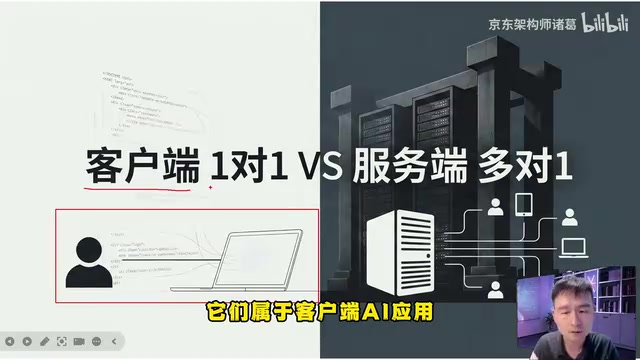
Many self-media outlets like to stir the pot, claiming that developing AI with Java is child's play, but such views often conflate two forms of AI applications. According to the course analysis by Bilibili creator Xu Shu, tools like Cloud Code and Codex belong to client-side AI applications, which typically adopt a one-to-one service model, serving only a single client user. Enterprise-level AI applications, on the other hand, run as server-side AI applications and need to serve all users across an enterprise or the internet.
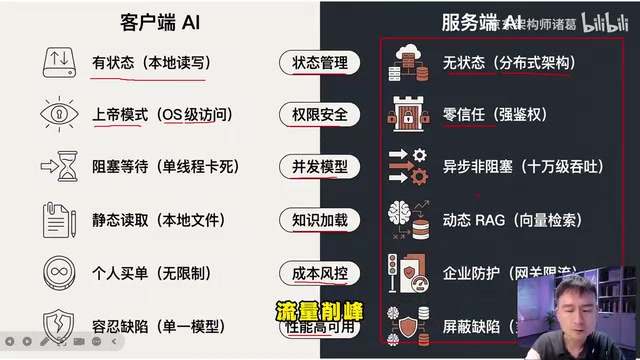
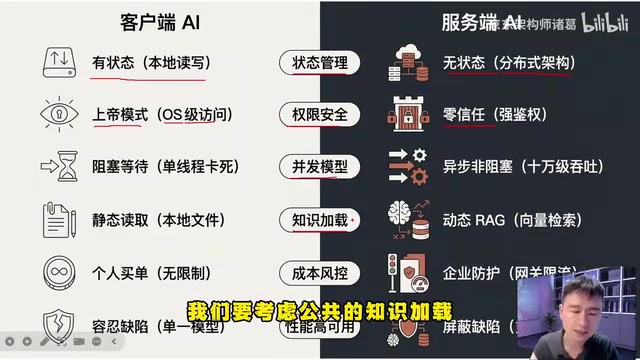
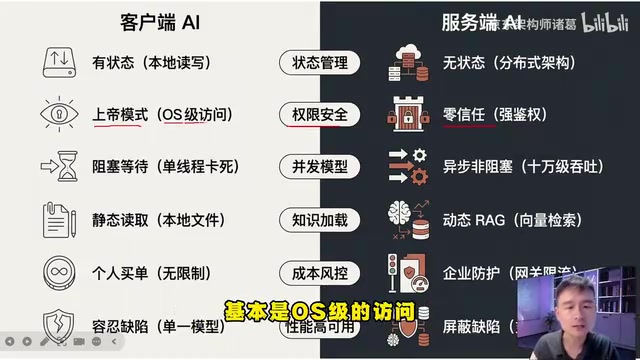
This difference directly determines the different requirements for technology selection. Server-side AI applications have higher requirements for permission security, adopting a zero-trust strategy toward user input information; whereas client-side AI applications, serving only a single user, basically rely on operating-system-level access control. In terms of state management, client-side AI applications only need to maintain a single user's state, while server-side AI applications must be stateless and need to consider a series of complex issues such as multi-user isolation, state persistence in distributed architectures, concurrency handling, public knowledge loading, cost control, and performance optimization.
Zero Trust is a security architecture concept whose core idea is "never trust, always verify." In server-side AI applications, even if a user has passed identity authentication, the system does not assume their subsequent requests are safe by default; instead, it performs permission checks and risk assessments on every input and every tool call. This differs from traditional boundary-based security models—the latter assumes that the intranet or authenticated users are trustworthy. In agent scenarios, zero trust is particularly important: an Agent may call external APIs, access databases, or execute code on behalf of a user. If inputs are not strictly filtered and permission-constrained, malicious prompt injection or unauthorized operations could cause serious consequences. Therefore, server-side AI frameworks typically need built-in mechanisms such as input validation, tool permission grading, and operation auditing, rather than relying on operating-system-level access control.
The Natural Advantages of Java in Enterprise-Level AI Scenarios
These requirements of server-side AI applications happen to be exactly the strengths Java has accumulated over many years. High concurrency, high availability, performance tuning, online monitoring—this complete set of solutions has been honed by major tech companies through high-concurrency scenarios like Double 11 and 618. Capabilities such as microservices, distributed architecture, multi-level caching, and traffic peak shaving are not something other languages can easily match.
If the development goal is an enterprise-level backend distributed AI application, Java should be the first choice; and within the Java ecosystem, when it comes to implementing agent engineering, AgentScope is the preferred option. According to the course introduction, an Agent project can be deployed directly with just a few short lines of code, greatly lowering the development threshold for enterprise-level AI applications.
The Core Positioning of AgentScope Java
AgentScope Java is an agent framework launched by Alibaba specifically for Java in enterprise-level distributed production environments. Its core value lies in combining agent capabilities with enterprise-level infrastructure, enabling Java developers to build runnable AI projects within a familiar ecosystem.
From the course structure, the learning path of AgentScope Java covers the complete chain from core principles, environment configuration, to Agent creation, task orchestration, and multi-agent collaboration. This progressive design from theory to practice is suitable for engineers who want to systematically master enterprise-level Agent development capabilities.
Agent is a software entity capable of perceiving its environment, making autonomous decisions, and taking actions to accomplish goals. In the era of large models, an Agent typically uses a large language model as its reasoning core, combined with tool calling, memory management, and task planning capabilities to break down complex goals into executable steps. Multi-Agent Collaboration refers to multiple Agents, each with their own responsibilities, working together through message passing, task division, or negotiation mechanisms to complete complex tasks that a single Agent cannot handle—for example, one Agent responsible for retrieval, one for coding, and one for review. Enterprise-level frameworks need to provide infrastructure such as task orchestration, message routing, failure retry, and observability for these collaboration patterns, which is precisely why AgentScope Java positions itself as a "production-environment agent framework" rather than a simple SDK.
State Management and Enterprise-Level Considerations
In server-side AI applications, state management is an unavoidable challenge. Since server-side applications need to serve a large number of users simultaneously, they must adopt a stateless design while also ensuring correct state persistence in a distributed environment.
This involves multiple dimensions such as multi-user isolation, concurrency control, public knowledge loading, and cost control. As a framework oriented toward production environments, AgentScope Java's design needs to respond to these enterprise-level demands. The task orchestration and multi-agent collaboration capabilities mentioned in the course content are precisely the key means for addressing complex business scenarios.
Stateless Design is a fundamental principle in server-side architecture: the server does not store any state related to a specific client session, and each request carries all the information needed to complete processing. The benefit is that any request can be routed to any instance, facilitating horizontal scaling and fault recovery. However, in agent applications, conversation history, intermediate results of tool calls, and task progress are inherently stateful, so state needs to be separated from compute nodes and persisted to external storage (such as databases, caches, or object storage), then reloaded by session ID between requests. This also brings the challenge of multi-user isolation—different users' states must be strictly partitioned to avoid data cross-contamination; in a distributed environment, concurrent write conflicts and consistency must also be handled. AgentScope Java's production-oriented design is precisely aimed at solving these enterprise-level state management problems at the framework level, rather than leaving them for developers to implement individually.
Who Should Learn AgentScope Java
The target audience for this course is engineers with a Java foundation who wish to enter the field of AI application development. The course emphasizes hands-on building of runnable AI projects, meaning learners need to have some coding practice ability. For developers already in enterprise backend development positions who want to integrate AI capabilities into existing systems, AgentScope Java provides a pragmatic path that fits the enterprise technology stack.
It should be noted that the currently public information about the course content mainly focuses on the framework's positioning and scenario analysis; specific technical implementation details need to be obtained in the complete course. For developers evaluating whether to invest time in learning, understanding the fundamental differences between client-side AI and server-side AI is the key prerequisite for judging whether this course matches their needs.
One-line Summary
Alibaba's AgentScope Java targets enterprise-level server-side AI, providing Java developers with a path to deploy agents.
Paragraph Summary
The article addresses the common misconception that "Java is unsuitable for AI applications," pointing out that the key is to distinguish between two forms: client-side AI and server-side AI. Client-side AI such as Cloud Code serves only a single user, while enterprise-level AI, as a server-side application, must serve a large number of users and imposes higher requirements on zero-trust security, stateless design, multi-user isolation, distributed state persistence, and cost control. These are precisely the strengths Java has accumulated over years in high concurrency, microservices, and distributed architecture, so enterprise-level backend AI applications should prioritize Java. Alibaba's AgentScope Java is exactly an agent framework for Java enterprise-level distributed production environments, already widely used within the group. The course covers the complete chain from core principles, environment configuration, Agent creation, task orchestration, and multi-agent collaboration, suitable for backend engineers with a Java foundation who want to integrate AI capabilities into existing systems.
Related articles

Multi-Agent Collaborative Development: Task Card-Driven Practices for Medium-to-Large AI Projects
A Bilibili creator shares a task card-driven, PM-orchestrated multi-Agent collaboration model with local-first repository state, so any Agent tool can take over a project anytime.
Cursor vs Copilot vs Claude Code: How Laravel Developers Should Choose
Compare Cursor, GitHub Copilot, and Claude Code for Laravel development: an AI-first editor, a plugin for existing editors, and a terminal agent for multi-file tasks and testing — plus workflow-based recommendations.

LangChain in Practice: Hand-Writing a Multi-Tool Agent and Execution Loop
Based on a Bilibili tutorial, this article explains how LangChain unifies model interfaces, manages context and tool calling, and how to hand-write a multi-tool Agent.