AgentScope Java Tutorial: Enterprise-Grade Agent Development in Practice

Alibaba open-sources AgentScope Java, enabling Java developers to build production-grade agents with Spring Boot.
The article introduces Alibaba's AgentScope Java framework, highlighting the fundamental differences between enterprise server-side AI and client-side AI: the former requires zero-trust security, multi-user isolation, state persistence, and concurrency cost control—exactly the strengths of the Java ecosystem. AgentScope Java turns model integration, sandbox environments, file workspaces, and state persistence into a Java-native production foundation, so developers can implement Honix Agent in Spring Boot with just JDK 17 and one Maven dependency. It includes a four-layer context compression strategy, and Workspace can connect to Redis, JDBC, MongoDB, and other storage to ensure state is not lost during scaling. The article also covers key issues from demo to production, including key security, workspace isolation, hot model switching, streaming responses, and checkpoint recovery, and introduces multi-agent collaboration and task orchestration.
Why Java Developers Need AgentScope Java
Java developers are often labeled as building "AI toys," but enterprise-grade AI applications are fundamentally different from client-side AI. According to an analysis by Bilibili creator Xu Shu in his tutorial, client-side AI (such as Cloud Code and Codex) only needs to serve a single user, whereas server-side AI must serve all users in an enterprise, requiring zero-trust security, multi-user isolation, state persistence, concurrency handling, and cost control. These are exactly the strengths Java has accumulated over the years: high concurrency, high availability, performance tuning, and production monitoring. AgentScope Java, launched by Alibaba, is designed specifically for Java enterprise-grade distributed production environments and is widely used within the Alibaba Group. It enables Java developers to implement agents directly in Spring Boot projects without switching to a Python environment.
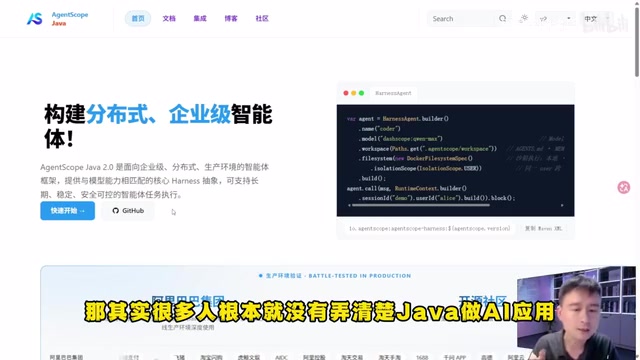
Core Design of AgentScope Java: A Production-Grade Foundation
Ordinary AI SDKs are only responsible for a single call that returns text, whereas AgentScope Java turns model integration, sandbox environments, file workspaces, and state persistence into a production foundation natively adapted for Java. According to the creator, the capabilities of Honix Agent are built on top of this system. With JDK 17 plus a single Maven dependency, developers can use the Honix Agent Builder to directly package workspaces, memory, drawing persistence, and Agent orchestration sandbox isolation. Business tasks can be automatically decomposed, invoke tools, maintain state, and handle exceptions automatically, forming a closed loop. If the built-in capabilities are insufficient, you can register and replace tools yourself.
Four-Layer Context Compression and State Management
AgentScope Java includes a built-in four-layer context compression strategy that distinguishes between ordinary messages and core task state. The Workspace can connect to storage backends such as Redis, JDBC, and MongoDB, ensuring that drawing state is not lost during multi-instance scaling. This is critical for stateless server-side architectures—the creator emphasizes that server-side AI must consider multi-user isolation and state persistence.
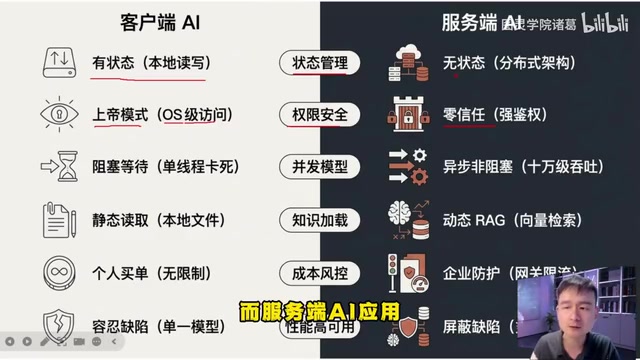
Sandbox Isolation: In multi-user server-side scenarios, if agents share the same runtime environment when executing code or invoking tools, one user's malicious or erroneous operation could affect other users or even the host machine. AgentScope Java makes the sandbox environment a native capability, typically based on process-level or container-level isolation, providing each session or task with an independent file system view and execution boundary, thereby meeting the requirement of "trust no input by default" under the zero-trust security model. This is fundamentally different from client-side AI, which only needs to consider a single-user trusted environment, and is a capability that an enterprise-grade framework must build in rather than bolt on.
State Persistence: Agents generate intermediate state during multi-turn conversations or long tasks (such as executed steps, tool call results, and pending subtasks). Without persistence, this state is lost when an instance restarts or scales, and tasks cannot resume. AgentScope Java abstracts state storage as a pluggable backend, decoupling an Agent's runtime state from the compute instance. This is the prerequisite for implementing "drawing checkpoint recovery" and a stateless server-side architecture.
Context Compression: The context window of large models is limited, while enterprise-grade tasks often involve long conversations, large amounts of tool return results, and document content. Concatenating them directly will quickly fill the window and drive up token costs. The core idea of the four-layer compression strategy is tiered processing: ordinary chat messages can be summarized or truncated, while instructions and key results that carry core task state are prioritized for retention, avoiding the situation where "compression erases the task goal." This approach of distinguishing ordinary messages from core task state is a key design for balancing cost, latency, and task correctness, and is the foundation for stable execution of long tasks.
From Demo to Production: Key Implementation Steps
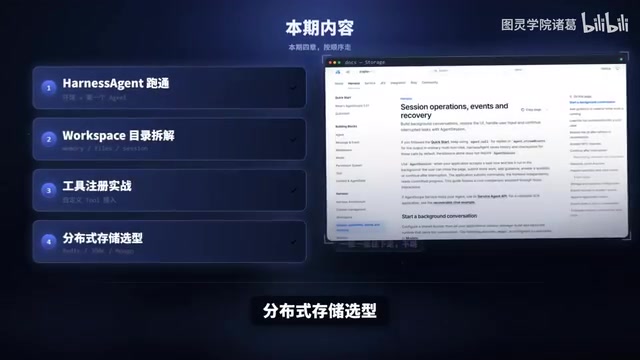
The official demo is easy to run—just connect an API key and you can make calls. But going to production requires solving issues such as key security, workspace isolation, hot model switching, streaming responses, and drawing checkpoint recovery. In the tutorial, the creator provides a complete walkthrough of getting the first Honix Agent running, including breaking down the Workspace directory, hands-on tool registration, and distributed storage selection, emphasizing "no skipped steps, no empty theorizing."
Code Examples and Configuration Checklist
The tutorial provides an essential configuration checklist covering the entire process from environment setup to Agent creation, task orchestration, and multi-agent collaboration. Java developers can implement a Honix Agent with just a few lines of code. Through Spring Boot integration, developers can embed agent capabilities into existing Java business systems and build their own agent workflows.
Multi-Agent Collaboration and Task Orchestration
AgentScope Java supports Agent orchestration and multi-agent collaboration, allowing business tasks to be automatically decomposed and assigned to different tools or sub-agents. The creator points out that this framework fully considers production scenarios, such as automatic exception handling, state maintenance, and closed-loop tool invocation. For enterprise applications that require complex workflows, this provides a native Java solution.
Who Should Learn This
This tutorial is aimed at Java programmers, especially developers using Spring Boot. Whether you want to start with a basic demo or seek production-grade implementation, this series covers core principles, environment configuration, Agent creation, task orchestration, and multi-agent collaboration. Creator Xu Shu emphasizes that after completing the tutorial, you will not only be able to run the demo but also integrate agents into existing Java business systems and build your own agent workflows.
Conclusion
AgentScope Java fills the gap in the Java ecosystem for production-grade agent frameworks, bringing enterprise-grade AI application development back to the areas where Java excels. Its design is tightly aligned with server-side requirements—security, isolation, persistence, concurrency, and cost control. For Java developers, this is a pragmatic path into AI application development.
One-line Summary
Alibaba open-sources AgentScope Java, enabling Java developers to implement production-grade agents with Spring Boot.
Paragraph Summary
The article introduces AgentScope Java, a framework launched by Alibaba, and points out the fundamental differences between enterprise-grade server-side AI and client-side AI: the former requires zero-trust security, multi-user isolation, state persistence, and concurrency cost control, which are exactly the strengths of the Java ecosystem. AgentScope Java turns model integration, sandbox environments, file workspaces, and state persistence into a production foundation natively adapted for Java, so developers only need JDK 17 plus one Maven dependency to implement a Honix Agent in a Spring Boot project. The framework includes a built-in four-layer context compression strategy, and the Workspace can connect to storage such as Redis, JDBC, and MongoDB to ensure state is not lost during multi-instance scaling. The article also outlines the key issues to solve from demo to production, including key security, workspace isolation, hot model switching, streaming responses, and checkpoint recovery, and introduces multi-agent collaboration and task orchestration capabilities.
Related articles
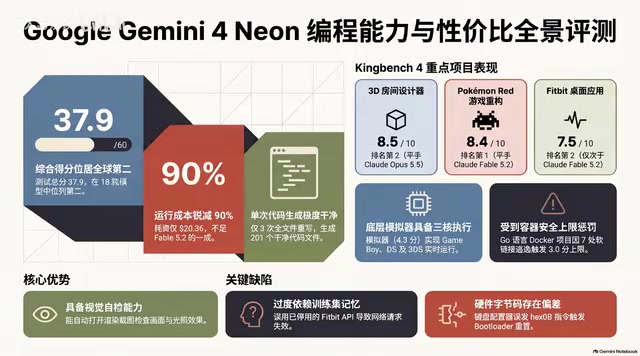
Gemini 4 Neon Hands-On: Value King or Confident Catastrophe?
Gemini 4 Neon review: 1M-token context, four thinking levels, 201 files in one KingBench4 pass at one-tenth Fable 5.2's cost—but it hallucinates fake data, leaves 7 symlink escapes, and bricks keyboards.

Google Gemini 4 Neon Hands-On: 6 3D Works That Impress and Fail
Hands-on with Google Gemini 4 Neon on a 3060 laptop: 6 3D works tested. Sunshower Fishing Harbor and mechanical keyboard impress; soft-body physics and faces fall short.
Gemini 4 Neo Web Novel Writing Test: Faint AI Flavor, Textured Dialogue
Bilibili creator's first-look review of Gemini 4 Neo for Chinese web novel writing: testing a Three Kingdoms transmigration opening with faint AI flavor, emotionally textured dialogue, and strong crisis building, plus comparison of 4A/4H/4C models and full workflow demos.