AgentSDR: The Open-Source AI Sales Assistant Aiming to Replace Clay and HubSpot

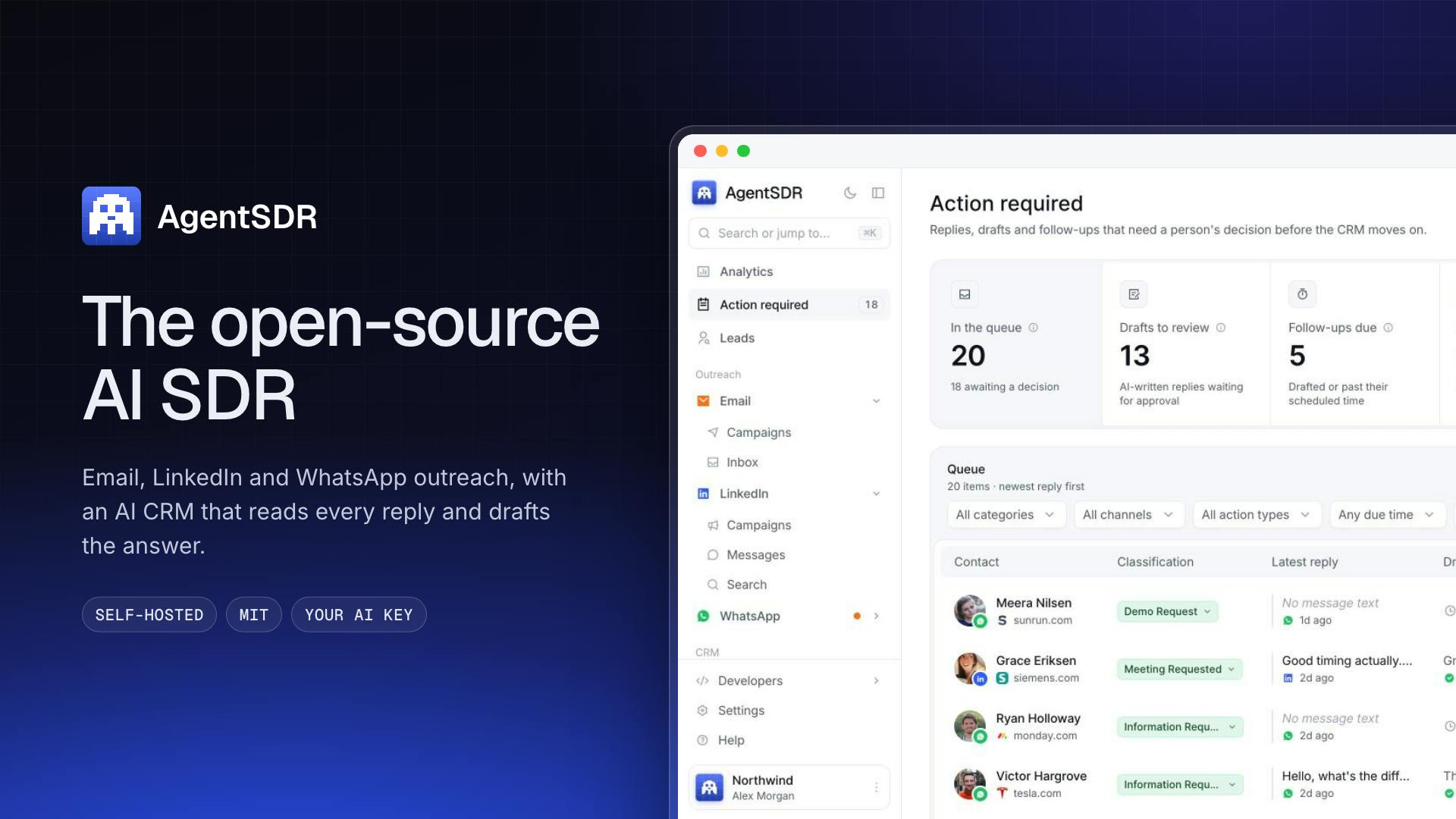
AgentSDR is an open-source AI SDR workspace aiming to replace Clay, Smartlead, and HubSpot with one self-hosted solution.
AgentSDR is an open-source AI Sales Development Representative workspace that consolidates multi-channel outreach (email, LinkedIn, WhatsApp), data enrichment, and AI-driven CRM into a single self-hosted platform. Its key differentiators are open source code, self-hosting for data privacy, and bring-your-own-AI-keys for cost transparency. The AI CRM auto-classifies replies and pre-drafts responses — the most direct labor-saving feature. The real challenge is whether it can match the depth of well-established commercial tools and whether teams have the technical capacity to deploy and maintain it.
One Open-Source Project That Wants to Consolidate Your Sales Tech Stack
Sales teams tend to run bloated, expensive tech stacks: Clay for data enrichment, Smartlead for automated email sending, HubSpot for CRM, plus a bunch of scattered automation tools. Each one means a separate subscription, a separate bill, and a ton of integration work between them. AgentSDR targets exactly this pain point — it's an open-source AI SDR (Sales Development Representative) workspace that aims to replace all of the above with a single self-hosted solution.
The project recently launched on Product Hunt, earning 80 upvotes and ranking 13th, listed under the Sales, Open Source, and Artificial Intelligence categories. The buzz wasn't explosive, but the direction it's heading — using AI to automate the entire outbound sales workflow — is one of the most actively watched areas for enterprise cost reduction right now.
What It Actually Does
According to the official description, AgentSDR covers multiple stages of the sales outreach process:
Multi-Channel Outreach
The product supports email sequences, LinkedIn campaigns, and WhatsApp outreach. This means salespeople can reach the same batch of prospects across multiple channels within a single workspace, without switching between platforms. Running parallel multi-channel outreach is standard practice in modern outbound sales, and AgentSDR brings it all into one interface.
SDR (Sales Development Representative) is a role in B2B sales teams focused on prospecting new clients. The core job involves proactively reaching out to potential customers via cold email, social media, phone calls, and other methods (i.e., "outbound"), then handing off qualified leads to Account Executives (AEs) who close the deal. The rise of AI SDR tools is essentially about using automation and large language models to take over this highly repetitive process — including finding target contacts, writing personalized outreach messages, and following up on non-responses. This work previously required significant headcount and was bottlenecked by human processing speed; with AI handling it, the same team can cover several times the outreach volume.
Built-In Data Enrichment and Automation
Data enrichment is the core selling point of tools like Clay — given an email address or company name, it automatically fills in job titles, company size, social profiles, and more. AgentSDR claims this capability is built in, with automated workflows attached, reducing dependence on external paid data tools.
Data enrichment sits at a critical "upstream" position in sales outreach: sales teams typically only have basic information on prospects (company name, domain, or LinkedIn profile), but writing targeted outreach messages requires knowing the contact's seniority level, company size, recent funding activity, tech stack preferences, and other details. Specialized tools like Clay accomplish this by aggregating multiple data sources (Clearbit, Apollo, LinkedIn, etc.) and supporting custom workflows, typically billing by "credit" with costs scaling linearly with outreach volume. By building this capability in, AgentSDR eliminates the cost of a separate data enrichment subscription — but whether its data source coverage and update frequency can match dedicated professional tools remains a key variable to verify before committing.
AI-Powered CRM
This is the most interesting part of the product. AgentSDR's AI CRM automatically categorizes incoming replies and drafts responses. In other words, when a prospect replies, the system can determine whether it signals positive interest, a rejection, or a need for follow-up, then pre-generate a draft for the salesperson to review and send. This combination of "reply triage + auto-drafting" is exactly where AI delivers the most meaningful labor savings in sales contexts.
Why Self-Hosting and Bring-Your-Own-Keys Matter
AgentSDR emphasizes two deployment features: self-hosted and bring your own AI keys.
For enterprises, self-hosting means customer data and sales leads stay on their own servers — a significant consideration for teams focused on data compliance and privacy, especially when dealing with channels like LinkedIn and WhatsApp that involve personal contact information. Bringing your own AI keys lets users connect directly to their own OpenAI or other LLM accounts, making costs transparent and controllable while avoiding platform markups on token fees.
This combination of "open source + self-hosted + bring your own keys" essentially converts commercial SaaS subscription costs into infrastructure and model inference costs. For technically capable small-to-mid-sized teams, the long-term economics may work out better — but for teams without in-house ops capacity, the deployment and maintenance barrier is just as real.
Automated outreach on LinkedIn and WhatsApp involves fairly complex compliance considerations. LinkedIn's Terms of Service explicitly restrict automated scraping and bulk message sending, and using third-party automation tools carries the risk of account restrictions. WhatsApp Business API requires official approval from Meta, and bulk sending via personal accounts is similarly restricted. Self-hosting improves data privacy, but it doesn't automatically resolve platform-level compliance issues. Teams should independently assess whether their intended use of automation on these two channels aligns with each platform's policies before deploying these features.
Is Replacing Multiple Commercial Tools Realistic?
Claiming to "replace Clay, Smartlead, HubSpot, and more" is a pretty bold positioning statement. Each of these tools has been refined in its niche for years, and a new project can't easily match their full feature depth across the board.
The more realistic interpretation: AgentSDR provides an open-source, integrated version of these tools' core functionality, covering 80% of common use cases and trading feature completeness for cost savings and data sovereignty. For early-stage teams with limited budgets and overly fragmented tech stacks, that consolidation alone has real value. But if a team heavily depends on advanced features or mature ecosystems from a specific commercial tool, any decision to fully migrate still warrants careful evaluation.
Being open source also brings advantages: customizability, auditability, and community-driven development. The sales automation space has long been dominated by closed-source SaaS. A viable open-source alternative — regardless of its ultimate outcome — gives the market another option.
Takeaway
AgentSDR targets a genuine pain point: fragmented sales tech stacks and high subscription costs. It addresses this with an open-source, self-hosted approach that integrates multi-channel outreach, data enrichment, and AI-powered CRM into one platform. Its core appeal lies in cost control and data ownership, while its main challenges are whether its feature depth can match mature commercial tools, and the deployment barrier that comes with self-hosting. For teams willing to invest technical resources in exchange for autonomy over their sales stack, this is a new option worth watching.
Related articles

Chain of Thought Isn't Just for AI: How Humans Can Use CoT to Improve Thinking Quality
Chain of Thought isn't just a prompt trick for large models. Starting from a Hacker News discussion, this article analyzes why CoT works for human thinking too, breaks down actionable ways to transfer it, and highlights the key differences between human CoT and machine CoT.
Cloudflare Teams Up with OpenAI: Closi…
Cloudflare Teams Up with OpenAI: Closing the Loop from Vulnerability Discovery to Defense with AI
Cloudflare uses OpenAI Daybreak to investigate security vulnerabilities and generate reviewable remediation plans, while developers use Codex to boost coding efficiency and quality.

Orca Multi-Agent Orchestration in Practice: A Guide to Parallel Collaboration with Claude and Codex
Orca is Stable AI's free open-source agent workbench supporting 34 agents like Claude Code and Codex in parallel. Learn its Git worktree isolation, multi-model orchestration, and mobile management.