AgentWall: A Security Interception Solution for LangChain Tool Calls
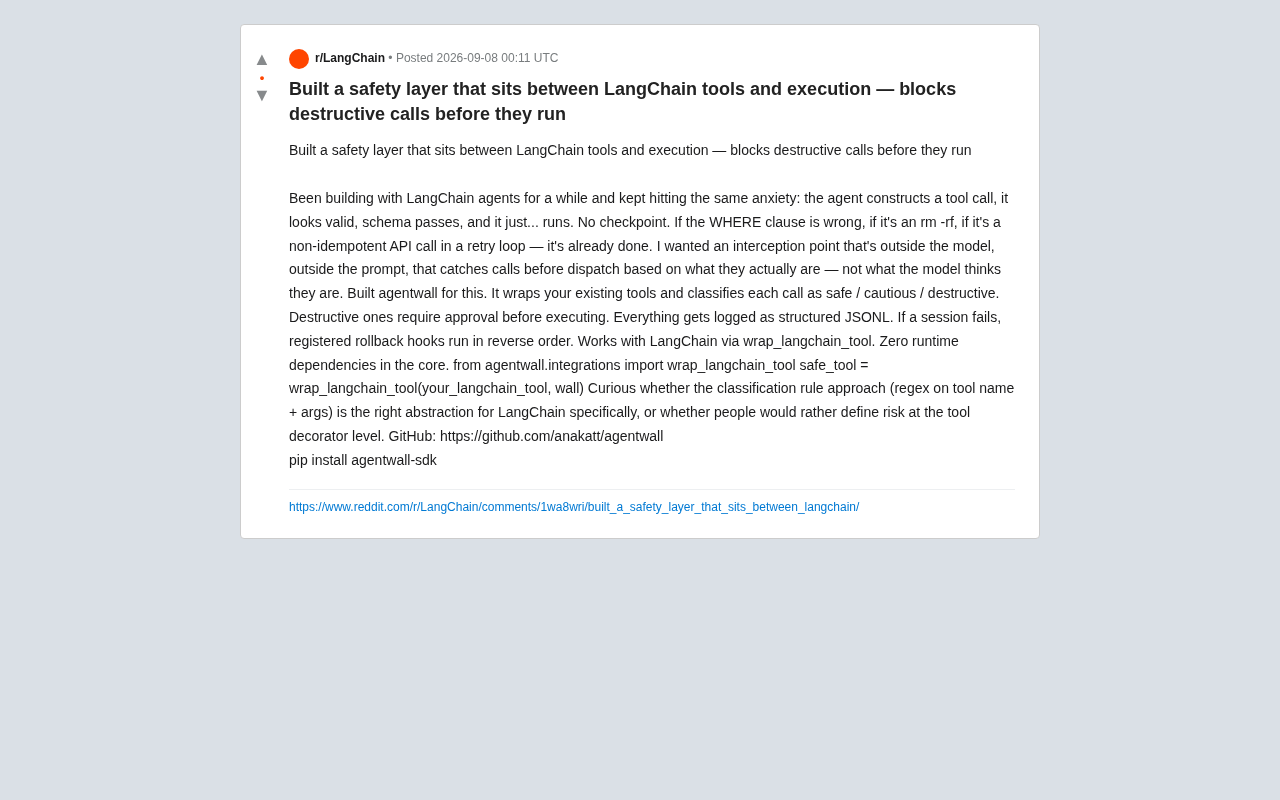
AgentWall adds critical security checkpoints to LangChain Agent tool calls through interception and approval workflows.
AgentWall solves a critical gap in LangChain Agent architecture: tool calls that pass schema validation execute immediately without safety checks. By placing interception points outside the model, it classifies operations into safe/cautious/destructive tiers, enforces human-in-the-loop approval for risky actions, and provides structured logging with rollback mechanisms for production safety.
When AI Agent Tool Calls Lack Security Checkpoints
As frameworks like LangChain gain popularity, more developers are building AI Agents capable of autonomously executing tasks. But a persistent pain point has emerged for practitioners: Once an Agent constructs a tool call that passes schema validation, it executes directly with no checkpoint in between.
LangChain Framework Background
LangChain is one of the most popular LLM application development frameworks today, created by Harrison Chase in October 2022. It provides a standardized abstraction layer that enables developers to rapidly build applications based on large language models. The framework's core concepts include Chains (sequential invocations), Agents (intelligent proxies), Tools (toolsets), and Memory (memory mechanisms). LangChain's greatest value lies in encapsulating complex LLM interaction patterns into reusable components, lowering the barrier to AI application development. As of 2024, LangChain has exceeded 90k GitHub stars, with a massive open-source community and rich ecosystem.
AI Agent Architecture Principles
AI Agents are AI systems capable of perceiving their environment, making autonomous decisions, and executing actions. In LLM applications, Agents typically consist of three core components: a large language model serving as the "brain" for reasoning and decision-making, a toolset (Tools) providing the ability to interact with the external world, and an execution loop (Agent Loop) coordinating the closed loop of perception-thinking-action. A typical execution flow is: receive user goal → break down into subtasks → select appropriate tools → invoke tools to obtain results → synthesize information and continue reasoning → until goal is achieved. This architecture enables AI to break through the limitations of single-turn conversations and execute complex multi-step tasks.
One Reddit developer precisely described this anxiety: The Agent generates what appears to be a legitimate tool call—parameters properly formatted, schema validated—and then it just... runs. If the SQL WHERE clause is wrong, if it's an rm -rf command, if it's a non-idempotent API call inside a retry loop—by the time you realize it, the operation is complete and irreversible.
Limitations of Schema Validation
Schema validation refers to verifying whether input data's format and types conform to requirements based on predefined data structure specifications (Schema). In LangChain, each tool defines a Schema for its parameters, typically implemented using data validation libraries like Pydantic. For example, a database query tool might require "table_name" to be a string and "limit" to be an integer. When an Agent generates a tool call request, the framework first performs Schema validation to ensure parameter types are correct and required fields are complete. However, this validation can only guarantee format correctness, not operational safety—a perfectly formatted DROP TABLE command will still pass Schema validation.
This isn't an issue of model intelligence, but rather an architectural lack of an interception point. To solve this problem, the open-source tool AgentWall was created.
AgentWall's Core Design Philosophy
The Interception Point Must Be Outside the Model
AgentWall's most critical design principle is: place the interception point outside the model, outside the prompt. The developers emphasize that security checks should be based on what the tool call actually is, not what the model thinks it is.
Why You Can't Rely on Prompt Constraints
This distinction is crucial. Relying on prompt constraints (like telling the model "don't execute dangerous operations") is fundamentally unreliable—the model might be jailbroken, might misjudge, might forget constraints in long conversations.
Prompt Injection is a class of security attacks against LLM applications where attackers manipulate model behavior through carefully crafted inputs, causing it to ignore original system instructions. Jailbreaking is the most typical form, using special rhetoric to induce the model to break through safety restrictions. For example, the classic DAN (Do Anything Now) jailbreak technique uses role-playing to bypass content审查. In Agent scenarios, such attacks are even more dangerous: attackers might induce Agents to execute malicious tool calls, and constraints relying solely on prompts are often fragile.
AgentWall extracts security logic to a physical position in the execution chain, intercepting calls before they're actually dispatched.
Three-Tier Risk Classification Mechanism
AgentWall classifies every tool call into three levels:
- safe: Can execute directly
- cautious: Requires additional attention
- destructive: Must pass human approval before execution
For destructive operations, AgentWall forcibly introduces a human-in-the-loop approval stage, preventing irreversible mistakes from occurring quietly without supervision.
Human-in-the-Loop Design Pattern
Human-in-the-Loop (HITL) is an important safety pattern in AI system design, referring to forcing human review at critical decision points. In automated systems, complete autonomous execution is efficient, but for high-risk operations (like financial transactions, medical diagnoses, infrastructure changes) it can bring catastrophic consequences. The HITL pattern finds balance between automation and safety: routine operations execute automatically, dangerous operations pause awaiting human approval. In Agent applications, HITL is typically implemented as an approval workflow where the system generates operation suggestions and humans review before confirming execution. This pattern is widely used in industry, such as AWS's Change Management and GitHub's Protected Branches.
Key Features
Structured Logging and Rollback Mechanism
Besides pre-execution interception, AgentWall provides two operations-friendly capabilities:
Structured logging: All tool calls are recorded in JSONL format. This provides a complete traceable chain for post-incident auditing, problem retrospectives, and behavior analysis. In production environments, this observability is often as important as interception capability.
JSONL (JSON Lines) is a file format for storing structured logs where each line is an independent valid JSON object, separated by newlines. Compared to standard JSON, JSONL's advantage is stream processing: it can be read line-by-line and appended without parsing the entire file, making it ideal for logging and big data scenarios. In Observability engineering, JSONL has become a de facto standard, with mainstream logging systems like Elasticsearch and Splunk natively supporting it. For AgentWall, using JSONL to record each tool call means: real-time tail tracking, convenient querying with tools like jq, and easy import into log analysis platforms for auditing.
Rollback hooks: If a session fails, registered rollback hooks execute in reverse order. This means developers can define corresponding compensating actions for each operation step, automatically rolling back on errors to restore to a consistent state as much as possible. This design borrows from database transactions and the Saga pattern.
The Saga pattern is a classic pattern for handling distributed transactions in microservice architectures, proposed by Princeton University's Hector Garcia-Molina in 1987. Traditional ACID transactions are difficult to implement in distributed systems, so Saga splits long transactions into a series of local transactions, each with a corresponding compensating transaction. If a step fails, the system executes compensation operations for all completed steps in reverse order, achieving eventual consistency. AgentWall's rollback hook mechanism borrows this idea: register rollback functions for each Agent operation, automatically executing compensation logic on failure. This is especially important for AI Agents because Agent execution paths are often unpredictable, requiring robust error recovery mechanisms.
Seamless Integration with LangChain
AgentWall directly wraps existing LangChain tools through the wrap_langchain_tool function, requiring almost no changes to existing code:
from agentwall.integrations import wrap_langchain_tool

safe_tool = wrap_langchain_tool(your_langchain_tool, wall)
Notably, AgentWall's core has zero runtime dependencies, lowering introduction costs and potential dependency conflict risks. Installation is also simple:
pip install agentwall-sdk
Design Tradeoffs in Tool Security Abstraction
The developers raised an open question at release that touches on the core tradeoff in Agent security tool design:
Is a rule-based classification approach (regex matching on tool names + parameters) the right abstraction for LangChain? Or would people prefer defining risk levels at the tool decorator level?
This question is worth deep consideration. The regex matching approach has the advantage of centralized management and decoupling from business code, allowing security policies to evolve independently; but the downside is that rules can be fragile, prone to false negatives or positives when facing complex parameter structures.
The decorator-level risk definition approach has tool developers declare risk attributes when defining tools, with clearer semantics and closer alignment to the tool's actual behavior; the tradeoff is that security logic couples with business code and depends on each tool author's conscientiousness.
Technical Details of the Decorator Pattern
Decorators are an elegant metaprogramming technique in Python that allows enhancing function functionality without modifying original function code. A decorator is essentially a higher-order function that takes a function as a parameter and returns a wrapped new function. In tool security scenarios, decorators can be used to declaratively annotate risk levels, for example @risk_level('destructive') directly declares danger at the tool definition. This approach's advantages are clear semantics, locality principle (risk attributes alongside tool definitions), and support for static analysis. Disadvantages are security policy coupling with business code and reliance on each developer correctly annotating.
In practice, a mature solution might combine both: use decorator declarations as the primary source, supplemented by a rule engine for fallback and policy override.
Why Agent Security Tools Are Becoming Important
AgentWall's emergence reflects a trend: as AI Agents move from demos to production, Agent security and governance is becoming an unavoidable engineering topic. When Agents are granted real execution permissions—operating databases, calling external APIs, executing system commands—the cost of a single mistake may far exceed the value of the model itself.
Many lessons from traditional software engineering, such as least privilege, approval workflows, audit logs, and transaction rollback, are being reintroduced to Agent architectures. AgentWall is essentially packaging these mature security practices into middleware adapted to the LangChain ecosystem.
For teams building Agent applications, whether or not adopting AgentWall, the design philosophy behind it is worth learning from: Never rely on model self-restraint; place security boundaries where the model cannot reach.
Key Takeaways
- AI Agent tool calls execute directly once they pass schema validation; the lack of security checkpoints is a significant pain point in current frameworks like LangChain
- AgentWall sets interception points outside the model, performing security checks based on actual tool call content rather than model judgment
- Three-tier risk classification (safe/cautious/destructive) provides differentiated handling for operations of varying danger levels
- Structured JSONL logs provide complete audit trails; rollback hooks borrow from the Saga pattern to implement error recovery
- Tool security abstraction has two design approaches—regex matching and decorator declaration; mature solutions may need to combine both
- Agent security is transitioning from an experimental topic to a production engineering necessity, with traditional software engineering security practices being reintroduced to the AI field
Related articles

OpenAI Launches ChatGPT Images 2.5: A New Breakthrough in AI Image Generation
OpenAI launches ChatGPT Images 2.5, supporting sketch, reference image, and text multimodal input, significantly enhancing personalized image generation and refinement.
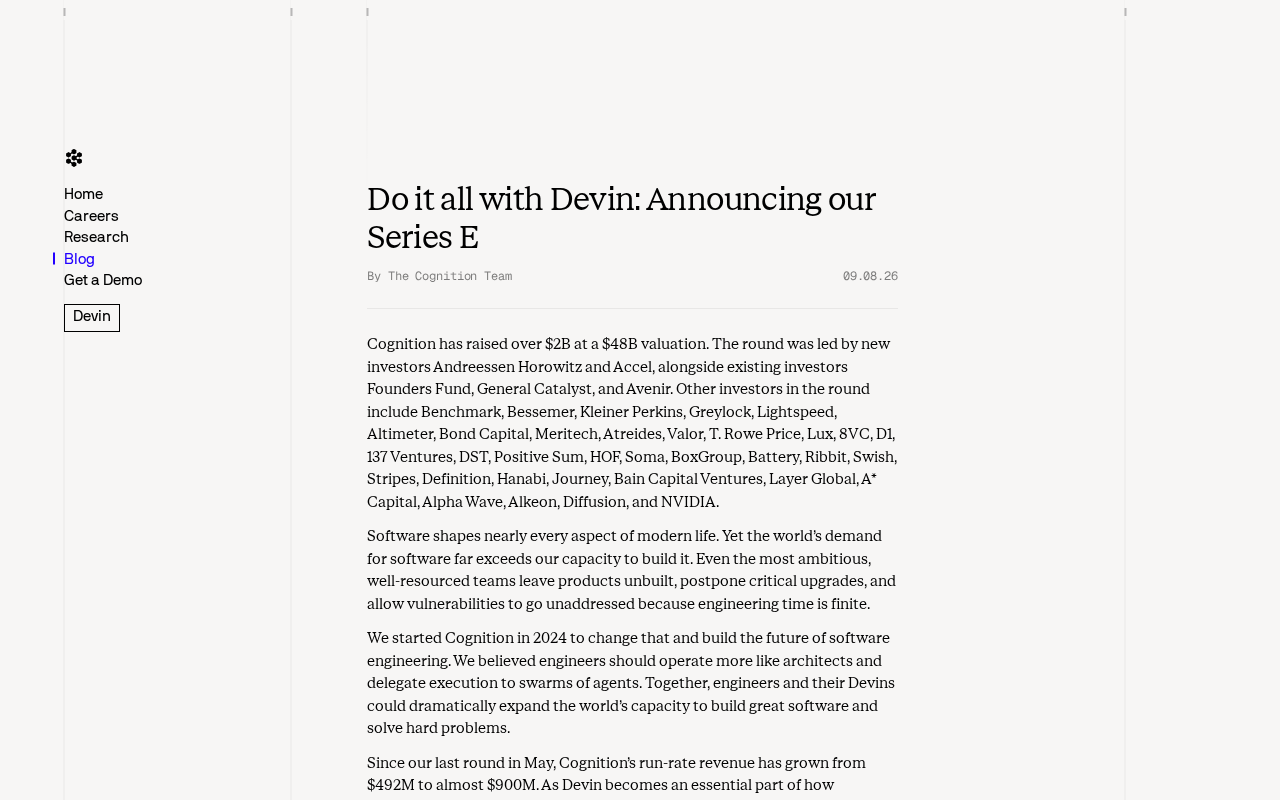
Devin's Parent Company Cognition Raises $2B, Valuation Soars to $48B
Cognition closes $2B funding round at $48B valuation, joining the ranks of highest-valued AI startups. Deep dive into Devin's technical positioning, capital logic, and competitive landscape.
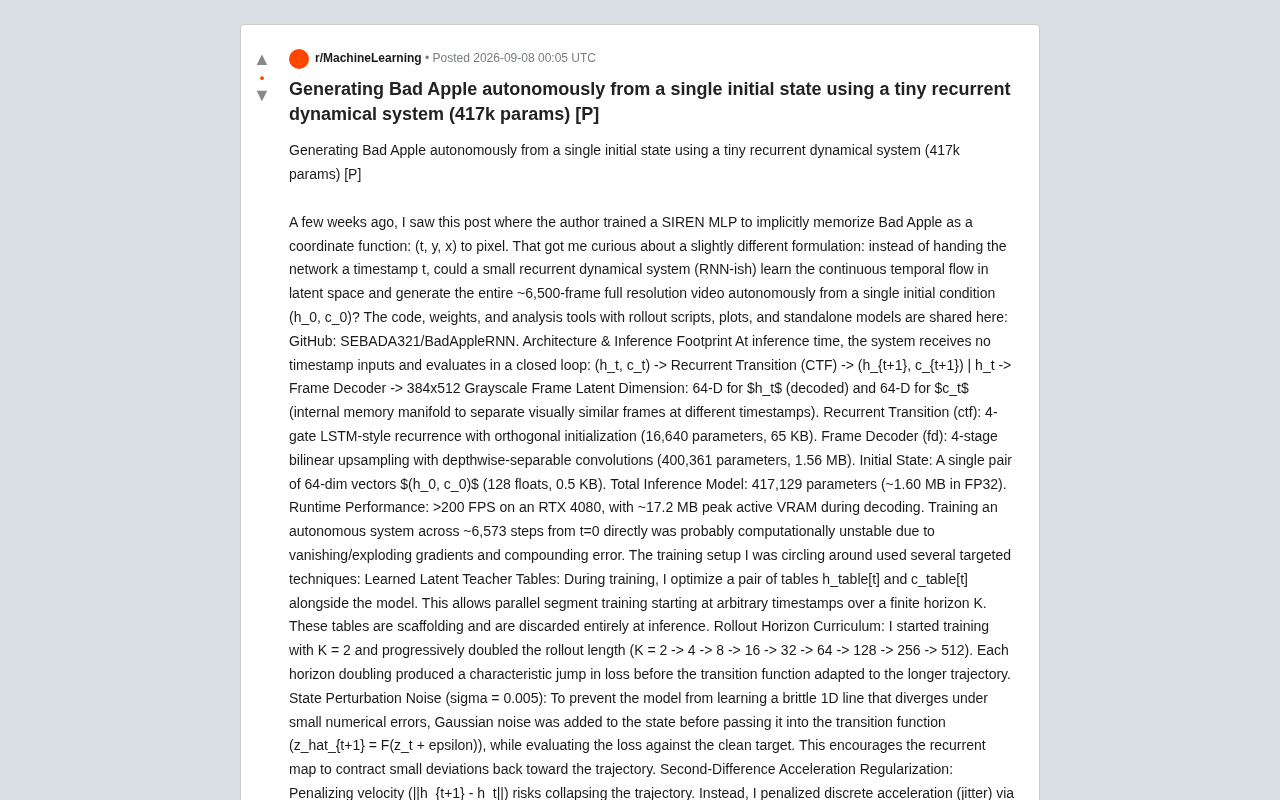
Complete Analysis: Autonomous Bad Apple Video Generation with a 417k-Parameter Recurrent Neural Network
Deep dive into how a tiny 417K-parameter LSTM system autonomously generates 6,500 frames of Bad Apple video from a single initial state, revealing five core strategies including progressive training, noise injection, and acceleration regularization.