AGIMUD: A Multi-Agent Interactive Simulation Framework for Building Socio-Affective AI

AGIMUD is a multi-agent MUD simulation framework combining affective modeling and distributed AI for real-time human-agent interaction.
AGIMUD is an early-stage arXiv paper proposing a software architecture that integrates humans and multiple AI agents into a shared dynamic simulation world — implemented as a Multi-User Dungeon (MUD) — for real-time interaction. Its theoretical core applies Theory of Mind to multi-agent systems, giving agents social awareness and affective modeling capabilities. The architecture comprises three modules: socially aware reasoning and affective modeling, a multimodal human-computer interaction scheme, and distributed AI processing for concurrent autonomous agents. The code has been open-sourced, offering researchers a reproducible experimental platform.
When AGI Meets the Multi-User Dungeon
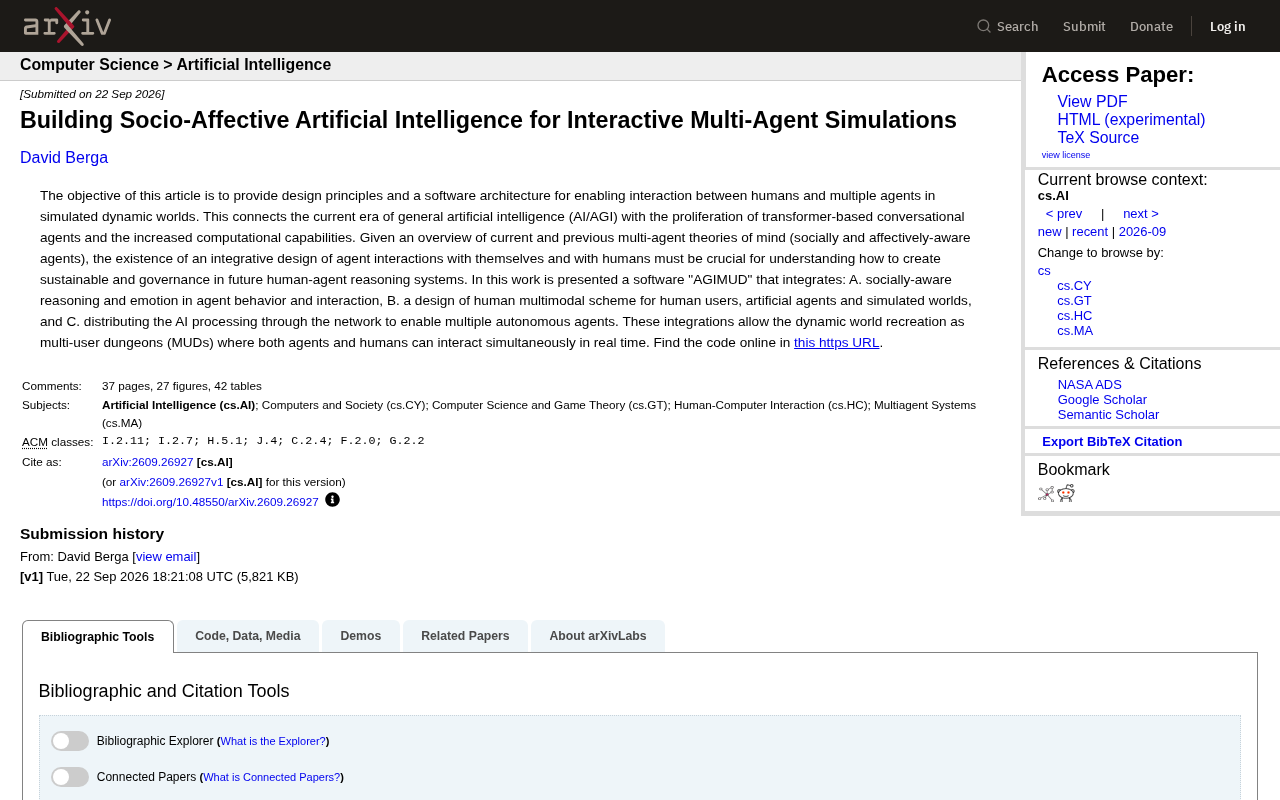
Multi-agent systems are becoming an increasingly important direction in AI research. One of the most challenging problems in this space is enabling humans and multiple AI agents to interact in real time within the same dynamic simulated world. A newly published paper on arXiv (arXiv:2609.26927) introduces a software framework called AGIMUD, which aims to combine advances from the current AGI era, Transformer-based conversational agents, and growing computational capacity to build a multi-agent interactive simulation environment with social and affective awareness.
The core goal of the paper is to provide a set of design principles and a software architecture that allows humans to interact with multiple agents in a simulated dynamic world. The authors structure this system as a Multi-User Dungeon (MUD) — a concept rooted in early text-based interactive games that allows multiple users to act simultaneously within the same virtual world. In AGIMUD, AI agents and human users can interact synchronously in real time within this dynamically reconstructed world.
Multi-User Dungeons (MUDs) originated in 1978 as purely text-based multiplayer online role-playing games, where players explored virtual worlds, interacted with other players and NPCs, and issued commands through typed text. Their defining characteristic is a "persistent shared world" — multiple participants act concurrently in the same evolving environment, with each participant's actions affecting the others. This paradigm later evolved into the precursor to modern MMORPGs. Using MUD as a container for multi-agent simulation offers several advantages: it natively supports concurrent multi-participant interaction, real-time world state updates, and natural-language-based communication — all of which align well with the capabilities of large language models, making it an ideal sandbox environment for testing AI agent social behavior.
Social and Affective Awareness: The Agent's "Theory of Mind"
One of the paper's theoretical foundations is the application of Theory of Mind (ToM) in multi-agent systems — enabling agents to be socially and affectively aware. The authors survey both current and prior multi-agent Theory of Mind research, emphasizing that if we are to truly understand how to build sustainable, governable human-machine reasoning systems, we need an integrated design that covers not only interactions between agents and humans, but also interactions within individual agents and between agents themselves.
In other words, AGIMUD is not satisfied with AI that merely "answers questions." Instead, it seeks to embed social awareness and affective factors into agent behavior and interaction. This design philosophy resonates with growing interest in affective computing and social intelligence: for agents to coexist and collaborate over time in complex multi-party scenarios, they need to understand each other's intentions, states, and emotions — rather than mechanically executing instructions.
AGIMUD's Three Core Integration Modules
Based on the paper's description, AGIMUD integrates three main components:
A. Socially Aware Reasoning and Affective Modeling
This module embeds social-awareness reasoning and affect into agent behavior and interaction, enabling agents to factor in social context and emotional states during decision-making — not just task objectives.
B. Multimodal Human-Computer Interaction Scheme
A human multimodal interaction scheme is designed for human users, artificial agents, and the simulated world. This means interaction is not limited to a single text channel; instead, it attempts to unify the information exchange between humans, machines, and the world.
C. Distributed AI Processing
AI computation is handled in a distributed manner across a network, enabling multiple autonomous agents to run simultaneously. This directly addresses a real-world bottleneck in multi-agent simulation — the computational limits of single-machine setups — and gives the system the ability to scale across multiple autonomous agents.
These three components collectively support the reconstruction of a dynamic world as a multi-user dungeon, enabling agents and humans to interact concurrently in real time.
Significance and Open-Source Value
AGIMUD sits at the intersection of several hot trends: AGI, the proliferation of Transformer-based conversational agents, and growing compute capacity. It attempts to answer a forward-looking question — as more and more autonomous, dialogue-capable agents emerge, how do we design a sustainable, governable framework for them to coexist and collaborate with humans?
Notably, the authors have open-sourced the code on GitHub (dberga/AGIMUD), providing researchers and developers with a reproducible, extensible experimental platform to explore multi-agent Theory of Mind, affective computing, and human-agent interaction simulation.
As a paper still in its early announcement stage, AGIMUD primarily offers design principles and an architectural blueprint rather than a mature product or large-scale validation results. The specific effectiveness of its socio-affective modeling, the performance of its distributed architecture under real workloads, and the feasibility of its ambitious goals around governance and sustainability all remain to be verified by future research. Nevertheless, as a systematic attempt to integrate socio-affective AI with multi-agent simulation, it offers a valuable reference framework for this interdisciplinary direction.
Background
Theory of Mind (ToM) is a foundational concept in cognitive science and developmental psychology. It refers to an individual's ability to attribute mental states — such as beliefs, intentions, desires, and emotions — to themselves and others, and to use those attributions to predict and explain behavior. Children typically demonstrate this ability around age 4 through the "false belief test." In AI research, ToM has long been viewed as a key threshold on the path to genuine social intelligence. In recent years, researchers have found that large language models exhibit nascent ToM capabilities on certain tasks, but remain significantly limited in complex multi-turn, multi-party scenarios. Introducing ToM into a multi-agent framework means agents must not only complete tasks, but also maintain "belief models" of other agents and human users, dynamically inferring their intentions and emotional states — placing higher demands on both computational architecture and training methodology.
The computational demands of multi-agent simulation grow nonlinearly: each additional autonomous agent requires not only independent inference capacity, but also the processing of inter-agent interaction states and communication overhead. Single-machine architectures often become bottlenecks when the number of agents exceeds a few dozen. Common approaches to distributed AI processing include: assigning the inference tasks of different agents to different nodes, sharing a single base model while independently maintaining each agent's context state, and coordinating asynchronous inter-agent communication via message queues. This design philosophy overlaps to some extent with recently popular agent orchestration frameworks (such as AutoGen, CrewAI, etc.), but AGIMUD situates it within a real-time simulation world context, introducing additional challenges around latency and state consistency.
Related articles

Chain of Thought Isn't Just for AI: How Humans Can Use CoT to Improve Thinking Quality
Chain of Thought isn't just a prompt trick for large models. Starting from a Hacker News discussion, this article analyzes why CoT works for human thinking too, breaks down actionable ways to transfer it, and highlights the key differences between human CoT and machine CoT.
Cloudflare Teams Up with OpenAI: Closi…
Cloudflare Teams Up with OpenAI: Closing the Loop from Vulnerability Discovery to Defense with AI
Cloudflare uses OpenAI Daybreak to investigate security vulnerabilities and generate reviewable remediation plans, while developers use Codex to boost coding efficiency and quality.

Orca Multi-Agent Orchestration in Practice: A Guide to Parallel Collaboration with Claude and Codex
Orca is Stable AI's free open-source agent workbench supporting 34 agents like Claude Code and Codex in parallel. Learn its Git worktree isolation, multi-model orchestration, and mobile management.