Agnos: Cleaning Documents for AI with Auditable Deletions

Agnos locally cleans redundant content from PDFs, Word files and web pages, delivering auditable clean text for RAG and training data.
Agnos is a document cleaning tool launched on Product Hunt that removes noise—repeated headers and footers, page numbers, cookie banners, boilerplate and duplicates—from PDF, Word, Excel, PowerPoint and web pages before feeding them to AI. It preserves tables, code and numbers, labels each deletion with a rule name for full auditability, runs entirely on a local Windows PC with no uploads, and exports JSONL chunks, plain text or training data for RAG pipelines and fine-tuning. Available via Microsoft Store with a 14-day free trial, then a $99 one-time purchase.
Why Does AI Need "Clean" Documents?
Feeding PDFs, Word files, or web pages directly into AI chatbots, RAG knowledge bases, or training data often introduces a lot of noise: repeated headers and footers, page numbers, cookie banners, templated boilerplate text, and duplicate content. This redundant information not only wastes context window space but can also interfere with model comprehension, degrading retrieval and generation quality.
Agnos, a new product on Product Hunt, targets exactly this pain point. Its tagline is straightforward: "Clean documents for AI, and see what was removed."
RAG (Retrieval-Augmented Generation) is a technical architecture in which a large language model, before generating an answer, first retrieves relevant document fragments from an external knowledge base to use as context. Unlike "baking" knowledge directly into model parameters, RAG relies on an external document index, so document quality directly determines the quality of retrieval results.
In a RAG pipeline, documents are first split into chunks, then converted into vectors via an embedding model and stored in a vector database. When a user asks a question, the system recalls relevant chunks by semantic similarity, stitches them into the prompt, and hands them to the model. Repeated text like headers, footers, and cookie banners produces large numbers of semantically similar "junk vectors" that crowd out recall slots that should belong to the main content during similarity retrieval—this is what the article calls "retrieval noise."
The context window refers to the total number of tokens a model can accept in a single pass, and its length is limited. The more redundant content there is, the less room remains for genuinely useful information. For RAG systems, document cleaning is therefore not optional—it's a prerequisite step that affects recall accuracy and generation quality.
Agnos's Core Capabilities: Cleaning, Preservation, and Transparency
Agnos supports cleaning PDF, Word, Excel, PowerPoint, and web pages, covering the most common document formats found in enterprise knowledge bases and training data. It primarily removes the following types of content:
- Repeated headers and footers
- Page numbers
- Cookie banners
- Boilerplate text
- Duplicate content
At the same time, it explicitly preserves tables, code, and numbers—the very structured information that many aggressive cleaning tools tend to damage by mistake.
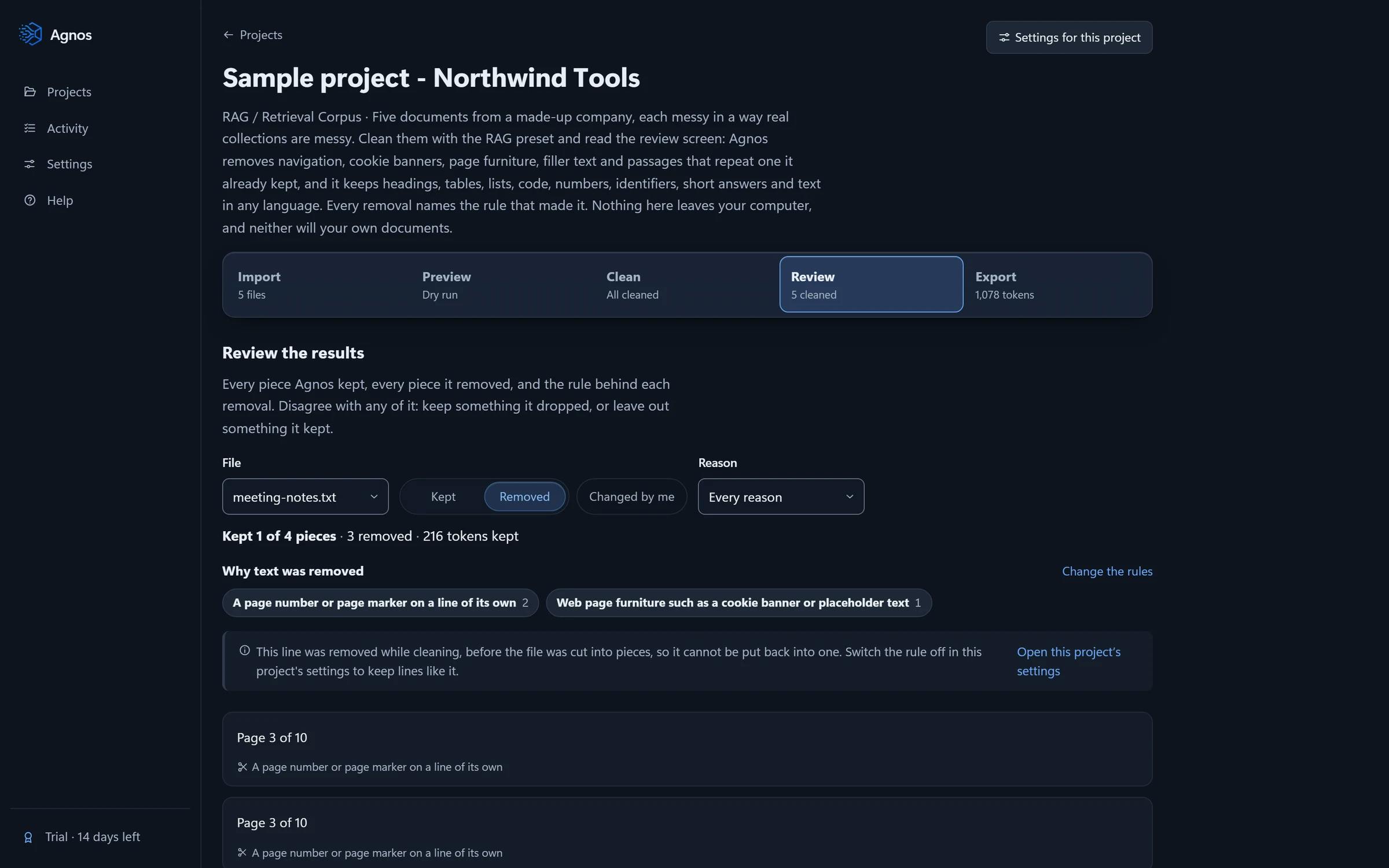
More importantly, there's transparency: Agnos labels each deletion with the name of the rule behind it. Users can keep a piece of content or simply disable the corresponding rule. This "rule-level control" design turns the cleaning process from a black box into an auditable, adjustable pipeline.
Local Execution + Multi-Format Export
On the privacy front, Agnos takes a route that puts developers at ease: it runs on your Windows PC and uploads nothing. For teams handling sensitive contracts, internal documents, or customer data, this eliminates the concern of handing raw files to a third-party cloud service.
For export, Agnos supports JSONL chunks, plain text, or training data formats, making it easy to plug directly into RAG pipelines or model fine-tuning workflows.
JSONL (JSON Lines) is a text format in which each line is an independent JSON object, separated by newlines rather than wrapped in one large JSON array. This structure supports streaming line-by-line reads without loading the entire file into memory, making it ideal for massive training datasets and chunked corpora.
In AI engineering, JSONL is a common de facto standard: OpenAI's fine-tuning API requires training samples submitted in JSONL, and bulk imports into vector databases, logging, and data annotation results also commonly use this format. In RAG scenarios, each JSONL line typically corresponds to one document chunk, accompanied by metadata fields such as source file, page number, and heading path, which facilitate filtering and traceability during retrieval.
Therefore, whether a tool can directly export structured JSONL chunks determines whether the cleaned output can seamlessly plug into downstream pipelines, saving the extra work of format conversion and field mapping.
Pricing and Availability
Agnos is distributed through the Microsoft Store, offering a 14-day free trial, after which it's a one-time purchase of $99. There's no subscription, so for teams that need to process documents long-term, the cost structure is relatively clear.
Who Is Agnos For?
- RAG developers: Batch-clean documents before building a knowledge base to reduce retrieval noise.
- AI application teams: Prepare clean context sources for chatbots.
- Data engineers: Generate structured JSONL chunks for training or fine-tuning.
- Privacy-sensitive industries: Legal, financial, healthcare, and other scenarios where documents cannot be uploaded to the cloud.
A Few Observations
Document cleaning is not a new problem, but Agnos has turned "explainability" into a product differentiator. Most cleaning tools only tell you the result, while Agnos shows you what was deleted at each step and why. For AI projects that require compliance audits or have extremely high data quality standards, this design approach may be worth far more than the cleaning itself.
Of course, as a new product that has just landed on Product Hunt, its rule library coverage and its handling of complex-layout documents still need more real-world use to be verified.
One-line Summary
Agnos locally cleans redundant content from PDFs, Word files, web pages, and more, providing auditable clean text for RAG and training data.
Paragraph Summary
Agnos is a document cleaning tool that debuted on Product Hunt, designed to solve the noise problem introduced when raw documents like PDFs, Word files, and web pages are fed directly to AI. It supports five formats—PDF, Word, Excel, PowerPoint, and web pages—removing repeated headers and footers, page numbers, cookie banners, boilerplate text, and duplicate content, while explicitly preserving structured information such as tables, code, and numbers that are easily damaged by mistake. Its standout feature is transparency: each deletion is labeled with a rule name, and users can keep content or disable rules, enabling an auditable cleaning pipeline. Agnos runs entirely on a local Windows PC and uploads nothing, making it suitable for privacy-sensitive scenarios in legal, financial, and healthcare industries. Export supports JSONL chunks, plain text, or training data formats that plug directly into RAG pipelines or fine-tuning workflows. The product is distributed through the Microsoft Store, offers a 14-day free trial, and then a one-time purchase of $99.
Related articles

RePlan-VLA: Progress-Aware Replanning Breakthrough for Long-Horizon Robotic Manipulation
The RePlan-VLA framework converts VLA models' short-horizon capabilities into reliable long-horizon execution through progress-aware adaptive replanning, improving success rates by 21.9% and 10.4% on RoboCasa365 and CALVIN, and validating real-world deployment on a Franka Research 3 robot.

Geometric Bridge Flow Matching: A New Breakthrough in Blind Rigid Motion Correction
Geometric bridge flow matching enables blind rigid motion correction in head CBCT, achieving 37.1 dB PSNR and 0.27 mm RPE on simulated data in ~9.1 minutes, outperforming existing methods.

Google Releases Gemini 4 Hydrogen: 2.5x Faster Without Sacrificing Intelligence
Google releases the lightweight Gemini 4 Hydrogen: 2.5x faster task completion, AA Intelligence Index of 54 beating its flagship sibling, 7.3s single-step on Agent Arena faster than Claude and GPT rivals, four thinking levels with pay-as-you-need pricing, now available across AI Studio and more.