Agnost AI: Catching the Hidden Agent Failures Your Evals Miss
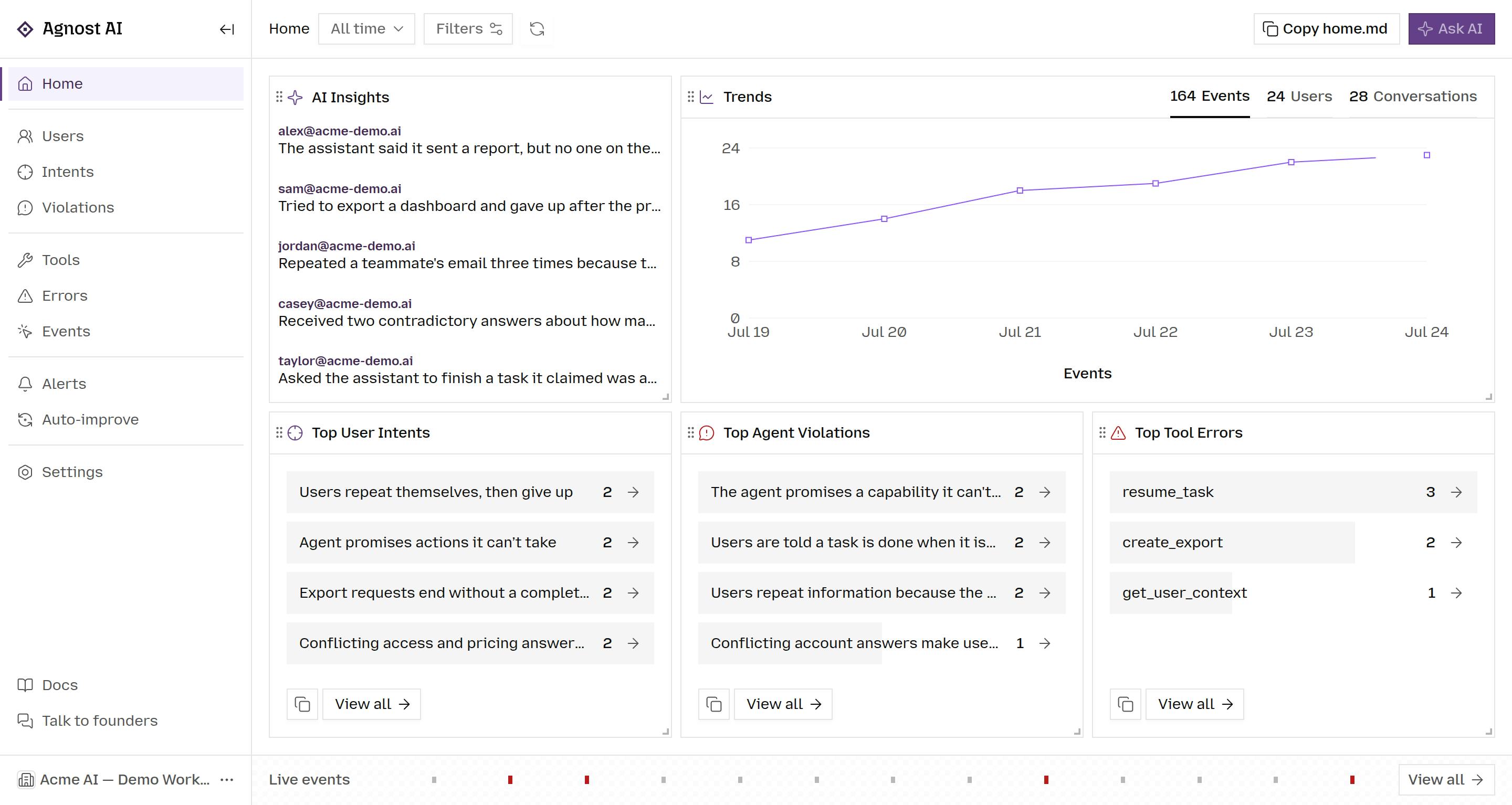
Agnost AI discovers hidden AI agent failures in production that traditional evaluations miss.
Agnost AI tackles the gap between offline evaluations and real-world AI agent performance by analyzing production conversations to automatically detect six types of hidden failures: silent failures, behavior drift, hallucinations, user frustration, hidden feature requests, and churn signals. It categorizes issues into recurring patterns, traces them to specific conversations, and converts findings back into eval cases and fix recommendations, creating a continuous quality improvement loop.
When Eval Frameworks Fall Short: The Hidden Failure Problem of AI Agents
As AI agents enter production environments at scale, a long-overlooked problem is surfacing: traditional evaluation (evals) frameworks can only cover pre-designed test scenarios, failing to capture the various hidden failures that emerge during real user interactions. Agnost AI, which recently launched on Product Hunt, targets exactly this pain point. Positioned as a tool that "catches agent failures your evals miss," it debuted at #4 on the daily product rankings with 120 upvotes.
For any team that has deployed conversational AI, this problem is all too familiar. You can pass an entire test suite before launch, but once thousands of real users start interacting with your system, unexpected edge cases, model drift, and hallucination issues inevitably emerge — and these are precisely what offline evals are most likely to miss.
What Problem Does Agnost AI Actually Solve
Agnost AI's core logic is straightforward: rather than relying on test scenarios that developers imagine in advance, why not mine problems directly from real conversations between users and AI agents in production? By analyzing this conversation data, it automatically identifies six categories of critical issues:
Six Overlooked Failure Signals
- Silent Failures: The agent gives responses that appear normal but are actually wrong or unhelpful. Users don't explicitly report errors, and the problems get quietly buried.
- Behavior Drift: Agent performance gradually deviates from expectations over time, due to model updates or context changes — something nearly impossible to detect with one-time evaluations.
- Hallucinations: The model generates false or fabricated information.
- User Frustration: Dissatisfaction and confusion identified from conversational tone and interaction patterns.
- Hidden Feature Requests: Product expectations that users inadvertently express during conversations.
- Churn Signals: Early indicators that users are about to abandon the product.
The value of this classification lies in breaking down the vague question of "where exactly is the agent underperforming" into observable, attributable, and specific dimensions.
From Insights to Closed Loop: Actionable Fix Paths Are What Matter
Agnost AI isn't just a "problem reporter." Its product design reflects a more complete closed-loop approach.
Categorization and Root Cause Tracing
First, it categorizes discovered issues into recurring patterns rather than scattering a list of isolated errors. This is crucial for engineering teams — when facing massive conversation logs, the ability to aggregate noise into meaningful patterns directly determines debugging efficiency.
Going further, Agnost AI surfaces the specific users and conversation records behind each insight. This means teams don't just know "there's a problem" — they can immediately pinpoint "who encountered it and in which conversation," dramatically shortening the path from discovery to reproduction.
Turning Real Failures into Eval Cases and Fix Recommendations
The most interesting part is that Agnost AI converts these real-world findings back into evals and fix recommendations. In other words, it lets real failures from production feed back into the offline evaluation system — turning missed cases into new test cases. This creates a continuous improvement cycle: real interactions expose problems → categorize and trace → generate new evals → fix and prevent regression.
Why the AI Observability Space Deserves Attention
Agnost AI is categorized on Product Hunt under Analytics, Developer Tools, and Artificial Intelligence — a positioning that itself speaks to its value proposition: it sits squarely in the rapidly emerging AI Observability space.
As LLM applications move from the "demo phase" to the "production phase," how to monitor, evaluate, and continuously improve deployed AI systems is becoming a real and urgent engineering need. Traditional software monitoring tools focus on metrics like latency, error rates, and throughput, but for AI agents, semantic-level quality — "is the answer correct" and "is the user satisfied" — is what determines product success or failure. And this is precisely the blind spot of traditional monitoring.
Agnost AI's approach — using real conversations as the data source, pattern categorization as the analytical method, and eval generation as the actionable output — represents a pragmatic solution in this space. It acknowledges a reality: no matter how thoroughly an eval set is designed, it can never exhaust the complexity of the real world. Therefore, a mechanism for continuous learning from production feedback must be established.
Final Thoughts
Agnost AI has identified an underestimated pain point in the process of scaling AI agents to production: the gap between offline evaluations and actual online performance. It transforms hard-to-quantify issues like "silent failures," "behavior drift," and "user frustration" into observable, attributable, and fixable targets.
Of course, as a newly launched product, it still needs to prove the accuracy of its analysis in practice — such as how to avoid misclassifying normal conversations as "failures," and how to analyze massive conversation data while protecting user privacy. These are challenges shared by all tools in this category. But from a product philosophy standpoint, the "production feedback-driven AI quality closed loop" that Agnost AI points toward is undoubtedly a direction that no team serious about AI agent deployment can afford to ignore.
Related articles

AureaCam: A Real-Time Composition Scoring Tool That Trains Your Photography Instincts Using the Rule of Thirds and Golden Ratio
AureaCam is a real-time composition scoring tool based on the Rule of Thirds and Golden Ratio, helping photography beginners build composition instincts with instant 0-100 feedback. As a PWA, it works directly in your browser with no installation needed.

Anthropic Asks Job Candidates About Their Views on Money: How an AI Safety Company Screens for Values
Anthropic directly asks job candidates about their views on money, screening for value alignment with its AI safety mission. Here's the logic behind it.

How to Write MiniMax H3 Prompts? One Skill Does It All
Struggling with MiniMax H3 video prompts? Learn the 6 core elements — character, scene, action, camera, timeline, sound — and use ProMate Skill to auto-generate pro-level prompts from a single sentence.