AI Accelerating Science and Society: Four Breakthroughs from Genomics to Weather Forecasting
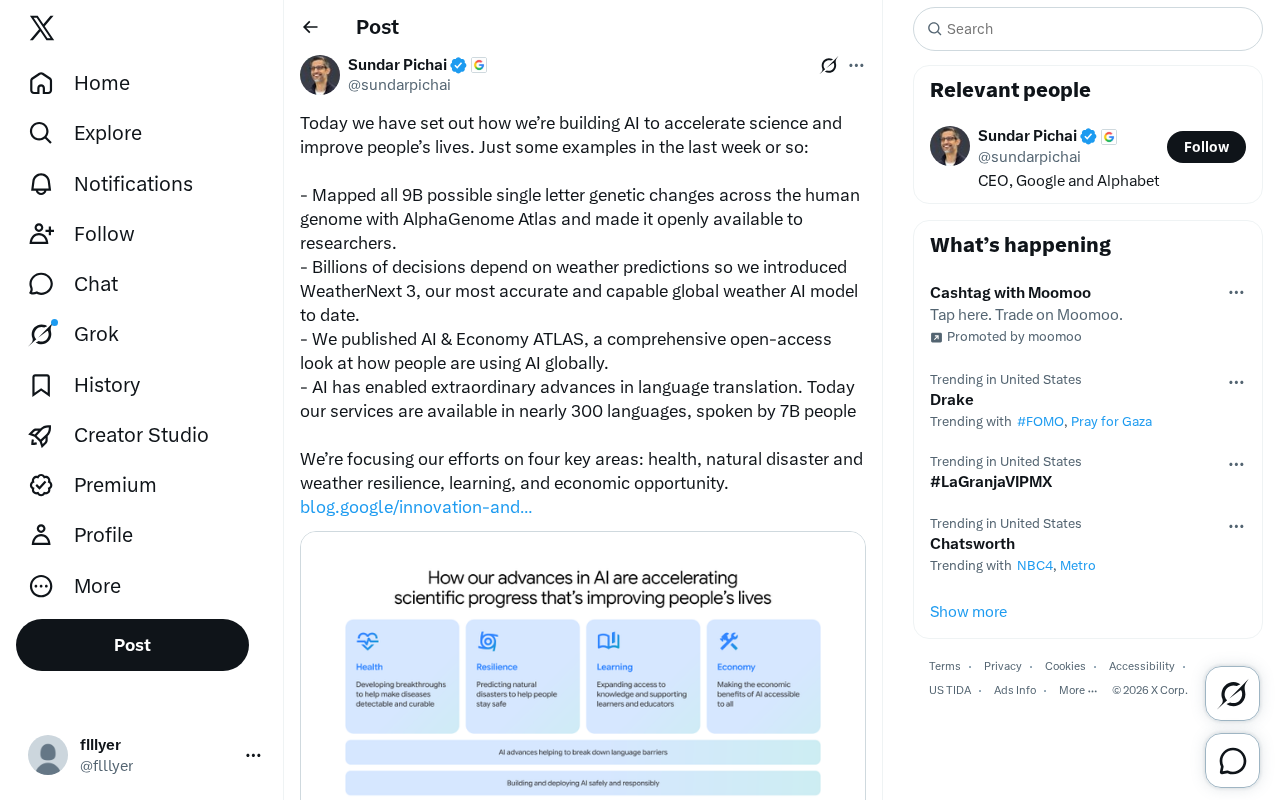
AI breakthroughs in genomics, weather forecasting, translation, and economic analysis go open to drive real-world impact.
A cluster of AI results spanning genomics, weather forecasting, socioeconomic analysis, and multilingual translation collectively signal a strategic push toward AI-enabled science and public services. AlphaGenome Atlas makes functional predictions for ~9 billion human genome variants freely accessible; WeatherNext 3 delivers the most accurate global weather AI to date at a fraction of traditional computing costs; AI & Economy ATLAS fills a data gap on real-world AI adoption; and translation service now covers nearly 300 languages, including previously underserved low-resource ones. All share a commitment to open access and target four concrete domains: health, disaster resilience, learning, and economic opportunity.
AI's value extends far beyond chat and code generation. A growing wave of frontier research is now landing in foundational science and public services. A recent cluster of open research results spans genomics, weather forecasting, economic analysis, and language translation — all pointing in one clear direction: using AI to accelerate scientific progress and improve people's lives.
What these efforts share is a commitment to openness and scale — moving beyond lab demonstrations to put real capabilities in the hands of researchers and everyday users worldwide.
Mapping Every Variant in the Human Genome
The most striking advance is in genomics. Using AlphaGenome Atlas, researchers have completed a mapping of all approximately 9 billion single-base (single-letter) genetic variants in the human genome — and made it freely available to researchers.
The significance lies in the comprehensiveness. Every base position in the human genome can theoretically undergo a variant, and different variants carry wildly different implications for gene expression and disease risk. Determining the functional consequences of any given variant traditionally required extensive wet-lab experiments — costly and slow. Assembling predicted results for all single-base variants into an open atlas gives researchers worldwide a directly queryable "variant function map," capable of significantly accelerating rare disease research and drug target discovery.
Open access is the key design choice here. Once foundational research resources are freely shared, the breadth of their use and validation expands exponentially.
A bit of background helps put this achievement in context. The human genome contains roughly 3 billion base pairs. Each position can theoretically be substituted with one of three other bases, making the theoretical ceiling for single nucleotide variants (SNVs) approximately 9 billion. AlphaGenome Atlas draws its core capability from DeepMind's AlphaGenome model, trained jointly on large-scale genomic sequences and functional data. It can predict the impact of a given variant on molecular phenotypes such as gene expression regulation and splicing signals — without requiring wet-lab validation for each one. Computational predictions are not the same as experimental confirmation, but they rapidly narrow the field of "candidate variants" and dramatically reduce downstream experimental costs. For teams studying orphan (rare) diseases, variants that couldn't previously be validated one by one due to resource constraints can now be given a preliminary functional priority ranking using the atlas — and that is its most direct practical value.
WeatherNext 3: A More Accurate Global Weather AI
Weather forecasting may seem routine, but it carries enormous decision-making value. As the original work notes, "billions of decisions depend on weather forecasts" — from agricultural planting and flight scheduling to disaster preparedness. The precision of weather data directly affects both economic outcomes and public safety.
The newly released WeatherNext 3 is described as the most accurate and capable global weather AI model to date. Compared to traditional numerical weather prediction (NWP), which relies on massive systems of physical equations and supercomputing resources, AI weather models offer faster inference, higher-frequency updates, and continuously improving accuracy on medium-to-long-range forecasts — in some cases matching or surpassing traditional methods.
This aligns with the broader goal of "natural disaster and weather resilience." In an era of increasingly frequent extreme weather events, earlier and more accurate warnings mean more preparation time and fewer losses.
To understand the significance of AI weather models, it helps to compare them against the baseline. Leading NWP systems — such as ECMWF's IFS model — generate forecasts by solving partial differential equations describing atmospheric motion. A single global forecast run consumes enormous supercomputing resources, with update cycles typically running every 6 to 12 hours. First-generation AI weather models like GraphCast and Pangu-Weather already matched or locally surpassed NWP accuracy on medium-range forecasts (3–10 days), while compressing inference time from hours to minutes. WeatherNext 3 is the next generation along this trajectory. Its claim to being "most accurate" means it outperforms both its predecessors and traditional baselines across more evaluation metrics and time horizons. It's worth noting that AI weather models currently still depend on NWP systems for initial-state data — the two approaches are complementary, not mutually exclusive.
AI & Economy ATLAS: A Global Picture of AI Adoption
Beyond hard science, this wave of results includes a socioeconomic perspective: the AI & Economy ATLAS. This is a comprehensive open-access report that systematically examines how people around the world are using AI.
Technological breakthroughs are easy to quantify, but how technology is actually adopted — in which industries, in which regions, and with what economic consequences — often lacks systematic data. The value of this kind of research lies in pulling "the real-world impact of AI" out of abstract debate and into observable evidence, giving policymakers and businesses a more grounded basis for decisions.
Translation in Nearly 300 Languages
Language translation is one of AI's earliest and most widely beneficial applications. The translation service now supports nearly 300 languages, reaching approximately 7 billion users.
Covering nearly 300 languages means a large number of previously overlooked "low-resource languages" are now included. These languages typically lack sufficient training data and have long been among the hardest challenges in machine translation. Extending coverage to this scale reflects real progress by multilingual large language models in data-scarce settings — and it means language is no longer a barrier to accessing information.
Low-resource languages represent a persistent core challenge in machine translation. Mainstream neural machine translation systems depend on large amounts of parallel corpora — bilingual text pairs covering the same content — for training. Of the world's 7,000-plus languages, only around 100 have sufficient digitized corpora; the vast majority are classified as low-resource or extremely low-resource. In recent years, multilingual large models have partially addressed this through cross-lingual transfer learning: representations of language learned from high-resource languages can transfer to data-scarce ones. Meta's NLLB (No Language Left Behind) project and Google's 1,000 Languages Initiative are representative efforts in this direction. Supporting nearly 300 languages and reaching approximately 7 billion users indicates extremely high population coverage — though an uneven distribution between language count and translation quality remains a real-world constraint, with low-resource languages typically achieving lower accuracy than high-resource ones.
Four Focus Areas: Health, Disaster Resilience, Learning, and Economic Opportunity
Connecting these individual results reveals a clear strategic thread. The efforts concentrate on four key domains:
- Health: Life-science breakthroughs exemplified by the genomic atlas
- Natural disaster and weather resilience: Weather forecasting exemplified by WeatherNext 3
- Learning: AI applications in education
- Economic opportunity: Socioeconomic research exemplified by the AI & Economy ATLAS
The value of this framework is that it gives "AI for social good" concrete, actionable footholds rather than empty slogans. Each domain is backed by specific products or research outputs, and most adopt an open-sharing model.
Trends Worth Watching
A few signals emerge from this body of work. First, AI is shifting from general-purpose capabilities toward domain-specific depth, creating real value in specialized fields like genomics and meteorology. Second, open access is becoming the default posture — whether it's a genomic atlas or an economic report, the emphasis is on free availability to researchers and the public, which enables broader validation and reuse. Third, evaluating AI's social value is being taken seriously, with dedicated research tools beginning to appear.
Of course, these are summary announcements of official progress. Specific accuracy metrics and methodological details still require independent assessment through each project's technical reports. But the overall direction is clear: AI is not just a productivity tool — it is becoming infrastructure for scientific discovery and public services.
Related articles
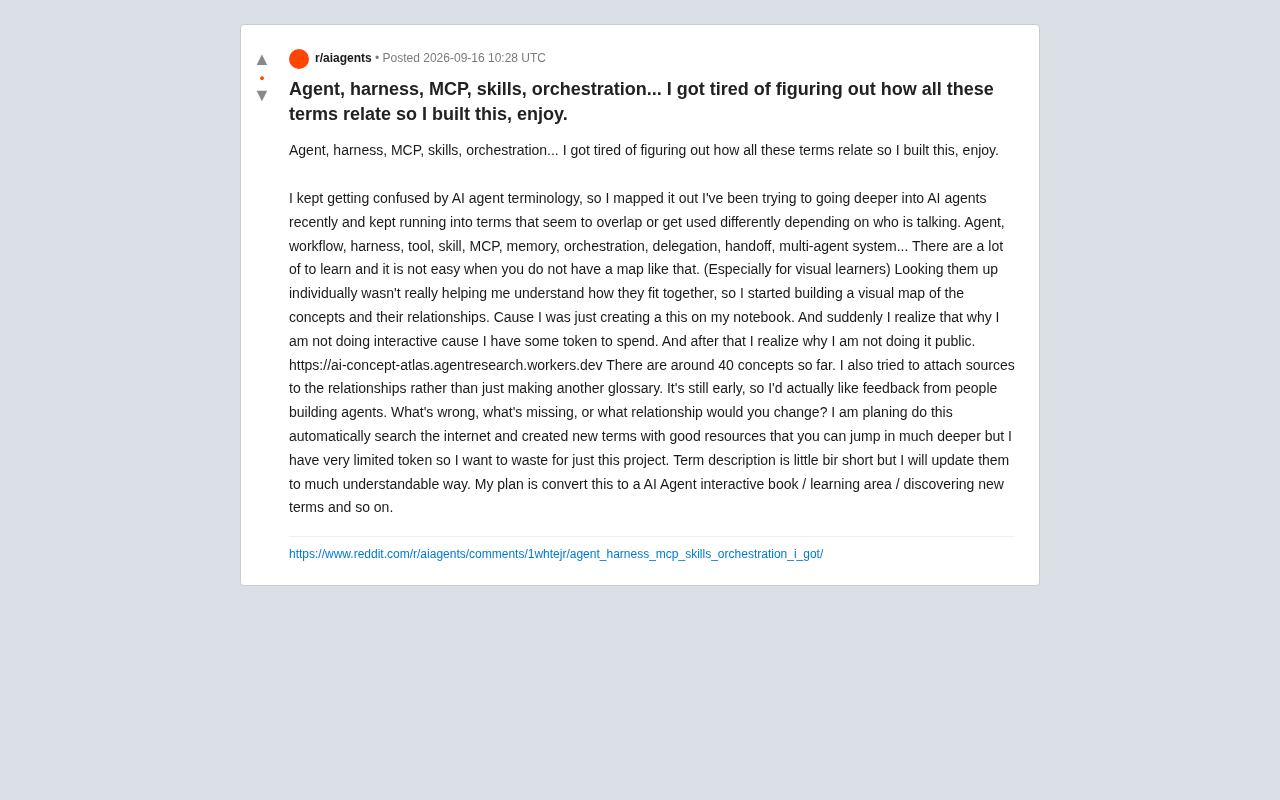
AI Agent Terminology Too Confusing? One Interactive Concept Map to Untangle 40+ Core Terms
Confused by AI Agent terms like MCP, harness, orchestration, and skills? AI Concept Atlas is an interactive map visualizing 40+ concepts and their relationships, with cited sources.
Meta's Broken Promise: Community Demands to Know Where the Muse Spark Weights Are
Meta promised to open-source Muse Spark model weights over a month ago, but still hasn't delivered. The community questions how this squares with Zuckerberg's "can't delay even a month" stance.
Running Qwen3 27B Locally on a Single RTX 5090: What Can It Actually Do?
A developer runs Qwen3 27B locally on a single RTX 5090 via the Row-Bot Agent framework, generating an 8-scene, 105-second interactive animation from one prompt — including real-time math, fractals, and physics.