AI Advice Homogenization: The Hidden Worry of Everyone Getting the Same Answers

AI advice converges due to statistical patterns and alignment, possibly eroding innovation and viewpoint diversity.
Starting from a Hacker News discussion that AI is giving everyone the same advice, the article analyzes why large language model outputs become homogenized. Models learn statistical patterns and favor high-probability mainstream expressions, forming an "average value" trap; alignment mechanisms like RLHF further compress diversity for safety, making advice more middle-of-the-road. This narrows individual decision-making safe zones and weakens innovation, while socially flattening the opinion ecosystem. The article suggests more specific, personalized prompting and balancing safety with diversity, stressing the importance of preserving human judgment.
Introduction: A Trend Worth Watching
On Hacker News, a discussion titled "AI is giving everyone the same advice" drew attention. Although the original post received only 3 upvotes and has no comments yet, the title itself points to an increasingly common phenomenon: AI is offering highly similar answers and advice to everyone. This is not an accidental technical glitch, but an inevitable result of how current large language models operate.
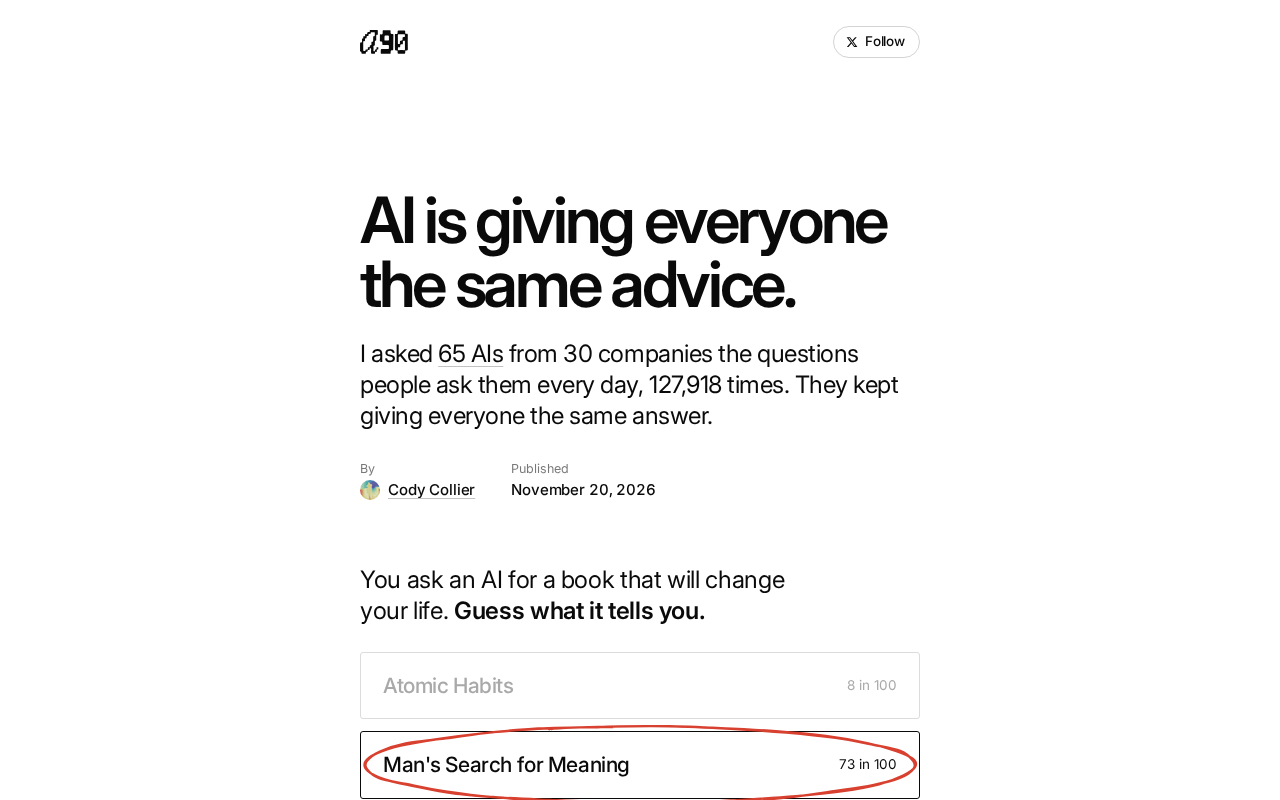
When hundreds of millions of users ask the same model similar questions, they tend to get converging responses. This homogenization may seem harmless in terms of efficiency, but at a deeper level it may weaken the diversity and creativity of individual decision-making.
Why Does AI Advice Converge?
The "Average Value" Trap of Training Data
The training process of large language models is essentially learning statistical patterns from massive amounts of text. Models tend to output the most frequent and "safest" expressions found in the training corpus. This means that for common questions like "how to improve work efficiency" or "how to handle interpersonal relationships," the advice the model gives is often an averaged expression of mainstream views, rather than unique insight tailored to an individual's situation.
The generation process of large language models is not about retrieving ready-made answers from a database, but about predicting the most likely next token word by word based on context. This probabilistic generation method means that model outputs naturally tend toward the peak regions of the probability distribution—that is, the mainstream expressions repeatedly articulated in the training corpus. In statistical terms, given an input, the model approximately outputs the mode or high-probability samples of the conditional distribution, rather than low-probability but potentially more fitting expressions for an individual situation. Although decoding strategies such as temperature parameters and top-p sampling can introduce randomness within a certain range, they only perturb the probability distribution and cannot create new viewpoints that do not already exist in the training data. Therefore, the so-called "average" is not an arithmetic mean, but a concentrated manifestation of high-probability regions—which is why different users facing different situations often receive responses with highly similar wording.
Side Effects of Alignment Mechanisms
To make models safer and more helpful, developers align them through techniques such as reinforcement learning from human feedback (RLHF). The alignment process further compresses output diversity—the model learns to avoid "out-of-line" answers and instead chooses widely accepted, middle-of-the-road expressions. While this mechanism reduces harmful content, it also inadvertently smooths away the edges of advice.
The typical RLHF (reinforcement learning from human feedback) pipeline is as follows: first, have the model generate multiple candidate responses to the same prompt; then have human annotators rank them by preference; train a reward model to approximate human preferences; and finally use reinforcement learning algorithms (such as PPO) to optimize the language model so that its outputs better match the reward model's scores. The problem is that this pipeline compresses the collective preferences of crowdworkers into a single scalar reward signal, and the model quickly learns to cater to this "average preference"—answers become polite, comprehensive, and cover every angle, yet often lack sharp positions or risky insights. In addition, refusal strategies and conservative wording commonly used in safety alignment also cause the model to retreat to the safest expressions when facing controversial topics, further narrowing the spectrum of viewpoints.
Practical Impact of Homogenized Advice
Individual Level: The "Safe Zone" of Decision-Making Narrows
When people become accustomed to seeking advice from AI and receiving converging answers, individual decisions may gradually move toward the same "safe zone." Job seekers may receive similar career planning advice, and entrepreneurs may hear the same market entry strategies. Over time, the diversity of innovation will be eroded.
Social Level: The Flattening of the Opinion Ecosystem
More broadly, if AI becomes the primary source of information and advice, the distribution of social opinion may become more concentrated. Diverse perspectives originally shaped by different experiences, cultures, and regions may be replaced by a "global average" answer. This flattening is not good news for public discussion that requires diverse collision of views.
How to Respond to Advice Homogenization?
User Side: Actively Seek Differentiation
Users can guide AI to give unique answers by asking more specific and personalized questions. Providing detailed background information, specifying constraints, or even asking the model to analyze a problem from multiple opposing perspectives can all help break homogenization to some extent.
Technical Side: Balancing Diversity and Personalization
Developers can introduce more randomness at the model level (such as adjusting the temperature parameter) or build personalized systems that remember user preferences. But how to restore output diversity while maintaining safety remains an open research question.
At the technical implementation level, adjusting temperature and top-p is the most direct way to regulate diversity, but they act on a single generation and cannot guarantee long-term diversity across users or sessions. More systematic approaches include: maintaining independent memory and preference profiles for different users to achieve contextual personalization; introducing retrieval augmentation during generation to inject domain-specific materials related to the user into the prompt, reducing reliance on general knowledge; and adopting diversity-aware reward design during training, such as penalizing semantic repetition in outputs or preserving multiple preference dimensions rather than a single scalar in RLHF. It is worth emphasizing that there is a real tension between diversity and safety—excessive pursuit of diversity may amplify harmful or erroneous content, so researchers are exploring frameworks for controllable diversity that allow systems to intentionally disperse advice directions within safety boundaries.
Conclusion
The homogenization of AI advice is a signal worth taking seriously. It reminds us that efficiency gains should not come at the cost of diversity of thought. While embracing AI assistance, preserving the uniqueness of human judgment and critical thinking may be the most reliable way to respond to this trend.
One-line Summary
AI advice converges due to statistical patterns and alignment mechanisms, potentially eroding individual innovation and social viewpoint diversity.
Paragraph Summary
Starting from a Hacker News discussion about "AI is giving everyone the same advice," the article analyzes the deep reasons behind the homogenization of large language model outputs. On one hand, models learn statistical patterns from training corpora and tend to output high-probability mainstream expressions, forming an "average value" trap; on the other hand, alignment mechanisms such as RLHF further compress output diversity in pursuit of safety and helpfulness, making advice more middle-of-the-road. This homogenization narrows the "safe zone" of decision-making at the individual level and weakens innovation diversity; at the social level, it may lead to a flattening of the opinion ecosystem. The article suggests that users can guide differentiated responses through more specific and personalized questions, while the technical side needs to find a balance between safety and diversity, emphasizing that preserving the uniqueness of human judgment is key to responding to this trend.
Related articles

From 0 to 1: Vibe Coding an AI Knowledge Base — A Practical Retrospective and Tech Stack Breakdown
A retrospective on building the AI knowledge base OilBook from scratch with Vibe Coding: Next.js+Neon stack, Oil Dev Skill workflow, Stripe paywall security, interview-style writing, AI-flavor control, and Vercel deployment.

GLM-5.4 Hands-On: Native Vision Meets a New Vibe Coding Workflow
Hands-on with Zhipu GLM-5.4: native vision tested across a 3D product demo, pure-code video generation, and remote-control Vibe Coding, compared with GPT-6.2 and Gemini Neon.

AI and Humans Claim to Prove the Riemann Hypothesis: Machine-Verified, Yet Nobody Can Understand It
Anthropic mathematician and AI Claude claim to prove the Riemann Hypothesis with 17 million lines of Lean code, machine-verified but unreadable by humans. This article analyzes the event, the zero proportion record from 41.6% to 67.2%, and the gap between machine verification and human understanding.