AI Agent Builds Open-Source After Effects Alternative EffectCraft in One Week, Featuring 306 Effects

AI agent builds open-source effects tool EffectCraft in Rust in one week, with 306 effects and MCP support.
A developer used an AI coding agent to build EffectCraft, a free open-source effects compositing tool, from an empty repository in Rust in about a week, featuring 306 effects and professional capabilities like layer compositing, character rigging, and ray-traced shadows. It supports ProRes, EXR, and Lottie export for film and web motion pipelines, and includes an MCP server for other AI agents to invoke. The editor is permanently free and open-source, but AI features require extra payment. Currently in early Alpha, its stability and real usability await community verification. This case showcases AI agents' potential in large-scale software engineering while raising questions about the value moat of professional software.
When AI Agents Set Their Sights on Professional Video Tools
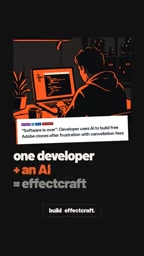
Adobe's subscription model has left many creators frustrated—you even have to pay to cancel. One developer decided to pursue a more radical approach: let an AI agent build a free, open-source effects compositing tool from scratch.
That's EffectCraft. According to the project's description, an AI coding agent, working in the Rust language, started from an empty repository and wrote nearly the entire piece of software independently.
306 Effects, Built in a Week
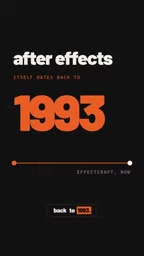
According to the project description, EffectCraft built 306 effects in about a week. That's an impressive number—consider that After Effects itself dates back to 1993, accumulating three decades of feature development.
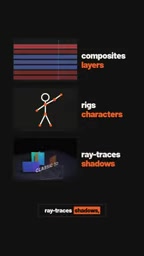
But EffectCraft is no toy. It offers core capabilities like layer compositing, character rigging, and ray-traced shadows—all hard requirements in professional motion graphics workflows. For users accustomed to After Effects' complex layer system, layer compositing and character rigging signal that this targets real production scenarios, not just a simple filter toy.
Rigging is a key step in animation and motion graphics, referring to building a controllable skeleton and controller system for a 2D or 3D character. Once rigged, animators only need to adjust bone poses, and the character's limbs, face, and torso move accordingly—no need to redraw frame by frame. In After Effects, this feature typically relies on third-party plugins like DUIK, with limited native support. By listing rigging as a built-in capability, EffectCraft aims to cover the full pipeline from modeling to animation, rather than stopping at filter stacking.
Ray-traced shadows are a physics-based lighting simulation technique. Traditional rendering fakes shadows through texture maps or approximation algorithms, while ray tracing actually calculates the paths of light rays through a scene, generating more realistic soft shadows, reflections, and refractions. Introducing this capability into a motion graphics tool typically means higher computational overhead, but also represents output quality moving toward film-grade standards.
Export Formats That Target Professional Pipelines
The usefulness of a compositing tool largely depends on whether it can fit into existing workflows. EffectCraft offers a fairly professional answer on export: support for ProRes, EXR, and Lottie.
ProRes is a standard intermediate format in film and video post-production, EXR targets high dynamic range compositing, and Lottie is the standard for web and mobile motion graphics. Together, these three cover the full chain from cinema to the internet, offering real value for independent creators and small teams.
ProRes is a family of intermediate codecs developed by Apple, widely used in film and video post-production editing and color grading. It preserves image quality at relatively high bitrates while maintaining smooth editing performance, making it a common exchange format for theatrical and broadcast-grade production. EXR (OpenEXR) was open-sourced by Industrial Light & Magic and supports high dynamic range (HDR) and multi-channel rendering, commonly used for floating-point image storage in visual effects compositing. Lottie is a vector animation format open-sourced by Airbnb, based on JSON descriptions with extremely small file sizes, capable of real-time rendering on web and mobile—it's the mainstream solution for UI motion graphics and marketing pages. Supporting all three indicates that EffectCraft covers the full spectrum on the output side, from film post-production to internet products, rather than being limited to a single scenario.
An Interface Reserved for AI Agents
One intriguing detail: EffectCraft ships with an MCP server, open to AI agents. This means it's not just a tool built by AI—it can also be invoked and operated by other AI agents. In an era where AI-assisted creation is increasingly common, this "AI-native" design approach is worth noting—software no longer serves only human clicks, but also serves automated agent workflows.
MCP (Model Context Protocol) is an open protocol proposed by Anthropic, designed to let AI models connect to external tools and data sources in a standardized way. Simply put, an MCP server acts as an adaptation layer: AI agents use it to call software functions, read context, or execute operations without writing separate integration code for each tool. EffectCraft shipping with an MCP server means other AI agents can drive it to complete compositing, export, and other tasks just like calling an API. This design extends software from a "human operation interface" to a "programmable node for agents," with practical significance in automated workflows—for example, an AI director agent could direct EffectCraft to batch-generate effects shots, then hand them off to another agent for editing.
The Real Cost of Early Alpha
The project team also candidly points out its shortcomings. EffectCraft is currently in early Alpha, and both stability and feature completeness remain to be verified. More critically, there's the explanation of the business model: the editor itself is permanently free and open-source, but AI-related features require purchasing additional credits.
This "free tool, paid AI capabilities" model is not uncommon among recent open-source AI projects, but for users, it's necessary to assess how much they'll depend on AI features in actual use.
Significance and Limitations
EffectCraft demonstrates a real attempt by an AI agent at large-scale software engineering: from an empty repository to a usable product, one week, 306 effects. This is both a showcase of AI coding capability and a question—when AI can rapidly replicate the core functionality of mature commercial software, where exactly lies the value moat of professional software?
What needs to be viewed calmly is that information from a single source has yet to be widely verified, and the completeness and real usability of an early Alpha still need community scrutiny. For creators, it's more appropriate to stay informed for now rather than immediately migrating workflows.
Related articles

Chain of Thought Isn't Just for AI: How Humans Can Use CoT to Improve Thinking Quality
Chain of Thought isn't just a prompt trick for large models. Starting from a Hacker News discussion, this article analyzes why CoT works for human thinking too, breaks down actionable ways to transfer it, and highlights the key differences between human CoT and machine CoT.
Cloudflare Teams Up with OpenAI: Closi…
Cloudflare Teams Up with OpenAI: Closing the Loop from Vulnerability Discovery to Defense with AI
Cloudflare uses OpenAI Daybreak to investigate security vulnerabilities and generate reviewable remediation plans, while developers use Codex to boost coding efficiency and quality.

Orca Multi-Agent Orchestration in Practice: A Guide to Parallel Collaboration with Claude and Codex
Orca is Stable AI's free open-source agent workbench supporting 34 agents like Claude Code and Codex in parallel. Learn its Git worktree isolation, multi-model orchestration, and mobile management.