AI Agent Can't Browse the Web? Open-Source Tool Agent Reach Connects 16 Platforms With One Command

Agent Reach gives AI Agents access to 16 platforms via a dispatch layer that handles routing, fallback, and API changes automatically.
AI Agents face a serious "data access" problem in practice: paid APIs, bot detection, and login requirements make it nearly impossible for Agents to independently gather information online. Agent Reach is an open-source dispatch layer — not a scraper — that handles tool selection, installation, health checks, and multi-backend automatic fallover. It supports 16 platforms, with 5 working out of the box, and manages API disruptions like Bilibili blocking yt-dlp without any user intervention. Cookies and Tokens are stored locally, the code is fully open-source, and local use is completely free.
The "Information Silo" Problem for AI Agents
AI Agents that can write code, edit documents, and manage projects sound incredibly capable — until you ask one to look something up online. Suddenly, it hits a wall. The problem isn't that the model is dumb; it's that nobody gave it the right keys to get in the door.
Real-world obstacles are everywhere: reading Twitter requires a paid API; hitting Reddit from a server IP gets you a 403 immediately; browsing Xiaohongshu without being logged in is a non-starter; and on Bilibili, general-purpose downloaders have long been blocked by the platform's bot detection. And even when you manage to scrape a webpage, you're left with a wall of raw HTML that's painful to parse. The internet is full of articles, videos, posts, subtitles, market data, and podcasts — but an Agent has to actually be able to "walk in" first.
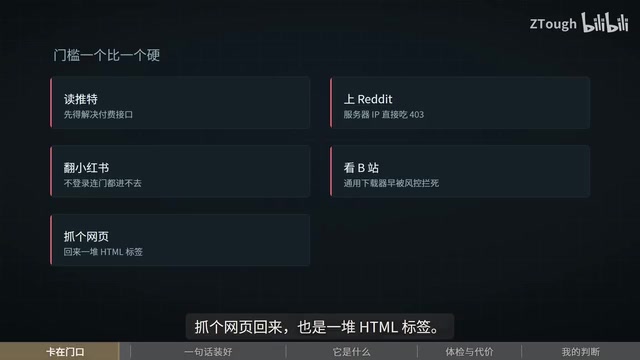
According to a Bilibili content creator, the open-source tool Agent Reach was built specifically to address this pain point. The way you use it is almost absurdly simple: paste the project's installation instructions directly to your Agent and tell it to "go ahead and install this." It handles the rest on its own.
16 Platforms, 5 Ready Out of the Box
Agent Reach currently supports 16 platforms, covering common information sources such as web scraping, YouTube subtitles, RSS feeds, general web search, and GitHub. Of these, five — web pages, YouTube subtitles, RSS, web search, and GitHub — require zero configuration and work immediately after installation.

The remaining platforms require an authenticated session — services like Twitter and Xiaohongshu that demand a Cookie or Token to access. Even here, you don't need to figure it out yourself. Just tell your Agent "help me configure this," and it will walk you through the setup step by step. The overall design compresses what is usually a painful and tedious process — getting an Agent online — into just a few natural language commands.
It's Not a Scraper — It's a Dispatch Layer
What truly sets Agent Reach apart from ordinary scraping tools is its role: it doesn't do the "fetching" — it handles the "routing." The actual data retrieval is delegated to existing underlying tools; Agent Reach is only responsible for four things: tool selection, installation, health checking, and routing.
In its design, each platform is backed by a prioritized list of backends. If the primary option fails, it automatically falls back to the next one. This "multiple backends + automatic fallover" mechanism is the key to handling the constant flux of platform API changes.
A textbook example: Bilibili's bot detection once completely blocked yt-dlp. For ordinary users, this meant their downloader suddenly stopped working and they had to diagnose and replace it themselves. But within Agent Reach's architecture, the user doesn't have to do a thing — the dispatch layer automatically switches to an available backend. Platforms change their rules without warning; in the past, you had to chase those changes yourself. Now the tool chases them for you.

A One-Command "Health Check"
To help users keep track of connectivity across platforms at any time, Agent Reach includes a built-in Doctor command. Run it once, and it tells you which platforms are reachable, which aren't, and which backend path is currently active. For workflows that rely on data from multiple platforms, this kind of observability saves a tremendous amount of guesswork and blind debugging.
The "dispatch layer" architectural concept is known in software engineering as the Adapter Pattern or Middleware. Its core value lies in fully decoupling the diversity of interfaces from the consumer's logic — the AI Agent on top only needs to know how to talk to the dispatch layer, without caring whether the underlying tool is yt-dlp, gallery-dl, or some dedicated API. The underlying tools can be swapped out at any time without changing a single line of the upper-layer logic. This is highly analogous to the role of an API Gateway in a microservices architecture: unified entry point, route distribution, and failover. For AI Agent workflows, this means the maintenance cost of platform adapters drops from O(Agents × Platforms) to O(Platforms) — the larger the scale, the greater the benefit.
Observability is a core concept in modern software operations, typically covering three dimensions: Logs, Metrics, and Traces. The connectivity check provided by the Doctor command is essentially a lightweight Health Check mechanism. In AI Agent workflows, silent failures in a data pipeline — where a tool errors out without any obvious alert — can cause an Agent to continue reasoning on empty or stale data, producing hallucinated outputs that are nearly impossible to trace back. A one-shot visibility report helps developers eliminate environmental issues before building a workflow, rather than reverse-engineering the problem after the Agent produces unexpected output.
Privacy and Cost: Almost Entirely Free
On the data security front, Agent Reach stores all Cookies and Tokens exclusively on the user's local machine — nothing is uploaded or transmitted. The code is fully open-source and available for independent auditing.
The cost profile is equally restrained: the only thing that costs money is running a proxy on a server, which amounts to roughly one dollar per month. If you're using it locally only, it's completely free.

As the creator puts it, the most valuable thing about this tool is that it holds down a cost that keeps going up. The real headache with tools like this was never the initial installation — it was the fact that every time a platform changed its rules, you had to update your setup manually. Agent Reach takes that ongoing maintenance burden off your hands. You just use it.
A Word of Caution
It's worth noting that platforms accessed via Cookie login (such as Twitter and Xiaohongshu) are capable of detecting scripted requests, which creates account risk. It's strongly recommended not to test with your main account, as it may trigger bot detection. The project link can be found in the description of the original video.
For developers building Agent workflows who are struggling with the "data can't get in" problem, Agent Reach offers a way to abstract away platform adaptation — rather than having every Agent project reinvent the wheel and individually chase API changes, a single unified dispatch layer can serve as the foundation. This is an infrastructure concern that's easy to overlook but increasingly critical as AI Agents move toward real-world utility.
Bot Detection typically relies on multi-dimensional signals evaluated in combination: the regularity of request frequency and timing intervals, the User-Agent string, Cookie creation time and behavioral history, TLS fingerprinting, and the absence of environmental characteristics a real browser would carry (such as JavaScript execution capability). Reusing Cookies to replicate a logged-in session can bypass username/password authentication, but request patterns that deviate too far from real users will still trigger detection. Once a platform flags anomalous behavior, the consequences range from rate limiting on the mild end to permanent account bans on the severe end — and those bans often happen after an account has accumulated significant content or social connections, making the loss difficult to recover from. Using a secondary or dedicated test account, kept strictly isolated from your main account, is standard engineering practice.
Related articles

ChatGPT Space Launches: Team Collaboration and New Pages Features Explained
ChatGPT Space is OpenAI's new team collaboration feature with Pages, real-time collaboration, and Slack/Google Drive sync. We break down its privacy design, multi-platform integration, and the full workflow from conversation to document.

Migrating Apache Spark UDFs to GPU Acceleration with AI Agents
NVIDIA developer blog explains how AI Agents rewrite Apache Spark UDFs for GPU acceleration, covering migration criteria, agent rewriting and verification workflows, plus pitfalls like result consistency and CPU-GPU transfer overhead.

Zed Editor v0.40.4-rc2 Released: Usage Credits Now Available Without Upgrading
Zed editor releases v0.40.4-rc2, allowing users to use usage credits for AI features without upgrading to a paid plan, lowering the trial barrier.