AI Agent Capability Levels: Using the Autonomous Driving L1–L5 Framework to Understand How Much AI Can Do for You

An L1–L5 framework maps AI Agents from Copilot autocomplete to full autonomy, clarifying where humans still matter.
A Bilibili creator applies the autonomous driving L0–L5 framework to AI, proposing an AIL1–AIL5 capability scale measuring AI autonomy versus human involvement. AIL1 is Copilot-style autocomplete; AIL2 is ChatGPT-style free conversation; today's mainstream sits at AIL3, where agents autonomously explore execution paths with 70–80% task success rates. L3's ceiling is its tendency to reproduce the most common training-data solutions, limiting innovation — domain experts unlock more by supplying targeted sub-directions. AIL4, where AI solutions surpass all human alternatives, has appeared in narrow fields like mathematical proof but generates outputs faster than humans can comprehend. For employment, L3 primarily displaces standardizable beginner tasks, L4 would shrink researcher headcount, and L5 would eliminate human participation in a field entirely.
Autonomous driving uses levels L0 through L5 to describe a spectrum from driver assistance to full automation. That same framework is now being borrowed to understand the evolution of AI Agents. A Bilibili content creator has proposed reexamining today's AI coding tools and research capabilities through an "AIL1 to AIL5" lens — fitting everything from Copilot autocomplete to multi-agent collaboration into a single, comparable framework. This analogy is more than a conceptual exercise. It gives a clear answer to a very practical question: how much can AI actually do for you right now, and where does it still need humans in the loop?
From Copilot to Multi-Agent Systems: A Unified Coordinate System
AI coding tools have proliferated rapidly in recent years — GitHub Copilot's autocomplete in 2021, the arrival of agents like Claude Code and OpenCode, and more recently multi-agent dynamic workflows and Codex's concurrent execution mode. These may seem like independent developments, but they can all be placed on the same capability curve for comparison.
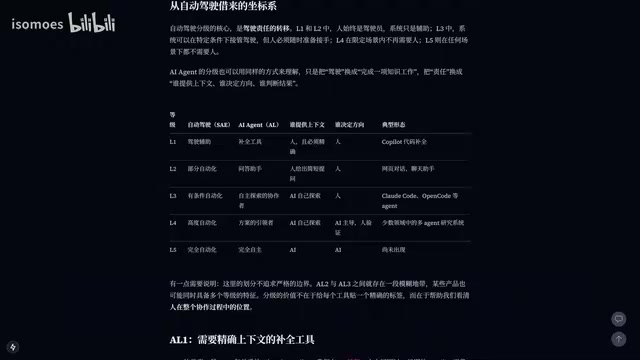
The creator's core argument is that borrowing the L0–L5 framework from autonomous driving allows us to "spread out" these technologies and see clearly where each one sits on the capability scale. The value of this framework lies in what it ignores — it doesn't get bogged down in model architecture, and instead approaches things from the user's perspective: how autonomously can AI operate, and how much does a human need to step in? That makes it far more relevant to developers' day-to-day experience.
AIL1 to AIL2: From Precise Autocomplete to Free-Form Conversation
AIL1 corresponds to the "assistance" level in autonomous driving. The archetypal example is Copilot-style code completion. Its defining characteristic is that humans must supply precise context — you write the opening of a for loop, provide an explicit function name and variable names, and only then can it fill in the relevant snippet. This kind of capability had already taken shape ten to twenty years ago.

AIL2 is marked by ChatGPT's rise to mainstream popularity in 2023. A user provides a brief prompt and the AI responds — even answering general knowledge questions in unfamiliar domains. Early on, accuracy was limited, but hallucination rates have dropped significantly since then. Today's mainstream web-based AI chat interfaces and e-commerce customer service bots remain at this level. Their responses follow relatively fixed paths, operating in a question-and-answer mode without proactively exploring context.
AIL3: The Autonomy of Agent Coding — and Its Ceiling
The creator considers 2025 the inaugural year of agents, with projects like OpenCode, Claude Code, and Codex launching in quick succession — marking the emergence of AIL3. The biggest difference from the previous level is a significant leap in autonomy: given a general direction, an agent can independently explore paths, invoke existing tools, and adjust its strategy when tools are unavailable or edits go wrong — all the way until it reaches the goal. This is the leap from "vibe coding" to "agent coding": the human sets the direction, and the agent handles the execution path in between.
Based on the creator's hands-on experience, when humans clearly describe the task boundaries (what can and cannot be done) and objectives, and when using the best publicly available models, the success rate for these kinds of tasks has already reached 70–80% or higher — well above 50%. The value of multi-agent execution and dynamic workflows lies precisely in allowing agents to explore more paths, reaching the goal faster and more accurately.

But AIL3 has a critical limitation. When given only a broad goal, an agent tends to decompose sub-tasks by defaulting to the most common, most established technical approaches in its training data. For engineering tasks this is a strength — it's reliable and solid. But for research-oriented or exploratory tasks, it actually diminishes innovation, because the agent always takes "the most well-traveled road" — in other words, the most mediocre solution.
This leads to a counterintuitive conclusion: owning AI is not the same as having AI's capabilities. An ordinary user who asks only a vague question gets AI's output in its "default state" — routine and unremarkable. Only domain experts who can supply targeted sub-directions and sub-goals can truly unlock AI's potential and produce results that outshine everyone else's. So at the L3 stage, AI is always a "collaborator" rather than a "leader" — who proposes and defines the approach is still entirely in human hands.
"Vibe coding" is a term coined by OpenAI co-founder Andrej Karpathy in early 2025. It refers to a workflow where users describe their intent in natural language without caring about the underlying code implementation details, driving AI to generate code entirely by feel (vibe). The key distinction from "agent coding" lies in the degree of autonomy of the executing party: in vibe coding, users still need to incrementally confirm the AI's output and provide the next instruction — it's essentially an enhanced form of Q&A. In agent coding, the AI autonomously formulates an execution plan, invokes a tool chain, validates intermediate results, and iterates in a loop. The human only needs to supply the goal at the start and perform acceptance testing at the end. Dynamic Workflow further extends this autonomy — unlike static processes with pre-fixed steps, an agent can dynamically decide at runtime which sub-agent or tool to invoke next based on current state, allowing the overall task path to adjust in real time as context evolves, achieving higher success rates on tasks with larger search spaces.
AIL4: When AI's Solutions Surpass Human Thinking
The dividing line between AIL4 and L3 is a shift in who owns the solution — AI produces approaches better than any a human could conceive. The most illustrative examples come from the AI4Math space: AI has made progress on certain Millennium-level problems, even producing proofs that are difficult for humans to understand or replicate independently. This is where AI's advantage truly comes into its own.

But AIL4 has so far only been achieved in a narrow set of domains and tasks, and the barrier to entry is extremely high. It requires a large number of agents running concurrently, and it requires that results can be self-verified by the AI — forming a complete "explore–verify" closed loop — with many prerequisites and high operating costs.
The deeper tension is this: AI's generation speed has far outpaced human comprehension speed. The novel solutions produced at L4 take enormous human effort to understand and translate into communicable knowledge. Some outputs can only be used by another AI operating at L4 — for humans, they're essentially inaccessible. The creator noted that there have recently been voices in the mathematics community calling for a slowdown in AI problem-solving, on the grounds that much of mathematics' value lies in producing knowledge that humans can actually understand — not in accumulating results that humans can't digest.
AI4Math (AI for Mathematics) is a frontier area drawing joint attention from academia and industry, with the goal of enabling AI systems to autonomously perform mathematical reasoning, conjecture generation, and theorem proving. Around 2024, DeepMind's AlphaProof and AlphaGeometry systems made significant advances on International Mathematical Olympiad (IMO)-level problems. At the same time, research teams have announced AI-assisted progress on sub-problems related to Hilbert's Problems — 23 classic mathematical problems posed by David Hilbert in the early 20th century, several of which remain unsolved. These systems typically rely on "formal proof verifiers" (such as Lean or Coq) as their self-verification closed-loop tools — proof steps generated by the AI must pass rigorous formal verification to be considered valid. This gives AI4Math a reliable "explore–verify" loop, and is precisely the structural reason why AIL4 has first manifested in the mathematics domain: the correctness of results can be determined automatically by machine, without relying on subjective human evaluation.
AIL5 and Self-Evolution: The Ideal of Full Autonomy
AIL5 is the ideal endpoint of this framework — a system where solving and maintaining tasks entirely eliminates human participation. Related to this is the currently buzzy direction of "self-evolution": AI autonomously iterating on itself, with the V1 model developing V2, V2 developing V3, independently identifying and fixing problems. However, the creator acknowledges that no obviously impactful events or reports on this front have emerged yet.
It's worth emphasizing that between each leap from AIL1 to AIL5, new problems emerge that require new technical solutions to address. This is not a smooth, straight line.
The Employment Impact Behind the Levels: New Entrants Are Hit First
The most practical value of this framework is in helping us see the differentiated impact AI has on different groups of people.
- AIL3 (present day): Primarily impacts newcomers to a field. For experts with decades of deep domain knowledge, L3 is an "accelerator" rather than a "replacement."
- AIL2 capability: Most tasks that newcomers can handle day-to-day sit at this level — and L2 success rates are already high, which is exactly why the situation is unfriendly for beginners.
- After AIL4 becomes widespread: If AI solutions consistently exceed what most human experts can produce, the number of researchers in a given field will shrink dramatically.
- After AIL5 is fully realized: That field can effectively "cease to exist" — no human participation needed at all.
The creator's conclusion carries a note of melancholy: most people in day-to-day work can achieve roughly L3 level — but if L4 truly arrives, "that direction is basically finished." For newcomers hoping to enter a field, today's AI capabilities are already sufficiently threatening. Improving your ability to wield L3 may be the most pragmatic response available right now.
This gradient of impact closely mirrors the "task substitution" framework in labor economics: technology doesn't replace entire professions — it replaces the specific, decomposable, standardizable tasks within those professions. Junior engineers and entry-level researchers tend to focus on executing clearly-specified sub-tasks — code completion, literature search, format conversion, common bug fixing — which are precisely the tasks AIL2 and AIL3 can already complete with high reliability. Senior experts, by contrast, derive their core value from problem definition, solution trade-offs, and cross-domain judgment — capabilities that still require vast amounts of tacit knowledge and domain experience, and are difficult for current AI to replicate in the short term. "Improving your ability to wield L3" therefore means, in practical terms: shifting your focus away from standardized tasks that AI can execute, and toward task decomposition, directional judgment, and outcome evaluation — continuously moving toward the role of "providing AI with well-defined sub-directions."
Conclusion
Using the autonomous driving L1–L5 framework to understand AI Agents offers a key insight that goes beyond "how powerful is AI" — it helps us see exactly which layer the boundary of human-machine collaboration is shifting at. Today's mainstream sits at L3: humans set the direction, AI executes, serving as a powerful collaborator but not yet a decision-maker. The real inflection point is L4: once AI solutions systematically surpass human thinking, the entire logic of knowledge production in a field will be rewritten. Until that day arrives, the ability to give AI well-defined sub-directions remains the crucial factor that separates people from one another.
Related articles

Gemini 4 Argon Hands-On: AI Builds Board Games, Constructs Temples, and Trains Robots Autonomously
Gemini 4 Argon hands-on roundup: AI autonomously builds a desk racetrack and temple in Blender, writes a ray tracing engine, trains a humanoid robot to sink 7 shots, plus API pricing and developer access.

The Magic Octagonal Coin: Why Only 9% of People Can Predict Its Flip?
Only 9% of people can correctly predict the Magic Octagon coin flip. This article explains its spatial rotation mechanism, common cognitive pitfalls, and a new hypothesis based on Relevance Theory, exploring the limits of human spatial reasoning.

Sam Altman: AI Is Entering the Era of Scientific Discovery — Math Breakthroughs Will Replicate in Biology and Energy
Sam Altman says AI is entering the era of scientific discovery — math breakthroughs will replicate in biology, materials science, and energy to help develop new drugs and energy sources.