AI Agent Core Principles Explained: The Decision Loop and Three-Component Architecture

AI Agents upgrade LLMs from chat tools to autonomous digital employees via planning, memory, tools, and action.
AI Agents essentially quantify human problem-solving logic into programs. Unlike LLMs that can only passively answer questions, AI Agents possess four core components—tool calling, memory storage, task planning, and autonomous action. Through a Sense-Plan-Act-Observe decision loop with continuous error correction, they can independently decompose complex tasks and execute them, achieving a true evolution from "brain only" to "brain plus body."
Introduction: From Chat Tool to Digital Employee
Many people use large language models (LLMs) daily, crafting elaborate prompts, yet AI still stumbles when facing complex tasks. The root cause is that most people treat LLMs as nothing more than advanced Q&A chatbots. The real differentiator isn't being good at writing prompts—it's understanding AI Agents. Those who do have already equipped LLMs with "hands and feet," transforming them into fully autonomous digital employees.
This article breaks down the core technical principles of AI Agents from the ground up, helping you understand this key concept that's reshaping how AI is applied.
What Is an AI Agent? The Fundamental Difference from LLMs
From "Brain Only" to "Brain Plus Body"
In one sentence: an AI Agent quantifies human thinking habits into a program. A standard LLM is like a "one-track mind"—you feed it an input, it thinks for a moment, then outputs a block of text. That's it.
A true AI Agent is completely different. Beyond perceiving the external environment, it goes through a complex intermediate process: reviewing past memories, planning tasks, calling external tools, and finally converting everything into actual actions. Put simply, it's not a typewriter that just chats with you—it's a digital employee that can autonomously understand and handle complex tasks.
Here's a vivid analogy: suppose the task is "hammer a nail into a wall." A pure LLM's approach is to overthink—what angle should the nail tilt at? How much force should be applied?—but no matter how perfect the reasoning, the nail never goes in, because it has a brain but no hands. An AI Agent's approach is: plan → grab the hammer → hold the nail steady with the left hand → swing with the right hand. Planning the sequence, picking up tools, acting step by step—that's the core difference between an AI Agent and a plain LLM.
The Four Core Components
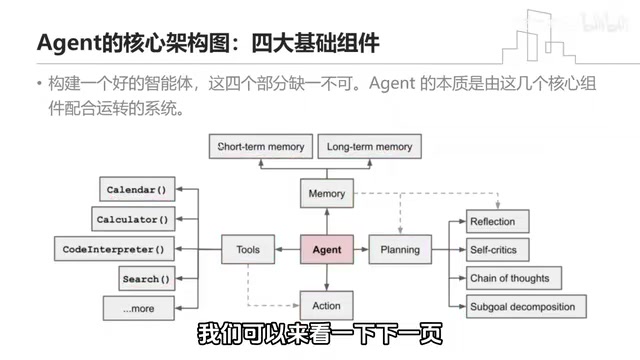
Building a truly effective AI Agent requires four foundational components working together—none can be missing:
- Tools: Calendars, calculators, code executors, search engines, etc.—essentially giving the LLM a connected smartphone
- Memory: Divided into short-term and long-term memory, enabling it to remember what you said a second ago or the preferences you set last month
- Planning: Includes chain-of-thought reasoning, task decomposition, and self-reflection—so it doesn't try to bite off more than it can chew when facing big problems
- Action: All thinking must ultimately translate into real-world operations
The AI Agent Decision Loop: Sense-Plan-Act-Observe
At its core, an AI Agent operates as a closed loop of continuous error correction and iterative optimization:
Step 1: Sense — Receive input from the external environment and figure out what the user is actually asking
Step 2: Plan — The brain kicks into high gear, decomposing the big task into step one, step two, step three
Step 3: Act — Pick up the tools and execute the first planned sub-task
Step 4: Observe — Check whether the feedback from the external environment after execution is positive or negative
The critical branching point: if feedback is positive, continue executing the next planned step; if feedback is negative (task failed or errors encountered), the Replan mechanism triggers—pause, reflect, revise the subsequent plan, then act and observe again. This loop keeps running until the task is fully completed.
Practical Walkthrough: Smart Home Scenario
Let's use "adjusting indoor temperature based on family members' needs" as an example to see how an AI Agent operates step by step:
Sensing Phase
You come home from work and irritably shout: "Can you turn up the temperature? I'm freezing to death!" An advanced Agent doesn't just understand the literal meaning—it performs sentiment analysis, picks up on your strong dissatisfaction, and immediately prepares a quick response with a soothing tone.
Planning Phase
The Agent combines memory for a comprehensive assessment: current room temperature is 20°C; historical data shows that last winter, when you weighed 60kg, you typically set it to 29°C; but recently you've gained weight to 80kg, which might mean you're relatively more heat-sensitive now. After comprehensive evaluation, it decides to first set a compromise of 26°C and generates a voice response script.
Action and Observation Phase
It controls the AC to rise to 26°C while announcing: "I've raised the temperature to 26°C. Please wait a moment—the room will gradually warm up." Then it continuously monitors the environmental temperature changes and waits for user feedback.
If you still feel cold after five minutes, the Replan mechanism triggers—the Agent reflects that "26°C was too conservative," adjusts its strategy to incrementally increase the temperature, and keeps looping until it receives satisfactory feedback.
Deep Dive into the Three Core Components of AI Agents
Component 1: Planning — From Chain of Thought to Tree of Thought
Planning capability is the cerebral cortex of an AI Agent. It boils down to two points: how to break big tasks into small ones, and how to reflect and adjust when errors occur during execution.

LLM planning capabilities have evolved through four stages:
1. Basic Input-Output: Straightforward—given an input, directly produce an output. Complex tasks inevitably fail.
2. Chain of Thought (COT): Introduces the "think step by step" instruction, making the model decompose problems into multi-step reasoning. Accuracy improves dramatically, but the fatal flaw is it's a one-way street—if one step goes wrong, everything downstream collapses.
3. Self-Consistency: Generates multiple chains of thought simultaneously and takes the majority vote as the answer. It's like having four experts solve the same problem and picking the most common answer. But there's a "herd mentality" risk—three incorrect chains can overpower one correct chain.
4. Tree of Thought (TOT): The current strongest approach. At each step, multiple branches are generated and self-scored. If a path is predicted to be a dead end, a backtracking mechanism triggers, returning to the previous node to make a different choice. It combines breadth and depth of foresight while knowing when to backtrack and correct errors.
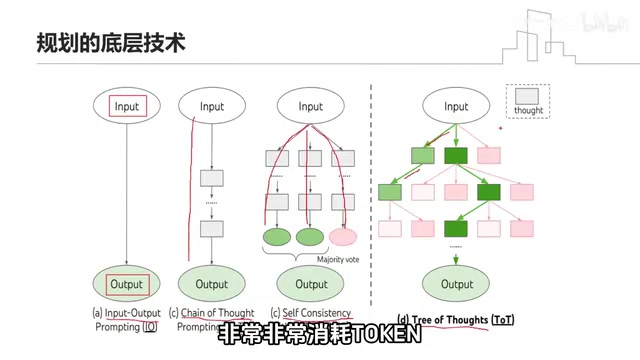
Of course, the trade-off with Tree of Thought is massive computational overhead and heavy token consumption, making it expensive. In real-world development, you need to choose the appropriate reasoning strategy based on task complexity.
Component 2: Memory — From Short-Term to Persistent Storage
To understand an AI Agent's memory mechanism, you can draw an analogy to human memory levels:
- Sensory memory: Disappears in seconds—like background details while scrolling short videos
- Short-term/Working memory: Active during the current task—like remembering a package pickup code for a few seconds
- Long-term memory: Divided into explicit memory (conscious recall) and implicit memory (muscle memory)
The corresponding memory types in AI Agents:
Innate memory: The massive internet data force-fed to the LLM before deployment, stored in parameter weights—never forgotten.
Short-term memory: The context—instructions and tool return results during a conversation stored in temporary variables. But once the program closes or the browser refreshes, the memory is completely wiped.
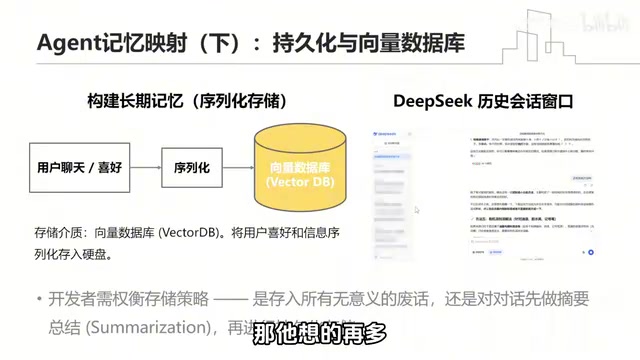
Long-term memory (persistent): This is currently the core technical challenge in building AI Agents, typically requiring vector databases (VectorDB). The principle is to convert chat history and personal preferences into vector encodings through serialization and store them on disk. In the next conversation, relevant memories are "retrieved" from the database and fed back to the brain.
In practice, there's also a strategic trade-off: you can't store every user conversation in an expensive database. Typically, before storage, the LLM summarizes the conversation, distills core information, and then persists it—saving space while improving retrieval precision.
Component 3: Tools — Equipping the Agent with Hands and Feet
Tool calling is the key capability that distinguishes AI Agents from plain LLMs. Tools used in current development fall into three broad categories:
Pre-built tools: Ready-made capabilities officially packaged by LLM providers, such as web search and code interpreters—plug and play.
Custom tools: Built by developers to meet internal enterprise needs, wrapping internal API endpoints as specific tools. Examples include querying company attendance records or pulling ERP financial data.
Tool collections: "All-in-one suites" provided by frameworks like LangChain or cloud services like Microsoft Azure, containing dozens or even hundreds of ready-made tools. Once connected, an Agent's capabilities are instantly enriched.
Why do LLMs with billions of parameters still need external tools? Because they need to compensate for three critical shortcomings:
- No real-time information: Knowledge is frozen at the training cutoff date—they can't know today's weather or news
- Inability to perform precise calculations: LLMs are essentially "liberal arts students" that rely on probability to generate text—complex math is error-prone
- No access to proprietary information: They can't possibly know your personal bank balance or confidential corporate data
Through Function Calling technology, AI Agents can autonomously determine when to invoke which tool, thereby breaking through these limitations.
Conclusion: AI Agents Are Essentially Quantified Human Thinking
An AI Agent is far more than a pile of cold code. Its essence is a complete quantification of human problem-solving logic—replicating our instinctive reactions when encountering problems (perceive the environment → plan and decompose → execute actions → observe and reflect) onto machines.
It's precisely because of this Sense-Plan-Act-Observe decision loop mechanism that LLMs have truly broken free from the passive "poke it and it responds" chatbox paradigm, evolving into intelligent agents capable of autonomously handling the complex external world. Once you understand this underlying logic of AI Agents, no matter what new concepts emerge in the market, you'll be able to see right through to their skeleton.
Related articles
Deep Dive into AI Agent Skill Design: …
Deep Dive into AI Agent Skill Design: Engineering Practices from Anthropic and Perplexity
A deep dive into Skill design philosophy from Anthropic's Claude Code team and Perplexity's Agent team, covering the Tax Test, Gotchas Flywheel, progressive disclosure, and Eval-First practices for building high-quality AI Agent skill systems.
Deep Dive into OpenAI's Official GPT-5…
Deep Dive into OpenAI's Official GPT-5.6 Prompting Guide: The Shift from Manual to Automatic
A deep dive into OpenAI's official GPT-5.6 Sol prompting guide: conciseness-first, outcome-oriented design, autonomy boundaries, tool routing, and reasoning intensity tuning.
 Deep Dives
Deep Dive into How OpenClaw (Open-Source Crayfish) AI Agent Works
Deep analysis of OpenClaw AI Agent internals: System Prompt, tool calling, SubAgents, Skill system, memory, and Context Engineering explained.