AI Agent Developer Job Hunt Guide: Four Hard Standards to Clear Before You Apply
Hit four concrete standards — working project, debuggable issues, explainable design, survivable interviews — then apply.
This guide tackles the decision paralysis around AI Agent developer job applications by offering a practical, four-part framework: project runs, problems debuggable, solution explainable, and interview follow-ups survivable. It covers the right depth of Python/Linux basics, must-know Agent concepts like Function Calling and Memory, how to build business-grounded projects beyond shallow API demos, engineering details to shore up, and how to use real interview feedback — not endless prep — as the fastest path to an offer.
During fall recruiting season, many candidates who want to apply for AI Agent developer roles get stuck in a mental loop: How much do I actually need to know before submitting my resume? This kind of second-guessing often drags on until spring recruiting as a backup. The more realistic take is this — people who land offers aren't the ones who've learned everything; they're the ones who hit the baseline and went for it. This article breaks down the core logic for landing an Agent role into four measurable standards: project runs, problems debuggable, solution explainable, and interview follow-ups survivable.
Foundations: Good Enough, Not Exhaustive
A lot of people start by trying to master the underlying theory, and end up burning all their time going deep instead of broad. For job hunting purposes, your foundation just needs to be "good enough."
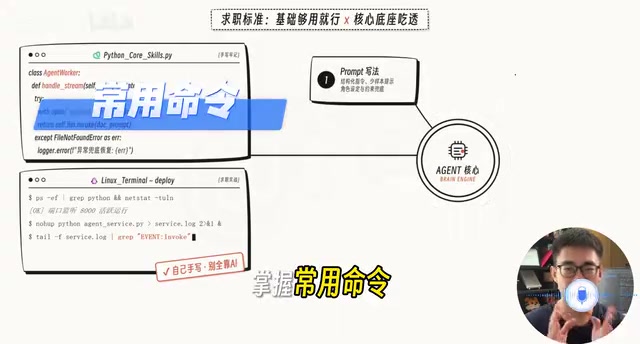
Python is non-negotiable — functions, classes, file I/O, exception handling. You need to be able to write these yourself, not rely entirely on AI autocomplete. On the Linux side, knowing common commands, being able to deploy a project, and reading logs to debug is more than enough for most interview scenarios.
What you actually need to know cold are the core Agent concepts: how to write effective Prompts, how Function Calling (tool invocation) works, and the Memory mechanism. You need to be able to explain what each does and when to use it. These are the knowledge points that distinguish Agent roles from general development roles — and exactly where interviewers tend to probe.
Function Calling is the core mechanism by which large language models interact with external systems. Developers pre-define a set of functions — their names, parameter structures, and descriptions — and the model decides at inference time whether to invoke one, outputting a structured call instruction (e.g., in JSON format). The application layer then executes the call and feeds the result back to the model. This is what lets an Agent query databases, call APIs, and run code, rather than just "talk." The Memory mechanism addresses conversational state management, typically divided into short-term memory (the current session's context window) and long-term memory (vector database retrieval). The former maintains coherence within a single conversation; the latter enables cross-session knowledge accumulation and personalization. Understanding the principles and limitations of both mechanisms — such as context window length constraints and fallback strategies when tool calls fail — is a high-frequency interview topic for Agent roles.
Ditch Shallow Demos — Build Projects with Real Business Grounding
If your resume only says "connected to a large model API and built a chat UI," interviewers will largely tune out. Companies aren't looking for someone who can wire up an API call; they want someone who can ship something that works in a real business context.
Take a customer service Agent as an example. A compelling walkthrough should cover: when to query the knowledge base vs. call a tool API, what to do when an API call fails, how to handle model hallucinations, and how to escalate to a human agent when the system can't resolve the issue. These design decisions are what demonstrate engineering judgment — and they're the dividing line between a toy project and a production-ready system.
In other words, a project's value isn't in how fancy the model is. It's in whether you can clearly explain an end-to-end business workflow, including how edge cases and failure paths are handled.
The "complete pipeline" design for a customer service Agent typically centers on a key architectural decision: the coordination between RAG (Retrieval-Augmented Generation) and tool calling. RAG retrieves relevant document chunks from a private knowledge base and injects them into the Prompt, addressing the model's knowledge gaps. Tool calling triggers real-time operations — like querying order status or submitting a support ticket. Being able to clearly articulate "which problems go through RAG, which scenarios trigger tool calls, and how to arbitrate when they conflict" demonstrates system design thinking rather than just "gluing libraries together." Fallback and degradation strategies matter just as much: when a tool API times out, do you retry or skip? When knowledge base retrieval has low recall, do you fall back to a canned response or escalate to a human? How you handle these edge cases often reveals more about a candidate's production environment intuition than the happy path does.
Fill the Engineering Gaps — Don't Just Know How to Run Code
A common reason candidates study for months and still fail interviews: they can get the project running, but can't hold up under detailed questioning.
Engineering gaps to fill include: exception handling, logging, retry logic, and evaluation. None of this needs to be sophisticated — but you need to understand the principles and be able to articulate them. Interviewers typically don't ask "what does your project do?" They ask "why did you design it this way?" and "what happens when it breaks?" The gap between candidates who can answer and those who can't is immediately obvious.
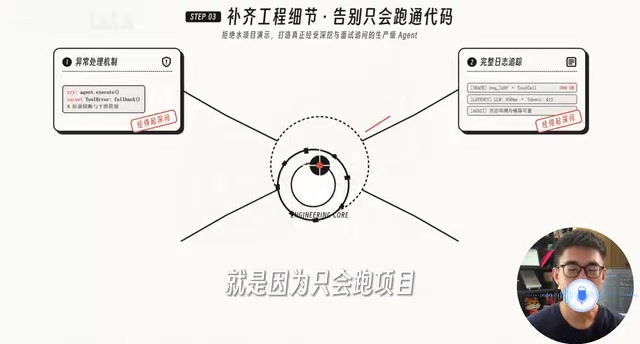
A useful self-check: for every technical item on your resume, make sure you can answer three questions — why did you use it, why not another approach, and how would you debug it if something went wrong? If you've internalized these three, you'll stay calm through most technical deep-dives in interviews.
Don't Abandon Your Roots: Databases, APIs, and Algorithmic Fluency
Agent roles may be a newer direction, but traditional development fundamentals still come up. Databases and API design are still fair game.
For algorithms, Agent roles tend to test foundational hand-coding problems — you don't need to grind competitive programming, but you do need to stay sharp enough that you don't blank on basic problems under pressure.

From a career trajectory standpoint, Agent-adjacent roles typically branch into two paths: CV (Computer Vision) and NLP (Natural Language Processing). Each requires a different set of model knowledge. Deciding which track you want before job hunting, then filling in the corresponding gaps, is far more efficient than spreading yourself thin across both.
CV (Computer Vision) and NLP (Natural Language Processing) are the two mainstream technical tracks in AI engineering, with notably different core model requirements. NLP is built on the Transformer architecture — you need to understand pretrained language models (e.g., BERT, GPT series), fine-tuning methods (e.g., LoRA, Prompt Tuning), and text vectorization (used in semantic retrieval for RAG). CV focuses on convolutional neural networks, object detection (YOLO series), image segmentation, and related techniques. Agent roles today are predominantly NLP-oriented, but multimodal Agents that handle both text and image inputs are rapidly gaining traction, making basic familiarity with visual encoders increasingly valuable. Picking a direction early helps you avoid the common trap of being shallow in both areas — and getting nowhere in interviews as a result.
Four Standards and the "Apply While Iterating" Strategy
To sum everything up in one sentence: foundation good enough, project grounded in real business logic, engineering solid, able to withstand follow-up questions. Once you hit this bar, send the resume.

One mindset point worth emphasizing: fall recruiting doesn't wait. Applying and iterating in parallel is far more effective than perfecting your preparation in isolation. Interviews themselves are the best feedback loop — wherever you get pressed hard, whatever project detail you can't answer, go fix that specifically. It's more efficient than studying in a vacuum until you feel "ready." According to the content creator referenced here, a large share of their students are career switchers, with coaching support covering research, resumes, and job placement provided by a team of technical instructors. This is institutional recruiting information — take it as a reference point, but remember: what actually matters is whether you meet the four standards above.
Summary
The real barrier for AI Agent developer roles isn't "how much have you learned" — it's "can you hold up under real scrutiny on both business logic and engineering details." Python and Linux foundations just need to be functional. Put your real effort into Agent core mechanisms, business-grounded project design, and engineering details, while maintaining your baseline in databases, APIs, and algorithms. Hit the bar and apply. Let real interview feedback drive targeted improvement — that's a more practical strategy than preparing indefinitely.
Related articles
$20/Month vs. $5M/Year: The Fundamental Difference Between Cursor and Blitzy
Cursor at $20/month vs. Blitzy at up to $5M/year: a Grafana 3M-line codebase test reveals how these AI coding tools differ in context, work unit, and production readiness.
Factoriax: A GPU-Parallelized Factory-Building Reinforcement Learning Research Environment
Factoriax is a GPU-parallelized RL research environment inspired by Factorio, focused on long-horizon planning and high-throughput sampling for complex factory-building simulations.
Matt Pocock Skills Deep Dive: Turning AI Coding from Chat into Engineering
Matt Pocock Skills transforms AI coding into an engineering workflow: requirements discussion, SPEC generation, task breakdown, TDD implementation, and code review — solving vague requirements and repeated bugs.