AI Agent Developer Toolchain: Code Search, Diff Viewing & K8s Config Generation in Practice

Tech roundup covering AI code search, local note-taking, and other practical developer tools
This tech roundup introduces several developer tools. Symbol is a code search library designed for AI Agents that combines Tree-sitter syntax parsing with BM25+Embedding hybrid retrieval, saving 98% of Token consumption compared to traditional approaches and supporting multiple deployment modes including MCP Server. Filess AMD is a counter-trend local Markdown note-taking app that advocates simple chat-style input, rejects complex "Second Brain" systems, and returns focus to thinking itself.
This week's tech roundup focuses on several practical tools designed for developers and AI Agents—from code search to note-taking apps, from GitHub Diff optimization to Kubernetes config generation—each addressing real pain points in today's development workflows.
Symbol: A Code Search Library Designed for AI Agents
Symbol is a code search library built specifically for AI Agents, claiming to save 98% of Token consumption compared to traditional grep + ripgrep approaches. The core technology behind this number is Tree-sitter syntax parsing—it refines search granularity to semantic units like functions and classes, rather than simple line-level matching.
Tree-sitter was originally developed by GitHub engineers and has become a core dependency of modern editors like Neovim and Helix. It parses source code into a Concrete Syntax Tree and performs incremental updates when code is modified, natively understanding semantic boundaries like "function bodies," "class definitions," and "parameter lists." For AI Agents, this means when they need to understand a function's implementation, Tree-sitter can precisely return the complete function body rather than truncated line fragments, dramatically reducing hallucinations caused by incomplete context.
On top of Tree-sitter, Symbol layers BM25 lexical retrieval and lightweight Embedding for hybrid ranking. BM25 is a classic information retrieval algorithm that calculates relevance based on term frequency and inverse document frequency with extremely low computational cost; Embedding vector retrieval can capture semantic similarity but suffers from "semantic drift." Hybrid retrieval combines both—using BM25 to ensure recall for exact function name matches and Embedding to supplement semantic understanding—which is the mainstream practice in current RAG systems. The result is an average indexing time of 250 milliseconds per repository and just 1.5 milliseconds per query.
Deployment is also flexible enough—it can be integrated into existing workflows as an MCP Server, CLI tool, or Python library. MCP (Model Context Protocol) is an open protocol released by Anthropic in late 2024 that defines standardized interaction between AI models and external tools. Symbol's support as an MCP Server means any MCP-compatible AI Agent (such as Claude Desktop, Cursor, etc.) can directly invoke its code search capabilities without additional integration work.
Over the past year, solutions for helping Agents efficiently read code have roughly split into two camps: pure vector retrieval with unstable precision, or pure grep that burns through Tokens. Symbol's deep investment in Tree-sitter represents a compelling middle ground worth watching. Syntax trees naturally correspond to code's structural boundaries, returning more complete and usable snippets—far more reliable than relying on Embeddings to "guess" semantics. As Agents operate more frequently within codebases, this type of precise, low-cost code search tool will become an infrastructure-level necessity.
Filess AMD: A Back-to-Basics Local Markdown Note-Taking App
Filess AMD is a fully local Markdown note-taking application—data never touches the cloud—offering both web and desktop interfaces. It includes built-in structural modules for notes, journals, todos, and habits, but doesn't force their use. Its core philosophy is using chat-style input to quickly capture thoughts, then building a knowledge network through links.
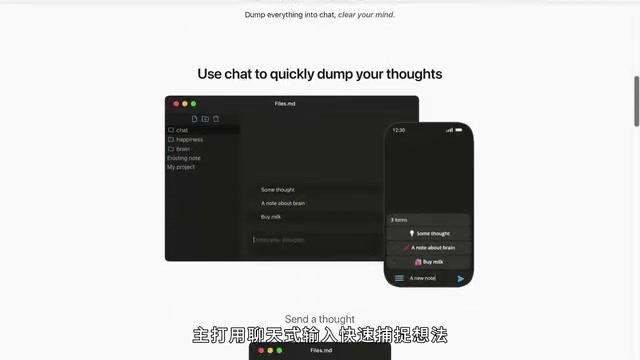
To understand Filess AMD's positioning, you need to understand the PKM (Personal Knowledge Management) tool ecosystem it pushes back against. Roam Research pioneered the bidirectional linking concept around 2020, sparking industry-wide adoption: Obsidian centers on local Markdown files with an extremely rich plugin ecosystem; Logseq focuses on outline-style structure and block-level references; Notion differentiates through databases and collaboration. Together, these tools spawned the "Second Brain" methodology, emphasizing structured storage of external information through frameworks like PARA. However, as tool features continuously expanded, "setting up the system" itself became a new source of productivity anxiety—users spending enormous time optimizing workflow templates and debugging plugins rather than actually thinking and creating. This phenomenon is known as "Tooling Procrastination."
Against this backdrop, Filess AMD takes a decidedly counter-trend stance. Its website explicitly opposes complex "Second Brain" systems, arguing that the more sophisticated the system, the less actual thinking occurs. While this viewpoint is radical, it genuinely hits a nerve for many users—exhausted by plugins, bidirectional links, and templates, spending more time "managing the system" than actually thinking.
Related articles
 Industry Insights
IRS Fully Embraces Claude AI, Accelerating Federal Government's AI Adoption
The IRS is recruiting staff with 24/7 Claude AI access, marking Anthropic's breakthrough into the federal government. Explore the strategic implications and tax use cases.
 Industry Insights
Nadella Introduces the Loopcraft Framework: Building AI Ecosystems Through Feedback Loops
Microsoft CEO Satya Nadella's Loopcraft framework explains how to build frontier AI ecosystems through nested feedback loops across technology, business, and ecosystem dimensions.
 Industry Insights
OpenAI's Internal Codex Usage Surges 56x — AI Coding Is Eating Everything
OpenAI reveals internal Codex usage data: Research up 56x, Customer Support 32x, Engineering 27x, Legal 13x since Nov 2025. AI coding tools are penetrating every department faster than expected.