AI Agent Development for Beginners: A Three-Phase Learning Path Breakdown

A structured breakdown of a beginner-to-advanced AI Agent course on Bilibili, with practical evaluation tips.
This article breaks down a Bilibili AI Agent development course structured across three phases: environment setup and basics, intermediate topics like RAG and tool calling, and hands-on project building. While introducing the course framework, it maintains a critical perspective on marketing claims like "zero to expert in seven days" and offers four practical criteria for evaluating any AI Agent tutorial. Ideal for readers exploring entry points into AI Agent development.
What a Zero-to-Hero AI Agent Course Actually Covers
This is an introduction to a series of AI Agent (intelligent agent) development tutorials published on Bilibili. The creator describes approaching the entire knowledge domain from the perspective of an "AI Agent beginner," spending roughly a month browsing existing Agent tutorials online — and concluding that most content is "neither thorough nor detailed enough." That dissatisfaction became the motivation for building a more systematic course from scratch.
In terms of positioning, the course emphasizes two core promises: accessible to complete beginners and hands-on enough to follow along. The creator notes that three months went into preparation, with the goal of helping learners genuinely master AI Agent skills through case demonstrations and practical exercises — not just accumulate abstract concepts.
To be transparent: the source material here is primarily the course's promotional and introductory segment, with no deep dive into technical specifics. This article therefore focuses on unpacking the course's learning path design, supplemented by a general knowledge framework for the AI Agent field — useful for readers who are just getting started.
The Three-Phase Structure: Fundamentals, Intermediate, and Hands-On
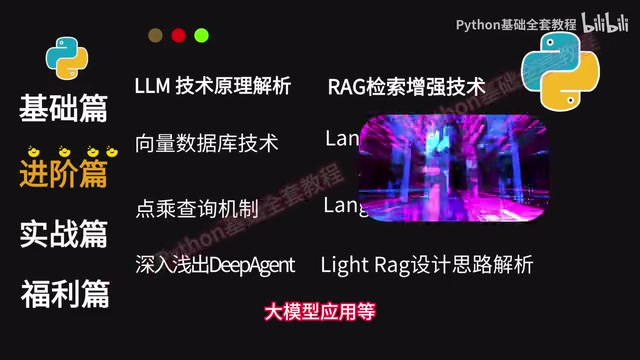
The course is divided into three parts. This "shallow to deep" layered approach is standard practice for most technical courses today.
Phase 1 — Fundamentals: Environment Setup and Basic Applications
The fundamentals phase focuses on "step-by-step installation and learning basic AI Agent applications." For beginners, this typically covers setting up a development environment, obtaining API keys, and understanding the basics of calling large language models. These seemingly trivial steps are exactly where many beginners get stuck and give up — so dedicating a dedicated chapter to them is a sensible decision.
Phase 2 — Intermediate: RAG, Agent Training, and LLM Applications
The intermediate phase introduces several core concepts worth unpacking:
- RAG (Retrieval-Augmented Generation) knowledge bases: By vectorizing and storing external documents, RAG allows a large model to retrieve relevant content before generating an answer. This is the leading approach for addressing LLM hallucinations and knowledge staleness.
- Agent practical training: This covers how to give a model the ability to plan, call tools, and perform multi-step reasoning — the key traits that distinguish an Agent from a standard chatbot.
- LLM applications: Focused on integrating large models into real-world business scenarios.
This phase carries the highest technical weight in the entire course and is where the most "practical value" lies.

Tool Use / Function Calling is another foundational pillar of Agent capability and deserves its own explanation. Large models on their own can only generate text — but through tool-calling mechanisms, a model can actively trigger external functions during reasoning: searching the web, executing code, querying a database, or calling a third-party API. Major frameworks like LangChain, LlamaIndex, and OpenAI's Assistants API all have this built in. In practice, a typical Agent execution loop looks like: receive user instruction → determine whether a tool call is needed → call the tool and retrieve the result → incorporate the result back into context and reason again → repeat until the task is complete. This "Think-Act-Observe" loop (the ReAct pattern) is currently the most dominant Agent architecture paradigm, and it's the underlying logic behind the "multi-step reasoning" and "planning capability" covered in the intermediate phase. Understanding this loop helps learners make sense of the design intent behind framework code in real projects.
Phase 3 — Hands-On: Building Your First Intelligent Agent Project from Scratch
The hands-on phase promises to walk learners through "from environment setup to completing their first intelligent Agent project." For beginners, successfully running a complete end-to-end project delivers far more confidence and satisfaction than absorbing scattered concepts in isolation.
Bonus Materials: Useful or Just Marketing Bait?
The course includes a bonus section with a beginner's mind map, a learning resource pack, assets, e-books, videos, and more — available by leaving a comment. This type of "resource bundle" is extremely common in educational videos and has understandable appeal for newcomers.
That said, whether these materials actually help depends entirely on whether they're coherent and complement the course content. A pile of loosely collected resources often creates the illusion that "saving = learning." The practical advice: keep your primary focus on following along and doing the hands-on work in the videos. Use the materials as supplementary reference, not a substitute.
How to Evaluate Whether an AI Agent Tutorial Is Worth Your Time
Based on the messaging around this course, here are four practical filters for anyone looking to get started:
- Check for a complete, runnable project: A solid Agent tutorial should include end-to-end examples, not just API call walkthroughs.
- Check that RAG and tool calling are covered: These two are core Agent capabilities. A course that omits them can hardly claim to teach "intelligent agent" development.
- Be skeptical of exaggerated titles: Phrases like "most comprehensive on the entire internet" or "zero to expert in seven days" are mostly marketing copy. Actual learning outcomes depend on personal effort.
- Check how up-to-date the content is: LLMs and Agent frameworks evolve extremely fast. Whether the tutorial keeps pace with the current toolchain matters a lot.
It's also worth familiarizing yourself with the current mainstream tool ecosystem before committing to a learning path. LangChain is the most active Agent development framework in the community, with built-in modules for model calls, tool integration, and memory management — and plenty of beginner resources. LlamaIndex is more focused on RAG use cases, making it ideal for projects that involve heavy document and knowledge base processing. AutoGen (from Microsoft) and CrewAI support multi-agent collaboration, suited for building more complex task pipelines. Frameworks iterate quickly — if a course is still teaching half-year-old API versions, you'll likely run into a wall of breaking changes when you try to follow along. Beyond evaluating course quality, it's worth keeping an eye on the official documentation and GitHub changelogs of whichever framework you're learning, and using them to cross-check what the course teaches.
Closing Thoughts
This Bilibili AI Agent tutorial series follows the classic "fundamentals → intermediate → hands-on" structure and covers key topics including RAG, Agent training, and LLM applications — making it a reasonable starting point for complete beginners. That said, claims like "become an expert in seven days" or "the most complete course online" are more clickbait than substance. Real learning outcomes come from systematic practice and sustained effort. If you're looking to break into AI Agent development, treat this as a starting point — then reinforce your skills with official documentation and real projects.
Related articles

Chain of Thought Isn't Just for AI: How Humans Can Use CoT to Improve Thinking Quality
Chain of Thought isn't just a prompt trick for large models. Starting from a Hacker News discussion, this article analyzes why CoT works for human thinking too, breaks down actionable ways to transfer it, and highlights the key differences between human CoT and machine CoT.
Cloudflare Teams Up with OpenAI: Closi…
Cloudflare Teams Up with OpenAI: Closing the Loop from Vulnerability Discovery to Defense with AI
Cloudflare uses OpenAI Daybreak to investigate security vulnerabilities and generate reviewable remediation plans, while developers use Codex to boost coding efficiency and quality.

Orca Multi-Agent Orchestration in Practice: A Guide to Parallel Collaboration with Claude and Codex
Orca is Stable AI's free open-source agent workbench supporting 34 agents like Claude Code and Codex in parallel. Learn its Git worktree isolation, multi-model orchestration, and mobile management.