AI Agent Development Learning Path: Four Stages from Zero to Hands-On Projects
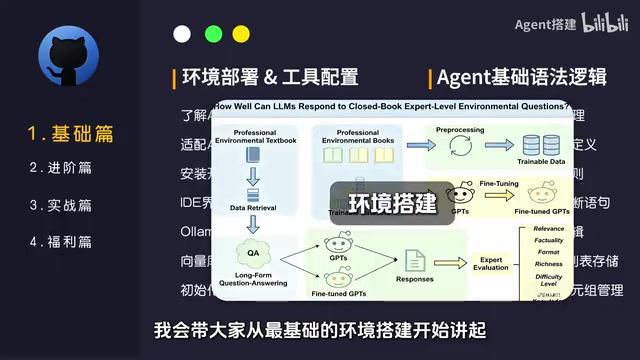
A four-stage AI agent development roadmap from zero foundation to hands-on projects.
This article outlines a clear AI agent development learning path across four stages—Fundamentals, Advanced, Practical, and Bonus—covering core principles, prompt engineering, RAG knowledge bases, tool use, multi-agent collaboration, and real-world projects, while objectively assessing the value and limitations of systematic courses.
Why AI Agents Are Becoming the New Learning Hotspot
As large language model capabilities continue to leap forward, AI agents have evolved from a technical concept into genuinely productive tools. They no longer merely answer questions—they can autonomously call tools, retrieve knowledge, manage memory, and even collaborate with other agents to complete complex tasks. This shift from "conversation" to "action" is precisely the core direction of current AI application deployment.
Understanding this shift requires tracing the evolution of agent technology. From expert systems in the 1980s that relied on manually written rule bases (such as the medical diagnosis system MYCIN), to reinforcement learning agents in the deep learning era that excelled in specific domains like Go but lacked generalization ability (such as AlphaGo), to today's LLM-driven agents—the true paradigm breakthrough lies in this: large language models, for the first time, enable a single model to understand arbitrary natural language instructions and transfer across domains without requiring separate training for each task. This is what fundamentally made "general-purpose agents" an engineering reality rather than merely a laboratory concept.
This shift has profound technical roots. The leap of large language models from GPT-3 to GPT-4, Claude, Gemini, and other new-generation models is reflected not only in parameter scale but more importantly in qualitative changes in reasoning, instruction following, and tool-use capabilities. Researchers call this phenomenon Emergent Abilities—when a model's scale exceeds a certain critical threshold, certain capabilities that previously did not exist at all suddenly emerge, such as multi-step reasoning, code debugging, and complex instruction decomposition. Google Brain's 2022 paper "Emergent Abilities of Large Language Models" systematically documented this phenomenon: when a model's parameter count is below a certain threshold, performance on specific tasks is nearly random; but once that threshold is crossed, performance jumps precipitously. This nonlinear emergence of capabilities is believed to be related to the model learning deeper semantic representations and abstract reasoning rules, rather than simple statistical interpolation. Notably, some researchers (such as Schaeffer et al. from Stanford) have questioned this, arguing that emergence may partly be a measurement artifact caused by the choice of evaluation metrics—this academic debate itself reveals the complexity of evaluating large model capabilities, and reminds developers to establish rigorous benchmark testing systems rather than blindly trusting a model's "intelligent" performance. It is precisely this leap "from quantitative change to qualitative change" that enables models to reliably understand complex instructions, decompose multi-step tasks, and stably invoke external tools, making "autonomous execution" truly possible—which is exactly why the agent paradigm accelerated its deployment after 2023.
Recently, a Bilibili agent system tutorial aimed at zero-foundation learners has drawn attention. The creator integrated and upgraded knowledge points accumulated over the past year, dividing the entire learning framework into four modules: Fundamentals, Advanced, Practical, and Bonus. This article builds on the course's roadmap design to outline a relatively clear AI agent development learning path, and analyzes the core capabilities that truly need to be mastered at each stage.
Fundamentals: Building a Solid Engineering and Theoretical Foundation
Many beginners rush to build flashy agent projects but overlook underlying principles and engineering conventions, often ending up in a situation where "the demo runs, but the code can't be modified." The Fundamentals module starts with environment setup, gradually guiding learners to master the basic principles of large models, Prompt Engineering, and API calling methods.
The core goal of this stage is to establish correct AI development thinking, which includes three levels:
- Understanding the boundaries of model capabilities: Knowing what large models can and cannot do, and forming reasonable expectations about issues like Hallucination. The root of hallucination lies in the fact that a language model is essentially a predictor over probability distributions rather than a factual database—it tends to generate text that "sounds reasonable" rather than facts that have "been verified." Understanding this helps developers design more robust fault-tolerance mechanisms.
- Mastering Prompt Engineering: Using structured instructions to make the model reliably output results that meet expectations—this is the foundation of controllable agent behavior.
- Proficient API calling: Being able to independently connect to large model interfaces and write your first runnable AI application.
The importance of Prompt Engineering is especially prominent in agent development, and its technical connotations are worth understanding deeply. It is a systematic method of guiding large language models to produce desired results through carefully designed input text. Core techniques include: Chain-of-Thought prompting, which guides the model to reason step by step rather than jumping to conclusions—research shows that simply adding a guiding phrase like "Let's think step by step" to the prompt can significantly improve model performance on math and logical reasoning tasks; Few-shot Learning, which provides a few examples to help the model understand the expected task format; and Role Prompting, which assigns the model a specific role identity to activate particular capabilities. In agent development, the System Prompt directly defines the agent's behavioral boundaries, tool-use rules, and output format—it's fair to say that prompt quality largely determines the upper limit of an agent's reliability.
It's worth noting that prompt engineering is not a standalone collection of tricks; rather, it must be combined with an understanding of the target model's architectural characteristics to achieve maximum effectiveness. Different models (such as GPT-4o, Claude 3.5 Sonnet, Gemini 1.5 Pro) differ significantly in instruction-following style, output format preferences, and reasoning capability boundaries, which means that a prompt carefully tuned for one model may need to be re-adapted when ported to another. Therefore, the learning focus of the Fundamentals module lies not only in mastering specific techniques, but more importantly in cultivating the engineering intuition of "observing model behavior through systematic experimentation"—this intuition will continue to play a role throughout the entire lifecycle of agent development.
For zero-foundation learners, being able to independently run a small program that calls a large model interface is already a crucial step from "user" to "developer."
Advanced: Building a Complete Agent Capability System
If the Fundamentals module teaches an agent to "speak," then the Advanced module teaches the agent to "think" and "act." This stage covers several of the most core technologies in current agent development.

RAG Knowledge Base and Memory Management
RAG (Retrieval-Augmented Generation) is the key technology that lets agents break through the limitations of a model's training data. By building an external knowledge base, an agent can retrieve relevant materials before answering, thereby providing more accurate and better-grounded results. Memory management solves the problem of an agent "not remembering context" across multiple rounds of interaction—an essential capability for building genuinely usable assistants.
RAG's technical implementation is worth understanding in depth: its core relies on vector databases (such as Chroma, Pinecone, Weaviate) to convert text into high-dimensional semantic vectors for storage. This process is performed by an Embedding Model (such as OpenAI's text-embedding-3 series or the open-source BGE series), which maps semantically similar text to nearby positions in vector space. Vector databases use Approximate Nearest Neighbor (ANN) search algorithms at their core (such as HNSW—a hierarchical index structure based on navigable small-world graphs, or IVF—a partitioned retrieval scheme based on inverted file indexing), enabling millisecond-level similarity retrieval across millions of vectors—unlike the exact matching of traditional relational databases, vector retrieval pursues semantic "similarity of meaning" rather than literal identity, so even if the user's query wording is completely different from the document, it can still be accurately recalled as long as the semantics are close. During a query, semantically relevant document fragments are recalled by computing vector cosine similarity, and these fragments are then injected into the model's prompt as context.
It's worth noting that the quality of a RAG pipeline largely depends on the Chunking Strategy—if the chunking granularity is too large, it introduces noise; too small, and it loses context. This is a key parameter that requires repeated tuning in engineering practice. The industry has developed several chunking approaches: fixed-size chunking (splitting evenly by token count, simple to implement but potentially cutting off semantically complete sentences), recursive character chunking (splitting preferentially at natural semantic boundaries such as paragraphs and sentences, which LangChain adopts by default), and semantic chunking (using embedding models to detect points where semantic similarity between adjacent sentences drops sharply as splitting positions, offering the highest quality but greater computational overhead). In engineering, a hybrid retrieval strategy can also be adopted (combining vector semantic retrieval with BM25 keyword retrieval, merging the two result sets via the Reciprocal Rank Fusion (RRF) algorithm), which often achieves better recall than a single method—especially when processing technical documents containing proper nouns, code, or precise numbers. The core advantages of this architecture are: the knowledge base can be updated at any time without retraining the model, every answer has a traceable source, and the hallucination rate is significantly lower than in pure generation mode. This is also the mainstream technical approach for scenarios such as enterprise knowledge base Q&A and internal document assistants.
Tool Use and Multi-Agent Collaboration
Tool Use gives agents the ability to "take action"—calling search engines, executing code, operating databases, and more. Its underlying mechanism is: developers pre-define the tool's name, description, and parameter structure (Schema); during inference, the model determines when and which tool needs to be called, outputs structured invocation instructions, which an external program executes and then returns the result to the model to continue reasoning. This "perceive-decide-act" loop is precisely the technical foundation of the ReAct (Reasoning + Acting) paradigm—formally proposed by Google Research in 2022, its core idea is to alternate reasoning traces (Thought) with concrete actions (Action), forming a "Thought→Action→Observation" loop of nodes that makes every decision step transparent and traceable.
The reliability of tool-calling capabilities has undergone significant technical evolution. Early implementations relied entirely on prompt engineering, where the tool-call instructions output by the model had to be extracted via string parsing methods such as regular expressions—minor changes in the model's output format could cause parsing failures, resulting in poor stability. In mid-2023, OpenAI incorporated this capability into the model's native training objective via the Function Calling feature, enabling the model to directly output validated structured JSON call instructions, greatly improving reliability. In 2024, this was further upgraded to the Tool Calling interface supporting parallel invocation of multiple tools, enabling an agent to issue multiple tool requests simultaneously in a single inference (for example, querying a weather API and a calendar API at the same time), significantly reducing the overall latency of multi-step tasks, and becoming a de facto industry standard—major model providers such as Anthropic and Google subsequently adopted compatible interface designs.
Multi-Agent collaboration further decomposes complex tasks and distributes them among multiple specialized agents to complete through division of labor—an important trend in the current evolution of agent architectures. Typical architectural patterns include: the Orchestrator-Worker pattern (a main agent handles task decomposition and scheduling while multiple specialized agents handle execution, akin to the "microservices architecture" concept in software engineering) and the Peer-to-Peer pattern (multiple agents negotiate as equals and invoke one another, suitable for creative or decision-making tasks requiring multiple perspectives). The core value of multi-agent architectures lies in improving single-task quality through specialized division of labor, boosting overall efficiency through parallel execution, and reducing error rates through mutual validation among agents—research shows that a "debate-style architecture" in which two agents review each other's outputs can reduce factual error rates by over 30%.
However, multi-agent systems also introduce engineering challenges absent in single-agent architectures: communication protocol design (the message format, state synchronization, and context passing between agents must be carefully designed, otherwise information becomes distorted during transmission), the error propagation problem (in serially dependent pipelines, errors from upstream agents are amplified downstream, requiring Human-in-the-Loop or automatic validation mechanisms at key nodes), and debugging complexity (which is why observability tools such as LangSmith and LangFuse become especially important—they can record the complete reasoning trace of each agent, helping developers locate problematic nodes). In addition, token consumption in multi-agent systems grows exponentially with the number of agents and conversation turns, so cost control must be factored into the architecture design stage to avoid unexpectedly high API bills in production.
This stage also covers advanced features of mainstream frameworks such as LangChain and AutoGen in depth. The two have different positioning: LangChain is a general-purpose LLM application development framework that provides a full set of abstractions including chained calls, memory management, vector store integration, and agent tool calling—suitable for building single-agent or RAG applications; AutoGen (from Microsoft Research) focuses on multi-agent conversation systems, allowing developers to declaratively define agent roles, capabilities, and collaboration rules—better suited for complex scenarios requiring multi-agent division of labor. In addition, emerging frameworks such as LangGraph (launched by the LangChain team, supporting stateful agent workflow graphs, modeling the agent execution flow as a directed acyclic graph, making loops, conditional branches, and state persistence first-class citizens) and CrewAI (organizing multi-agent teams via a "role-playing" paradigm, defining agents in a way closer to the mental model of human team collaboration) are rapidly gaining community attention and are worth following in parallel. The significance of mastering these frameworks is that developers need not reinvent the wheel—they can stand on the foundation of mature engineering paradigms to quickly build agent systems with complex capabilities.
Practical: From Case Accumulation to Demonstrable Project Experience
Technical learning must ultimately be applied. The Practical module follows the progressive principle of "from easy to hard," gradually transitioning from simple cases to complete projects.
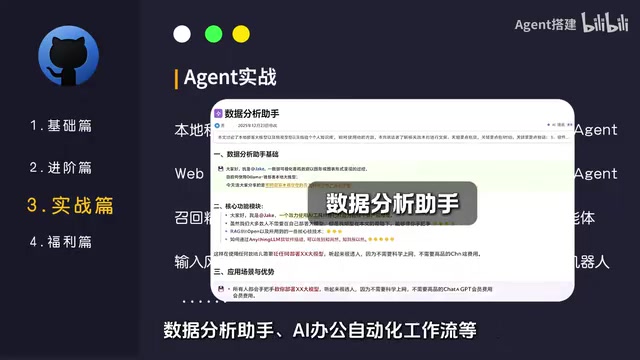
The practical directions have strong real-world relevance:
- Intelligent customer service agent: One of the most mature and in-demand directions in enterprise application scenarios, typically implemented by combining a RAG knowledge base with multi-turn dialogue management. The core technical challenges lie in intent recognition and dialogue state management—how to accurately understand users' true needs across multiple rounds of interaction, and gracefully escalate complex issues to human agents when necessary. Engineering-wise, special attention must also be paid to dialogue security, i.e., preventing users from bypassing system restrictions via Prompt Injection attacks—a production risk that cannot be ignored in public-facing customer service scenarios.
- Automated information collection agent: Autonomously gathers and organizes online information to replace large amounts of repetitive labor, relying on tool-calling and task-planning capabilities. Typical implementations include integrating search APIs such as Tavily and Serper, combined with web parsing tools to build an automated information collection-summarization-structured output pipeline.
- Data analysis assistant: Combining tool-calling capabilities to let agents directly process data and output insights. A typical implementation is the Code Interpreter mode (the agent automatically writes and executes Python code, runs it in a sandbox environment, and returns the execution results to the model for interpretation)—this mode enables non-technical users to complete complex data analysis tasks through natural language. Security isolation of the sandbox environment is key to engineering implementation, with common solutions including Docker container isolation and dedicated code execution sandbox services such as E2B.
- AI office automation workflow: Embedding agents into daily office processes to achieve tangible efficiency gains, often used in combination with automation platforms such as n8n and Zapier. As an open-source workflow automation tool, n8n supports local deployment and custom nodes; when integrated with agents, it can reach the APIs of nearly all mainstream SaaS tools—from Gmail and Notion to Slack and GitHub—building truly end-to-end automation flows.
The common value of these projects is that they not only hone hands-on skills but can also accumulate into demonstrable, reusable project experience. For learners hoping to find jobs or transition careers through AI skills, a complete project that runs and can be demonstrated is far more persuasive than scattered knowledge points. It's recommended to develop the habit of writing technical documentation during projects: clearly recording the reasoning behind architectural decisions, the pitfalls encountered, and the solutions—this not only facilitates future reuse but also has irreplaceable value when demonstrating the depth of your technical thinking in job interviews.
Bonus: Supporting Resources That Lower the Self-Learning Barrier
Beyond the core content, the course is equipped with substantial learning aids, including accompanying courseware, practical project e-books, mind maps, and study schedules.

The value of such supporting resources is often underestimated. For zero-foundation learners, mind maps help build a panoramic view of knowledge, while study schedules address the anxiety of "not knowing how long to study or where to reach." A systematic material system essentially reduces the cognitive burden during self-learning and lowers the probability of giving up midway. From the perspective of learning science, structured knowledge organization helps form "chunked memory" (Chunking)—cognitive psychologists (such as Nobel laureate in economics Herbert Simon) found that human working memory has limited capacity (Miller's Law states about 7±2 independent units, later revised to about 4), but by organizing related information into meaningful "chunks," effective memory capacity can be significantly expanded. Chess grandmasters can instantly memorize a board position precisely because they recognize the arrangement of pieces as meaningful tactical pattern chunks rather than isolated piece positions. When learning agent development, memorizing "RAG = vectorization + retrieval + injection" as a single integrated chunk is far more efficient than separately memorizing three isolated steps, and helps with flexible transfer and application across different scenarios. This turns scattered knowledge points into a retrievable network in the brain, rather than isolated fragments of information.
An Objective Assessment: The Value and Limitations of Systematic Courses
We need to view this rationally: no "from zero to hands-on" course can achieve a "quick fix." Agent development is a field requiring continuous practice and iteration. What a video tutorial can provide is a clear learning roadmap, not the destination itself.
Its true value lies in:
- A framework-based knowledge structure that keeps beginners from getting lost in a sea of information;
- A progressive path from shallow to deep that aligns with cognitive patterns;
- A practical orientation that makes learning outcomes deployable and demonstrable.
But learners must still understand that real capability growth comes from the cycle of doing projects, hitting pitfalls, and solving problems again. Agent development iterates extremely fast—the APIs of frameworks like LangChain and AutoGen undergo major updates every few months, and new architectural patterns continue to emerge: Agentic RAG lets agents autonomously decide retrieval strategies (including automatically rewriting query statements, decomposing complex questions into multiple sub-queries that are retrieved separately and then merged, and a routing mechanism that automatically determines whether retrieval needs to be triggered) rather than passively triggering a fixed process, with significant effectiveness in handling complex multi-hop questions; Memory-Augmented Agents equip agents with long-term memory storage across sessions, with mainstream solutions forming a layered architecture: Semantic Memory that stores summaries of historical conversations in a vector database, Entity Memory that maintains user preferences and entity relationships, and Procedural Memory that records past successful operation sequences for future reuse—frameworks such as MemGPT are specifically designed with a hierarchical memory management system that mimics operating system paging, dynamically scheduling content between "main memory" (the current context window) and "external storage" (persistent storage such as vector databases), breaking through the physical limitation of context window length.
This means the course content is merely a snapshot in time. Only by continuously tracking official documentation, arXiv paper preprints, and technical community activity (such as LangChain Discord and the Hugging Face forums) can one maintain genuine competitiveness. The course is a scaffold for getting started, not a substitute for learning.
Conclusion
AI agents are at the intersection of technological explosion and application deployment. Whether through systematic courses or independent exploration, the main line of "fundamental principles → advanced techniques → practical projects" is worth carefully planning for every learner who wants to enter the field. Rather than agonizing over which tutorial is "the most complete and detailed," it's better to start writing your own first agent as early as possible—this is the truly effective way to avoid detours.
Key Takeaways
Related articles
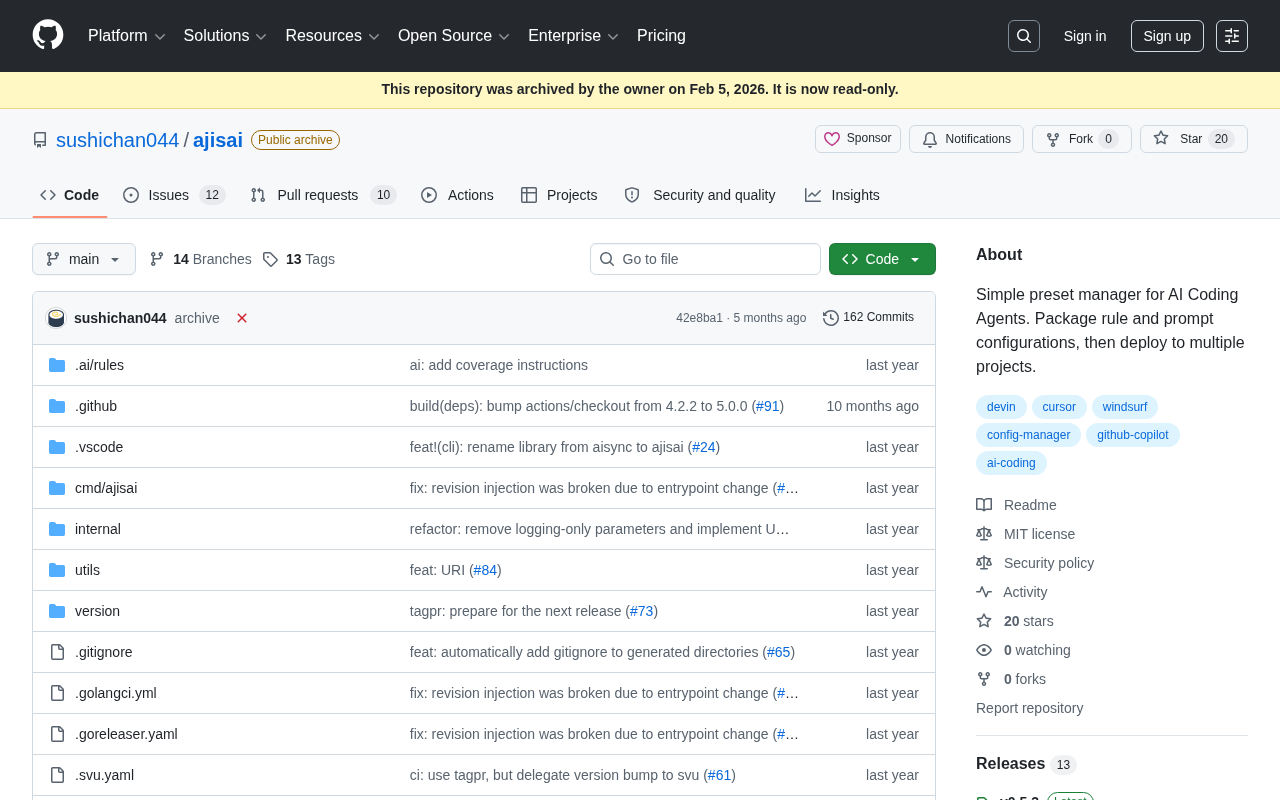
ajisai: A Preset Management Tool for Unifying Rules and Prompts Across AI Coding Assistants
ajisai is a Go-based preset manager for AI coding assistants like Cursor and Claude Code. Package rules and prompts once, deploy everywhere. Early-stage but promising.
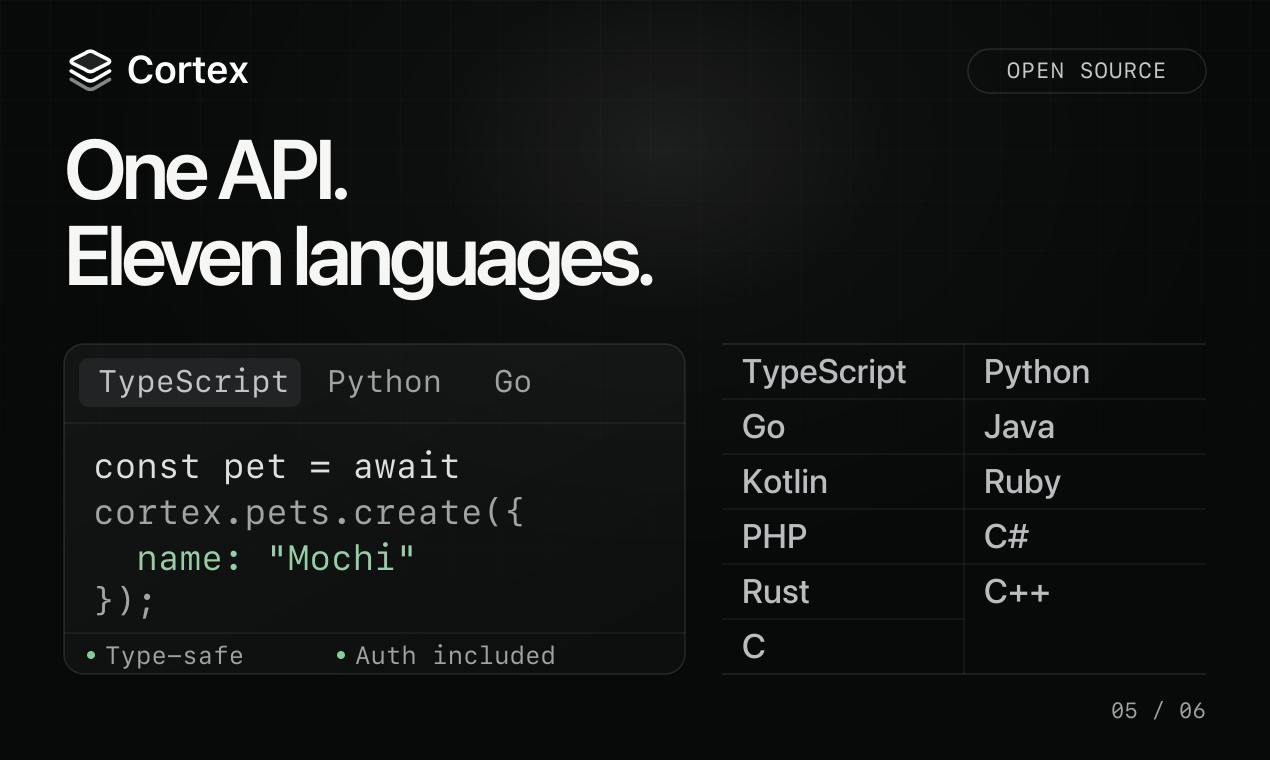
Cortex: Convert API Specs into Docs, SDKs, and MCP Servers in One Click
Cortex is an open-source tool that converts OpenAPI, GraphQL, gRPC and more into interactive docs, typed SDKs in 11 languages, and MCP servers for AI agents.

ABrush: An AI Studio Built for Digital Artists
ABrush is an AI studio for digital artists, ranked #4 on Product Hunt. It embeds leading AI models into existing workflows to remove repetitive tasks, speed up iteration, and keep artists in control.