AI Agent Development Learning Roadmap: A Four-Stage Guide from Concepts to Real-World Practice
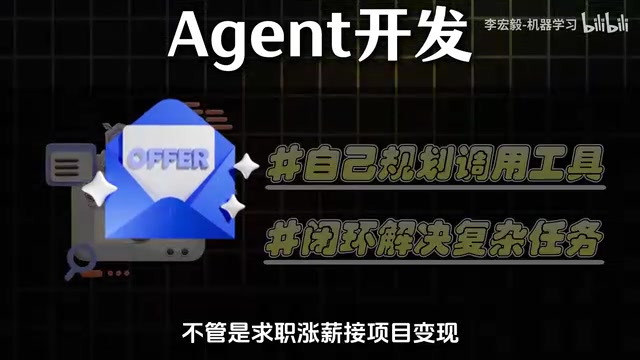
A four-stage roadmap for learning AI Agent development, from core concepts to real-world projects.
This article outlines a structured four-stage AI Agent learning roadmap for developers starting from scratch. Stage 1 covers foundational concepts — Planning, Memory, and Tool Use. Stage 2 dives into core paradigms like ReAct and CoT, plus prompt tuning. Stage 3 explores multi-agent collaboration and orchestration frameworks. Stage 4 focuses on completing real-world projects to turn theory into demonstrable results. The article also offers a grounded take on "speed-learning" claims, emphasizing that genuine Agent development skill is built through sustained hands-on practice.
AI Agent development is rapidly becoming one of the most valuable skill sets in the large language model space. As demand for AI roles continues to evolve, simply knowing how to call an API or build basic applications is no longer enough. The ability to independently design and develop agents capable of autonomous planning, tool use, and end-to-end resolution of complex tasks is increasingly becoming a true competitive edge for practitioners.
This article draws on relevant tutorial content to outline a structured AI Agent learning roadmap — from zero experience to real-world deployment — helping developers who want to enter this field build a clear learning framework.
Why Agent Development Deserves Systematic Study
Compared to earlier AI applications, the key differentiator of an Agent is autonomy. Rather than passively responding to single requests, an Agent can decompose tasks on its own, plan steps, invoke external tools, and iteratively refine its approach across multiple interactions — ultimately completing a complex goal end-to-end.
This capability has value across many scenarios: whether you're demonstrating technical depth in a job interview, taking on freelance projects, or building genuinely useful intelligent products, Agent development is an unavoidable core skill. The idea that "the earlier you systematically learn Agent development, the greater your advantage" holds real merit given how consistently today's AI job market demands hands-on practical experience.
That said, it's worth keeping expectations grounded. Claims like "go from beginner to expert in seven days" are largely marketing copy. Agent development spans LLM fundamentals, engineering implementation, and systems design — building solid competence requires sustained effort, not a crash course.
Stage 1: Foundations — Mastering the Core Concepts
The starting point is building a solid conceptual foundation. The goal at this stage isn't to write code — it's to understand what an Agent actually is and what it's made of.
Key points to cover:
- Understanding Agents: Get clear on the definition and core theory of Agents, and understand how they differ from traditional programs and simple AI applications.
- Familiarity with Large Language Models (LLMs): LLMs are the "brain" of an Agent. Understanding their capabilities and limitations is a prerequisite for everything that follows.
- Mastering the three core components: Planning, Memory, and Tool Use. These three form the basic skeleton of how an Agent operates — planning determines what to do, memory preserves context, and tool use connects the Agent to the external world.
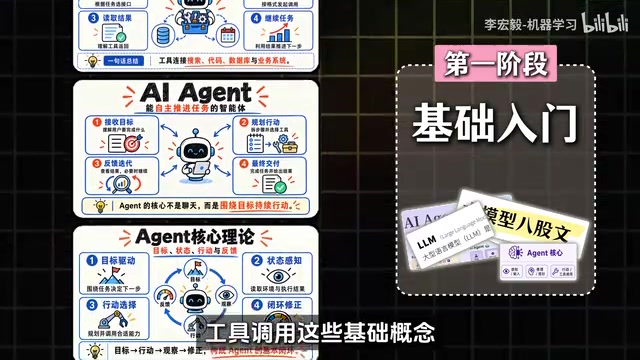
Truly internalizing these concepts is what allows you to build on them later — without this foundation, you'll find yourself repeatedly hitting walls at more advanced stages.
At the engineering level, each of the three core components has a corresponding implementation approach. The Planning module typically relies on the LLM's reasoning capabilities combined with task-decomposition prompts to break a user's goal into an ordered sequence of subtasks. The Memory module is split into short-term memory (information within the current conversation context window) and long-term memory (historical information and knowledge stored and retrieved via vector databases) — together, these ensure coherence across multi-turn interactions. Tool Use is implemented through a Function Calling mechanism, where the model outputs structured tool-invocation instructions that are executed by external code, with results returned to the model. Understanding the boundaries and interplay of these three components is foundational for later design decisions and debugging — many Agent instability issues ultimately trace back to poor memory management or a lack of error-handling in tool calls.
Stage 2: Core Advancement — Understanding Principles and Paradigms
The central leap at this stage is moving from "understanding concepts" to "understanding principles."
The focus is on understanding how Agents work internally, and learning the established paradigms the industry relies on. Key paradigms include ReAct (Reasoning + Acting, which interleaves reasoning and action) and CoT (Chain of Thought). These paradigms are essentially methodologies for how an Agent thinks and acts — mastering them helps developers understand the core operational logic of Agents, rather than just plugging into ready-made frameworks.
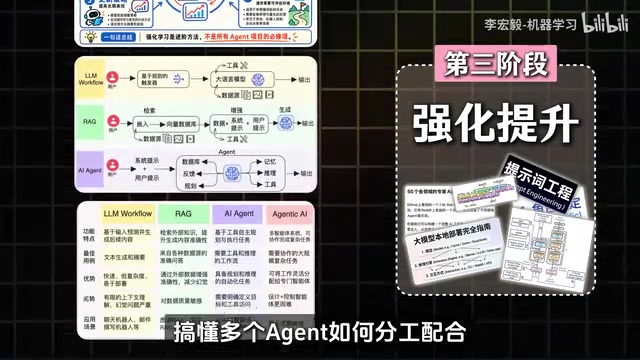
This stage should also cover Prompt tuning. Prompt quality directly affects the precision of an Agent's outputs. Given the same model and framework, differences in prompt design often determine whether the final result is useful or not. Learning to systematically tune prompts is a key lever for improving Agent reliability.
ReAct was proposed by Princeton University and Google in 2022. Its core idea is to have the language model output a natural-language reasoning step (Thought) before each action, then decide what action to take (Action), then observe the result returned by the environment (Observation) — repeating this cycle until the task is complete. This "think → act → observe" loop makes the Agent's decision-making process more transparent and debuggable, and reduces the tendency to go off-track on complex tasks.
CoT (Chain of Thought) is a prompting technique proposed by Google Research. The core approach is to include step-by-step reasoning examples in the prompt, guiding the model to produce intermediate reasoning steps rather than jumping straight to a final answer. Research has shown that CoT significantly improves model accuracy on complex tasks such as mathematical reasoning and logical judgment. In Agent development, CoT often serves as the underlying mechanism for the planning module, helping the model decompose complex goals into executable sub-steps. When used together, CoT improves the quality of individual reasoning steps while ReAct handles interaction with external tools and environments — the two approaches are complementary.
Stage 3: Multi-Agent Collaboration
A single Agent has limited capacity, and complex tasks often require multiple Agents working in concert. Multi-Agent systems address exactly the question of how multiple Agents collaborate effectively.
In these systems, different Agents can take on different roles — some handle planning, some handle execution, some handle review — completing tasks through coordinated collaboration that no single Agent could manage alone. Understanding how to structure roles and communication across multiple Agents is essential for building complex intelligent systems.
In Multi-Agent Systems, two common collaboration patterns exist: Hierarchical and Flat (Peer-to-Peer). In a hierarchical architecture, an Orchestrator Agent decomposes the overall task and delegates subtasks to Worker Agents — this works well when task structure is clear and division of labor is well-defined. In a flat architecture, Agents operate as peers and negotiate decisions through message passing — more flexible, but also harder to coordinate.
The communication mechanism between Agents is a key engineering challenge in multi-agent systems. Common approaches include shared memory, message queues, and structured JSON communication protocols. Major frameworks such as LangGraph, AutoGen (Microsoft), and CrewAI all provide out-of-the-box multi-Agent orchestration capabilities. When learning, it's worth picking one framework and diving deep — understanding its underlying state management and message routing mechanics rather than staying at the surface level of API calls.
Stage 4: Real-World Practice — Connecting to Actual Business Problems
The end goal of learning is converting knowledge into demonstrable results. At this stage, the recommendation is to complete 2–3 full end-to-end projects, covering the entire cycle of development, debugging, and optimization.
Suggested project directions include:
- Intelligent decision assistant: Analyzes input information and produces recommendations
- Automated office Agent: Handles repetitive administrative tasks to improve efficiency
- Multi-agent collaborative system: Brings together everything learned so far to build a coordinated cluster of Agents
The value of completing one project end-to-end far exceeds watching ten tutorials. Real projects surface the engineering details that theory misses, and they produce tangible artifacts you can show on a resume — directly improving your competitiveness when applying for jobs or pitching for freelance work.
Learning Roadmap Summary
Overall, this roadmap follows a logical progression: concepts → principles → collaboration → practice:
- Build a conceptual framework and understand the core components of an Agent
- Go deeper on principles — master paradigms like ReAct and CoT, and learn prompt tuning
- Expand into multi-agent collaboration to handle more complex scenarios
- Land real-world projects and convert technical knowledge into tangible outcomes
For developers starting from zero, this four-stage framework provides a clear sense of direction. That said, it's important to set realistic expectations about the actual learning timeline. Real capability is built on a large amount of hands-on practice. Approaching this with the goal of building something that actually works will yield far more durable skills than chasing the promise of instant employability.
Related articles
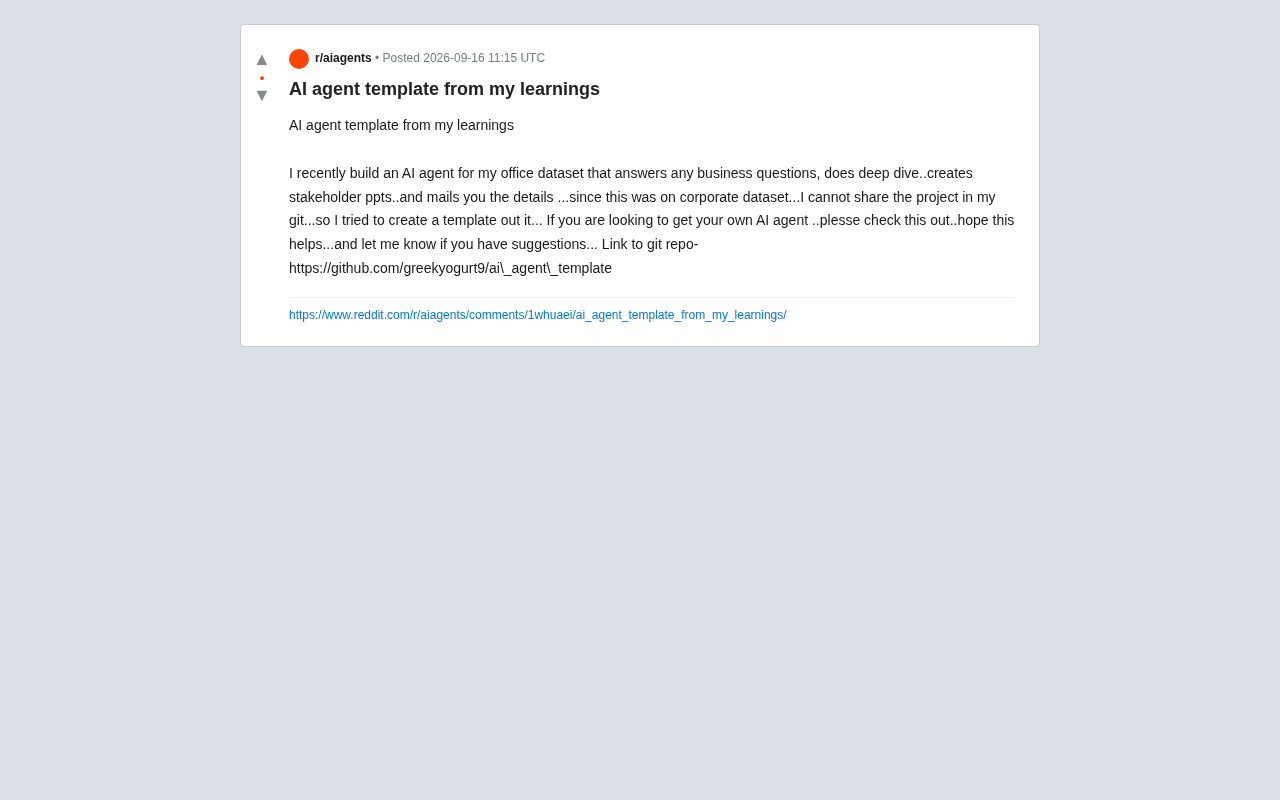
From Enterprise Practice to a Reusable Template: Lessons from Building an AI Agent
A developer shares an open-source AI Agent template built from an enterprise project, covering natural language data Q&A, analysis, auto-generated PPTs, and email distribution.

Nintendo's Open-World Design Evolution: Breaking Down Fire Emblem Fortune's Weave
Nintendo brings the open-world design philosophy of Breath of the Wild to Fire Emblem with the massive Switch 2 title Fortune's Weave. Here's what it means.
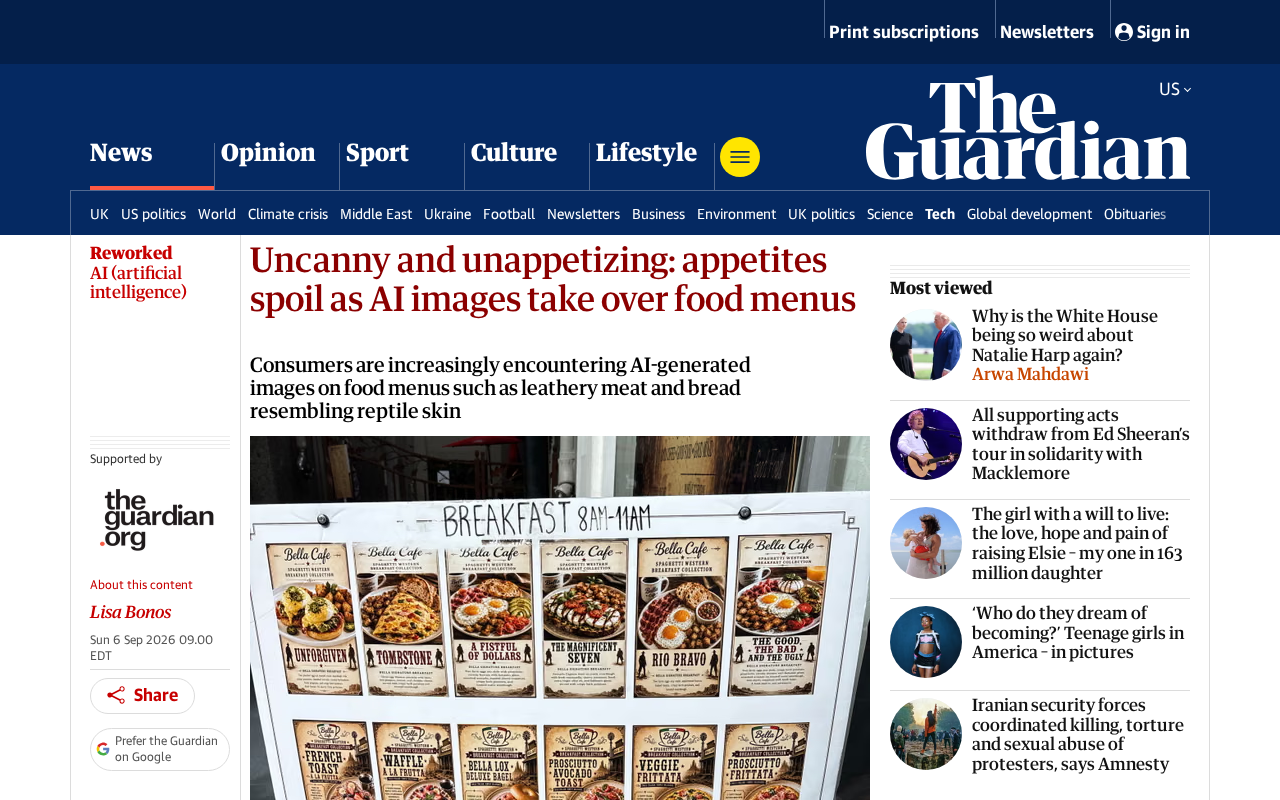
AI-Generated Food Photos Are Ruining Menus: How the Uncanny Valley Kills Appetite
AI-generated food images are flooding restaurant menus and delivery apps, but uncanny details kill appetite instead of sparking it. Here's why the uncanny valley effect hurts brands.