AI Agent Development Tutorial Project Overview: A Learning Path from Zero to Monetization

An open-source AI Agent tutorial project covering the full path from development basics to commercial monetization.
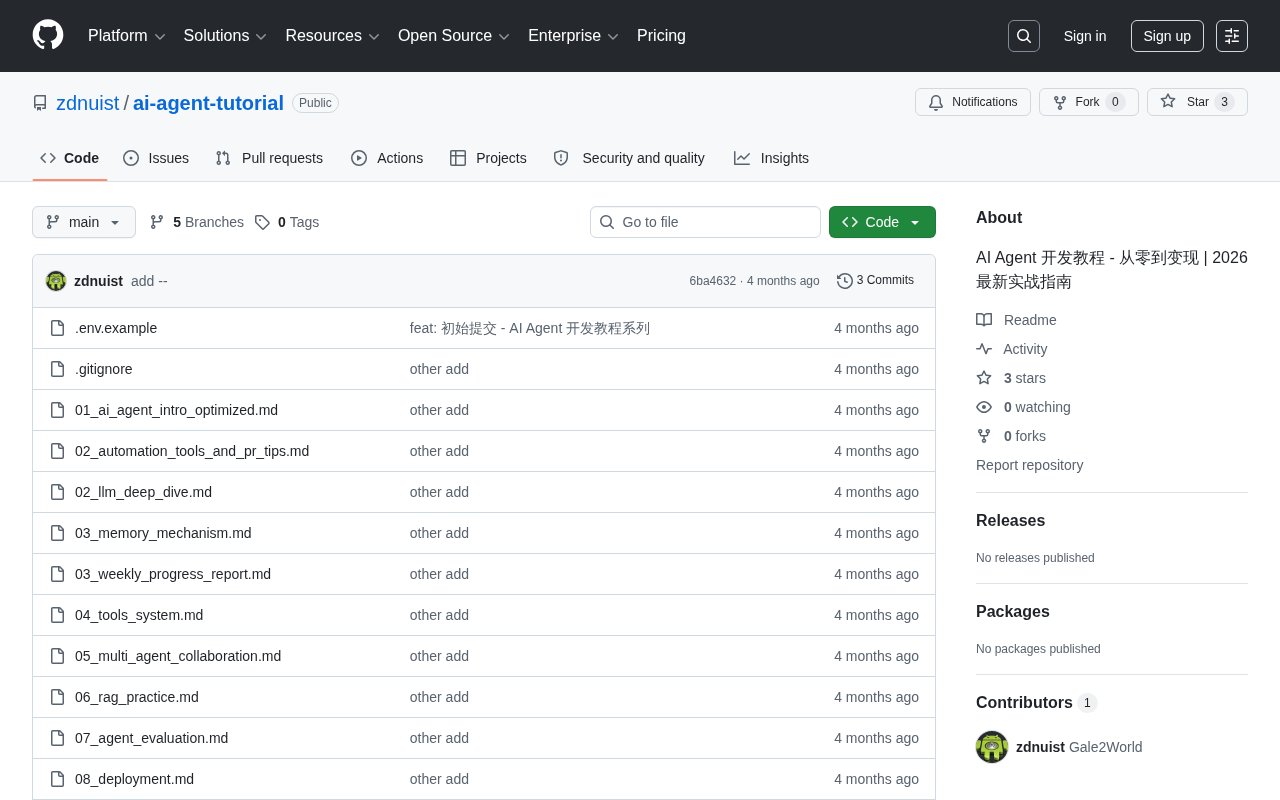
The GitHub project `zdnuist/ai-agent-tutorial` positions itself as a practical guide to AI Agent development from zero to monetization, aiming to bridge the gap between purely technical tutorials and real-world business deployment. Unlike most tutorials that stop at API calls and framework usage, it extends the learning goal to include identifying high-value automation scenarios, managing inference costs, and designing pricing models. A complete AI Agent curriculum typically spans three areas: core capabilities (LLM calls, prompt engineering, Function Calling), engineering practice (framework selection, memory and planning design), and commercial deployment. The project is in its very early stages with limited community traction, but its focus directly addresses what most developers want to know: can I make money with this?
A Hands-On AI Agent Learning Project
A GitHub repository called zdnuist/ai-agent-tutorial has emerged as an open-source project positioned as a practical guide to "AI Agent Development — From Zero to Monetization." Its name alone signals an ambitious scope: covering the full journey from getting started with AI Agent development all the way to commercial deployment, targeting developers and tech entrepreneurs who want a structured path into intelligent agent development.
The project is still in its early days community-wise (1 Star, 0 Forks), and the repository language is listed as empty — suggesting the content is primarily documentation and tutorials rather than a codebase in any specific programming language. For early-stage tutorial projects like this, the real measure of value lies in how well the content is organized, not in star counts.
Why "From Zero to Monetization" Is Worth Paying Attention To
Most AI Agent tutorials stay firmly in the technical weeds — how to call a large model API, how to design tool calling, how to build multi-agent collaboration pipelines. The "from zero to monetization" framing extends the learning goal into commercial deployment, which is exactly where many developers today feel stuck.
Mastering Agent development techniques doesn't automatically translate into building valuable products. Bridging the gap between technical skill and real revenue typically means clearing several hurdles: identifying genuine user needs, packaging Agent capabilities into deliverable services, managing inference costs, and establishing a sustainable pricing model. If this tutorial can walk through all of these stages clearly, it would fill a real gap between purely technical guides and actual business scenarios.
A Typical Knowledge Framework for AI Agent Development
While the repository's publicly available information is still limited, a well-rounded practical tutorial in the AI Agent space generally needs to cover the following modules:
Core Capabilities
This includes calling large language models, prompt engineering, context management, and the key mechanisms that give models the ability to act — particularly Function Calling and Tool Use. These are what set an Agent apart from an ordinary chatbot.
Function Calling is one of the foundational mechanisms of modern AI Agents. It allows a large language model to recognize, during response generation, when an external tool or function needs to be invoked — and to output structured call parameters that the host application actually executes, feeding the results back to the model. OpenAI formally introduced this capability with GPT-4 in 2023, and major models like Claude and Gemini have since adopted similar mechanisms (collectively referred to as Tool Use). This mechanism is what allows Agents to break free from pure text generation and interact with external environments — databases, APIs, browsers, file systems — enabling compound tasks like search, calculation, booking, and code execution.
Frameworks and Engineering Practice
This covers how to select and use mainstream Agent development frameworks (such as LangChain, LlamaIndex, AutoGen, etc.), how to design memory, planning, and tool-dispatch modules, and how to handle state management across multi-turn tasks.
LangChain is currently the most mature Agent development framework in terms of ecosystem, offering ready-to-use abstractions for chained calls, tool wrapping, and memory management. LlamaIndex specializes in Retrieval-Augmented Generation (RAG) scenarios and excels at indexing and Q&A over large document collections. AutoGen, open-sourced by Microsoft, focuses on multi-agent collaboration, supporting dialogue and task delegation between multiple Agent roles — well-suited for building complex automated workflows. Framework selection should be driven by the use case: single-task Agents may be better served by lightweight frameworks or even direct SDK calls, while complex Agents requiring long-term memory or multi-step planning benefit from frameworks with robust state management. That said, heavy reliance on framework abstractions comes with trade-offs — harder debugging, less transparent underlying behavior — so understanding the principles behind the frameworks remains essential.
Commercial Deployment
This is where the "monetization" part of the equation lands. It involves identifying high-value scenarios that Agents can automate, evaluating ROI, and designing pricing and delivery structures. This is also the section most likely to differentiate one tutorial from another.

A Realistic Take on Early-Stage Open Source Tutorials
When approaching a newly launched tutorial project with limited community traction, a cautiously optimistic mindset makes sense. On one hand, its positioning speaks directly to the question developers care most about: "Can I actually make money after learning this?" On the other hand, the real test of any tutorial is content depth, authenticity of examples, and update frequency — all things that take time to prove.
For readers looking to get started with AI Agent development, projects like this can serve as a useful reference for mapping out a learning path, best used alongside official framework documentation and well-established open-source examples. Real skill development ultimately comes from building a complete Agent project from scratch and refining it through real-world use.
Summary
zdnuist/ai-agent-tutorial represents a growing category of AI tutorial projects that lead with "hands-on practice + monetization" as their core value proposition. Its positioning is clear, targeting the gap between technical learning and commercial deployment. Since the project is still in its early stages with limited public information, the actual quality of its content remains to be seen. For developers looking to systematically enter the AI Agent space, it's at least a learning entry point worth keeping an eye on.
Related articles

Spotit: Turn Every Mac App into a Real-Time Interactive Tutorial
Spotit is an AI-powered interactive tutorial tool for Mac. Press a shortcut, ask in plain language, and it highlights exactly where to click next — guiding you through any Mac app as you learn by doing.
OpenCode: The Open-Source Coding Agent That Hit 150K GitHub Stars
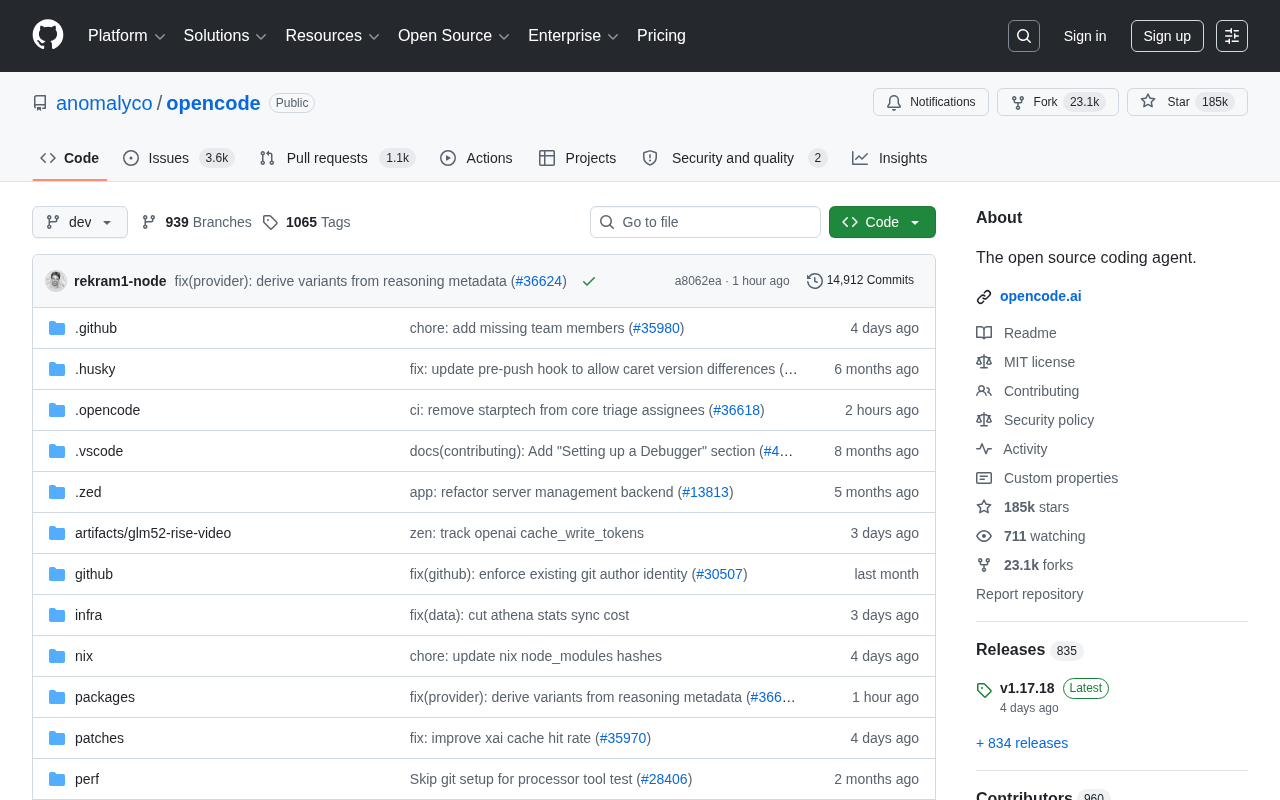
OpenCode is an open-source TypeScript coding agent with 150K+ GitHub stars. Learn about its features, advantages, and use cases for AI-powered development.
Learning AI Agent Development from Scratch: An Open-Source Tutorial Worth Bookmarking
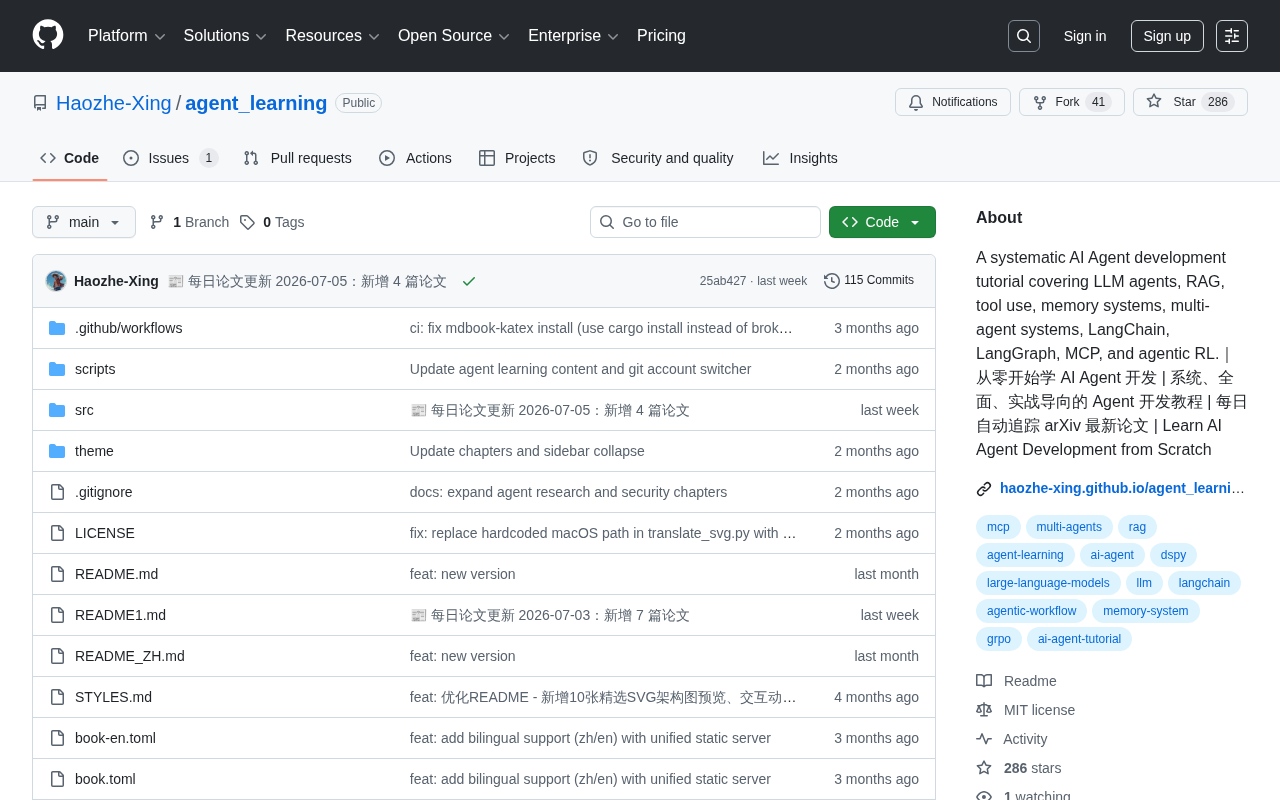
Haozhe-Xing/agent_learning is a systematic, hands-on open-source tutorial for learning AI Agent development from scratch, with daily arXiv paper tracking built in.