AI Agent from 0 to 1: Breaking Down the Underlying Logic and Four Major Implementation Categories

Clarify the four-stage evolution of large models and the four roles of Agents, then match against the four categories to find implementation scenarios.
Addressing the two major problems of current Agent tutorials—"piling on jargon" and "misleading quick-fix promises"—the article proposes building a framework before taking on projects. It sorts through the four stages of large model commercialization—native large models, prompt engineering, RAG, and Agents—noting that the first three are limited by hallucinations and knowledge cutoff, dependence on manual prompt design, and passive one-question-one-answer capability, while Agents add autonomous planning and tool calling to become the mainstream approach for enterprise digital transformation. Using a "translator" analogy, the article explains Agents' four roles—translator, tool expert, memory keeper, and task manager—and presents four commercialization categories: tool-type, role-type, utility-type, and industry-type, arguing industry-type has the highest ceiling while reminding readers to discern the course-promotion flavor.
AI Agent from 0 to 1: Breaking Down the Underlying Logic and Four Major Implementation Categories
Most Agent tutorials on the market share a common flaw: they open with a pile of jargon—tool calling, task planning, memory mechanisms, the ReAct framework—and beginners get dizzy before they even reach the door. The other type peddles "learn Agent in ten minutes" or "one piece of code does it all," but after following along you find you can only replicate the finished product, and the moment you switch to a different business scenario it falls apart. According to an analysis by a Bilibili creator focused on hands-on Agent practice, these two paths correspond to the pitfalls of "putting the cart before the horse" and "misleading quick-fix promises" respectively—and after finishing either, you still can't independently deliver a project. The truly effective learning order is: first build a complete knowledge framework and thoroughly understand the underlying logic, then gradually move on to real projects.
The Four Stages of LLM Implementation: Why Agents Emerged
To understand the value of Agents, you first need to see the path that large model commercialization has traveled. According to the creator's breakdown, this path roughly divides into four stages, with difficulty increasing at each level.
Stage One: Native Large Models
Native large models are trained on massive public internet data and possess concept generation and Q&A capabilities. But they have obvious shortcomings: no autonomous thinking ability, knowledge limited by a cutoff date, a tendency toward severe hallucinations, and no way to connect to a company's traditional business processes. For enterprises looking to cut costs and boost efficiency, this stage is far from sufficient.
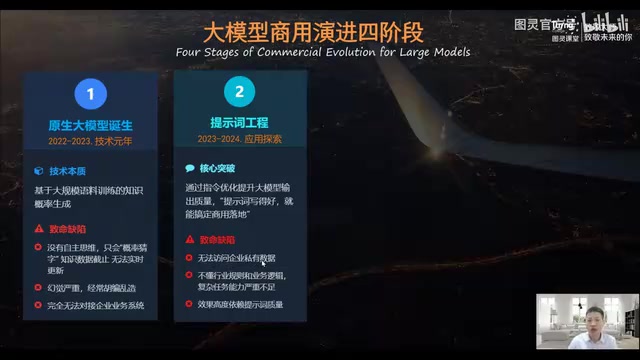
Stage Two: Prompt Engineering
Improving output quality by optimizing prompts was once an industry craze. But prompt engineering has three core flaws: it cannot access a company's internal private data, cannot handle traditional business processes, and output quality depends heavily on how well a person designs the prompt. The creator offered an analogy—learning to type doesn't make you an IT engineer; prompt engineering is now merely a basic skill for large model application practitioners, not the end goal.
Stage Three: RAG (Retrieval-Augmented Generation)
Store a company's repetitive business data (tables, images, etc.) in a knowledge base, and have the large model perform a relevance retrieval before answering. This is currently the choice of most enterprises building knowledge Q&A systems. But RAG's inherent flaws are equally obvious: it can only retrieve passively, cannot think proactively, supports only one-question-one-answer delivery, and cannot break down complex tasks. Take the e-commerce scenario: the entire flow from customer inquiry, order placement, inventory check to address change cannot be connected through RAG.
RAG (Retrieval-Augmented Generation)'s core mechanism is to retrieve document fragments relevant to the question from an external knowledge base before the large model generates an answer, then feed those fragments as context into the model so it answers based on the retrieved real materials. This alleviates the knowledge cutoff and hallucination problems of large models and allows enterprise private data to be utilized. But RAG's "retrieval" is one-way and passive: the system only looks up materials once when asked a question, and does not proactively follow up, break down goals, or call external systems to execute operations. This is the fundamental reason it can only handle knowledge Q&A and struggles to support multi-step business processes.
Stage Four: Agent
Agents give large models autonomous planning and execution-thinking capabilities, upgrading them from Q&A tools into "digital employees" that can call various tools to complete complex tasks and support agent collaboration to close the loop on enterprise business. According to the creator's judgment, this has become the mainstream implementation approach for enterprise digital transformation today.

ReAct (Reasoning + Acting) is a representative framework for how Agents achieve autonomous planning and execution: at each step the model first outputs a "thought" explaining the current goal and next step, then outputs an "action" to call a tool, then observes the tool's returned result and uses it to enter the next round of thinking, looping until the task is complete. This alternating "thought—action—observation" pattern enables the Agent to dynamically adjust its strategy based on intermediate results rather than generating an answer all at once. The task decomposition, tool calling, and proactive solution invocation discussed in this article are all essentially built on this loop mechanism.
Policy Winds: Why Learn Agents Now
The creator repeatedly emphasized one judgment: to track the direction of the AI industry, follow national policy. He cited major national-level deployments of the "AI+" initiative, noting policy support across science and technology, industrial development, consumption, people's livelihood and well-being, and other fields, and proposed development goals for the penetration rate of next-generation agents.
He drew an analogy with "Internet+": those who seized the dividends of the internet action opinions over a decade ago now hold stable positions at big tech companies; the current "AI+" is seen as a window of the same magnitude. This policy perspective can serve as a reference for career direction choices, but the specific pace of implementation still needs to be judged according to individual circumstances.
What Exactly Is an Agent: A Translator Analogy
The creator offered a plain-language explanation with a diagram: when a user raises a need, directly invoking a native large model either requires writing code or calling through an API—a fairly high barrier; and the native large model itself has only basic thinking ability, limited knowledge, no memory, no internet access, and no ability to read local files.
An Agent is essentially a "proxy" for the large model, like a translator between a Chinese speaker and an American. It can understand user needs, call various tools, complete complex tasks, and return results to the user.
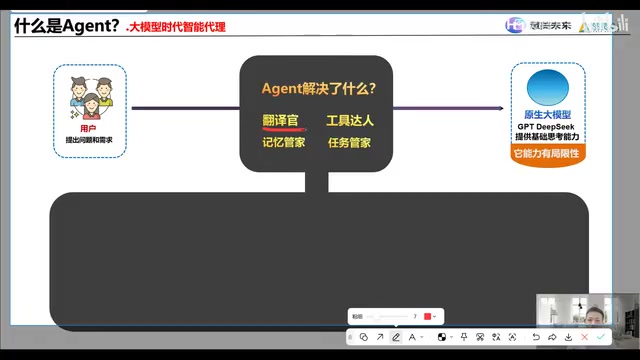
Specifically, an Agent solves four core problems:
- Translator: translates natural-language needs into instructions the large model can understand, then converts the output into usable results
- Tool expert: helps the large model call APIs, look up data online, operate files, and connect to enterprise systems
- Memory keeper: remembers context, user preferences, and historical conversations to support coherent multi-turn interaction
- Task manager: breaks complex problems into small steps and executes plans, proactively invoking solutions when problems arise
In daily life we actually use Agents every day—when you message Doubao, the question isn't thrown directly at the native large model but is scheduled through an Agent before results return; the code assistants programmers use can remember the entire project structure and call compilers to check code, which likewise reflects tool calling and memory capabilities.
It's necessary to distinguish Agents from mere function calls or workflow orchestration: the latter have execution paths hard-coded in advance by humans, and when encountering branches they can only follow preset rules; an Agent, by contrast, decides at runtime which tool to call, in what order to execute, and when to stop. This autonomy brings flexibility but also uncertainty—choosing the wrong tool, non-converging loops, and runaway execution costs are all problems to solve in real implementation, so Agents in production environments usually need to be paired with constraints, validation, and human fallback mechanisms.
The Four Agent Categories: Find Your Monetization Track
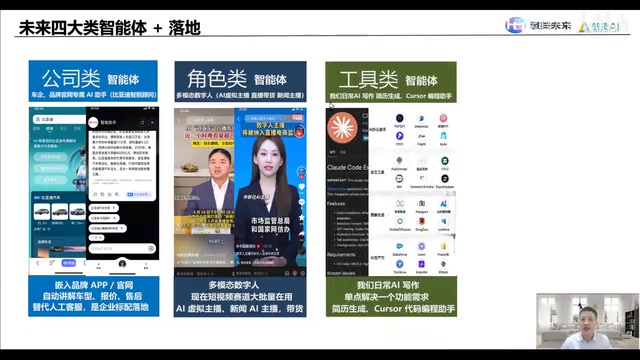
According to the creator's summary, Agents that can run a viable commercial logic on the market basically fall into four categories, which are also the relatively stable monetization tracks today.
Tool-Type Agents (Automaker Customer Service)
A typical scenario is the dedicated intelligent customer service on automaker brand websites and apps, covering model quotes, after-sales, and configuration inquiries, replacing humans to achieve 24-hour response. Companies of even modest scale are already deploying or preparing to deploy this.
Role-Type Agents (Multimodal Digital Humans)
Digital humans, virtual anchors, and livestream sales hosts fall into this category, with a technical foundation of Agent capabilities combined with digital humans. Short-video and e-commerce companies are already using such solutions en masse.
Utility-Type Agents (Single Function)
Focused on a single functional pain point, doing one thing deeply and thoroughly, such as AI writing or resume generation. This category suits ordinary people entering the field—you can build a product around a functional pain point and monetize through memberships or traffic; traditional enterprises can also use it to boost internal employee efficiency.
Industry-Type Agents (End-to-End B2B)
Aimed at the transformation of traditional B2B enterprises, industries such as healthcare, finance, e-commerce, logistics, industrial, and legal can all combine with large models. Take industrial agents: the entire flow from user inquiry, inventory check to order address change can be connected, reaching deep into the enterprise's full business process. The creator believes this is the direction with the highest ceiling in the future, and it is also the main content of the systematic course.
Final Thoughts: The Wave and the Judgment
The creator's timeline judgment is: the foundational large model stage competed on computing power and parameters; then Agents moved from concept to small-scale implementation but remained in the early-adopter trial phase; at the current stage, all kinds of enterprises are advancing large model implementation, and Agent development positions show a state of "many jobs, few people."
These judgments carry an obvious flavor of course promotion, and readers need to discern for themselves. But the valuable parts are worth absorbing: Agents aren't learned by copying examples—first clarify the evolutionary logic from native large models to prompt engineering to RAG to Agents, understand the four layers of capability (translator, tools, memory, tasks), then map against the four categories to find your own scenario positioning—this path is far more solid than "ten-minute quick fixes."
One-line Summary
First clarify the four-stage evolution of large models and the four roles of Agents, then map against the four categories to find implementation scenarios.
Paragraph Summary
Addressing the two major problems of current Agent tutorials—"piling on jargon" and "misleading quick-fix promises"—the article proposes a learning order of building a framework first, then taking on projects. The author sorts through the four stages of large model commercialization—native large models, prompt engineering, RAG, and Agents—pointing out that the first three are limited respectively by hallucinations and knowledge cutoff, dependence on manual prompt design, and the ability to only do passive one-question-one-answer; while Agents fill in autonomous planning and tool calling capabilities to become the mainstream approach for enterprise digital transformation. The article uses a "translator" analogy to explain Agents and summarizes their four roles—translator, tool expert, memory keeper, and task manager—and finally presents four commercialization categories: tool-type, role-type, utility-type, and industry-type, arguing that industry-type has the highest ceiling while reminding readers to discern the course-promotion flavor within.
Related articles

A New Paradigm for Text Editing in Compose: TextFieldState Replaces the Old API
Jetpack Compose introduces the TextFieldState API to fix dropped characters and cursor jumps from async input. The old value/onValueChange callbacks will be deprecated in 1.13. This article covers InputTransformation, OutputTransformation, four state hoisting patterns, and new formatted text editing capabilities.

Remote Compose: A New Document-Driven Paradigm for Cross-Platform UI on Android
Remote Compose transmits compact binary documents instead of screen pixels, enabling efficient UI rendering on remote surfaces like Wear OS and widgets. This article covers its document creation API, expression animations, size optimization techniques, and Wear OS progress.

How Crashlytics Eliminates Android Memory and Responsiveness Issues
Through the Chroma Clip case study, this article explains how Firebase Crashlytics uses Application Exit Info, Profiling Manager, GWP ASAN, and ARM MTE to pinpoint ANRs, OOMs, memory limit terminations, and native memory corruption—solving the challenge of stack traces that don't point to the real culprit.