AI Agent Fully Automates TV Subtitle Generation: From Audio Extraction to Final Output in One Go

AI Agent automates the full TV subtitle pipeline — zero manual steps, from audio to finished video.
This article demonstrates how an AI Agent orchestrates a fully automated subtitle generation pipeline for a 1959 TV remaster — handling audio extraction, ASR, timestamp alignment, line-length optimization, and video rendering without any human intervention. GLM5 processes a 26-minute video in just 10 minutes, illustrating a paradigm shift from isolated AI tools to complete, goal-driven workflows.
The Automated Pipeline Behind an Old TV Show's Subtitles
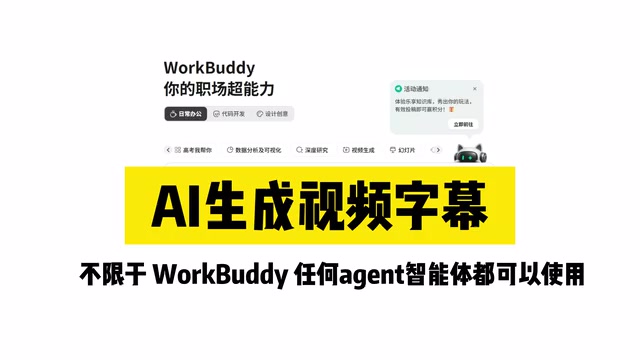
Video processing has always had a stubborn pain point: even with powerful AI tools at your disposal, a mountain of manual work still stands between raw footage and the finished product — extracting audio tracks, running speech recognition, aligning subtitles, syncing timestamps, optimizing line lengths. Every step has traditionally required human intervention and fine-tuning. The core goal of this demonstration is to break that fragmented workflow and achieve fully unattended, end-to-end automation from raw material to finished output.
The demo uses a highly representative case: the 1959 American TV series The Twilight Zone (a high-definition remaster). Content like this shares a common characteristic — the remaster brings improved picture quality, but accurate Chinese subtitles are nowhere to be found. And that, precisely, is where traditional manual processing consumes the most time.
Subtitle Quality: Not Just Recognition, But Fine-Grained Optimization
The demo results reveal two technically noteworthy highlights in the subtitles delivered by the AI Agent.
Precise Timestamp Synchronization
The subtitle timestamps are highly accurate, indicating that the system didn't just perform speech recognition (ASR) — it also achieved high-quality timestamp alignment. ASR (Automatic Speech Recognition) is the core technology that converts audio signals into text, and has evolved dramatically from early Hidden Markov Models (HMM) to today's end-to-end neural network models. Modern ASR systems like OpenAI Whisper, built on a Transformer encoder-decoder architecture and pre-trained on massive multilingual audio datasets, can achieve near-human recognition accuracy even in noisy environments.
Timestamp alignment goes a step further beyond recognition: Whisper tracks the audio frame position corresponding to each output token by analyzing Cross-Attention weight matrices, then uses CTC (Connectionist Temporal Classification) forced alignment to achieve word-level millisecond-precision positioning. For even higher precision, the system combines this with DTW (Dynamic Time Warping) to elastically map text sequences onto the audio timeline, compensating for temporal drift caused by variations in speaking rate.
For TV shows from the 1950s–60s, audio has often gone through multiple analog transcription passes, resulting in low signal-to-noise ratios and noticeable dynamic range compression — placing extremely high demands on ASR model robustness. Achieving precise timestamp sync with source material of this audio quality is genuinely difficult, and it reflects the Agent's deep audio processing capabilities.
Line-Length and Segmentation Optimization
Also worth noting is the subtitle line-length optimization — a detail often overlooked, yet one that directly affects the viewing experience. Subtitle line-length optimization isn't purely an engineering problem; it has deep roots in cognitive science. Research shows that during subtitle reading, the effective information capacity of a single fixation is approximately 7±2 Chinese characters, and single-line subtitles exceeding 14–16 characters significantly increase cognitive load, preventing viewers from reading the full text before it disappears. International streaming platforms like Netflix have explicit subtitle standards: Chinese subtitles should not exceed 16 full-width characters per line, with on-screen duration tied to character count.
When an AI generates subtitles with segmentation optimization, it is essentially combining a language model's semantic understanding with human factors engineering standards: the model first identifies semantic boundaries (avoiding line breaks in the middle of semantic units), then selects the optimal break point from multiple candidates based on audio time windows and character count constraints — simultaneously optimizing for semantic integrity and reading comfort. The AI's per-subtitle character control and segmentation optimization during generation is the critical step from "functional" to "good."
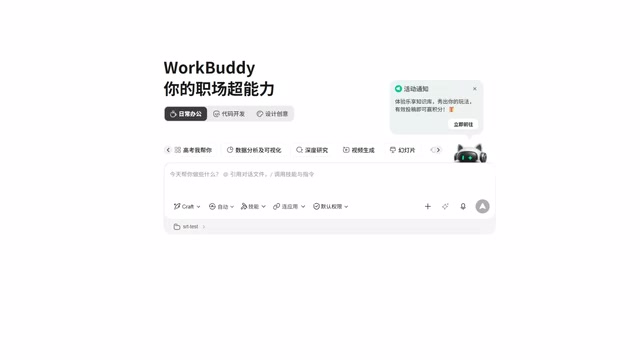
As the demonstrator noted, these results are achieved through the combined power of "AI Agent plus platform capabilities" — model capability alone cannot deliver an end-to-end finished product. It requires the Agent to orchestrate tasks and coordinate each processing stage to form a complete automated subtitle generation pipeline.
The AI Agent's role as "task orchestrator" in the video processing pipeline is typically built on the ReAct (Reasoning + Acting) framework — a paradigm proposed by Yao et al. in 2022, whose core is an iterative "think–act–observe" loop: the Agent uses a language model to reason about the current task state, selects and executes the corresponding tool call (e.g., calling an ASR API or translation API), and then feeds the tool's returned results into the next round of reasoning context. For multi-step tasks like video processing, the Agent can also combine task DAG (Directed Acyclic Graph) planning — arranging dependent subtasks sequentially and concurrently scheduling parallelizable subtasks (such as transcribing multiple segments simultaneously) — to maximize throughput efficiency while ensuring correctness.
Once the Agent receives a high-level goal (e.g., "generate a video with Chinese subtitles"), it automatically decomposes it into a sequence of subtasks: audio extraction → noise reduction → ASR → translation → line-length optimization → subtitle merging → video rendering, calling the corresponding tool or model API for each. Unlike traditional scripted automation, the Agent has exception handling and dynamic decision-making capabilities — if a step fails, it can try alternative approaches rather than halting entirely. This "goal-driven rather than step-driven" execution model is what fundamentally distinguishes an Agent from an ordinary automation script.
Breaking the Voice Dubbing Barrier: Unlocking Full Audio Freedom
Beyond automated subtitle generation, this platform capability brings another important extension: audio processing is no longer limited to the small set of common AI voice tones.
Overcoming the Inherent Limitations of Audio Clipping Tools
Traditional video dubbing or audio editing work has typically been confined to a handful of familiar AI voice tones, which constrains creative diversity and risks audience fatigue. TTS (Text-to-Speech) technology has gone through three generations: concatenative synthesis, parametric synthesis, and neural network synthesis. Modern neural TTS systems use an acoustic encoder-decoder architecture to decompose speech into three independently modeled latent variable spaces: content (text semantics), timbre (speaker voiceprint characteristics), and prosody (intonation and rhythm). The key breakthrough in voice cloning lies in the generalization capability of speaker embeddings — an encoder trained via contrastive learning can map 3–10 seconds of reference audio from any unseen speaker into a unified voiceprint vector space, which the decoder uses for conditioned generation to achieve zero-shot voice synthesis. By having the Agent extract and process audio tracks, creators can call on any voice material and completely break free from fixed voice libraries.
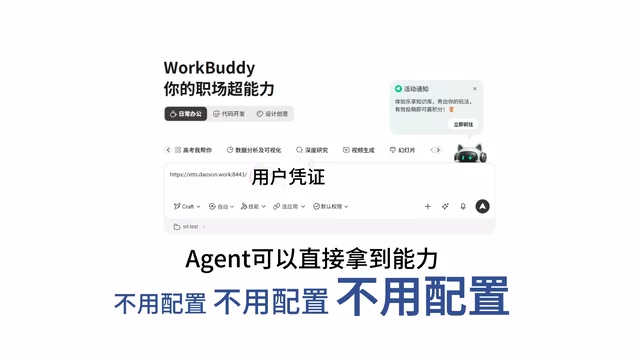
The significance here is that creative freedom over audio in video production has been dramatically expanded. Within the Agent framework, the audio processing module can dynamically connect to any TTS engine or voice cloning service, enabling consistent voice character across a dubbing actor's lines or faithful restoration of a specific character's voice through a unified audio processing chain. Whether reusing a specific character's voice or handling complex multi-track audio, the Agent acts as a unified coordination hub — creators no longer need to jump between multiple tools.
Efficiency Benchmarks: Processing a 26-Minute Video
When evaluating any automated video processing system, efficiency and output quality are the bottom line. The demo provides clear timing data:
- Original video length: 26 minutes
- WorkBody processing time: ~40 minutes
- GLM5 processing time: ~10 minutes
- Manual intervention: Zero — AI delivers the finished video directly

The difference in processing time between engines is quite striking. The GLM (General Language Model) series is a large language model family jointly developed by Zhipu AI and Tsinghua University. Its core architectural innovation distinguishing it from the GPT series is the "Autoregressive Blank Infilling" pre-training objective, which gives the same model both bidirectional understanding and unidirectional generation capabilities simultaneously. GLM5, as its fifth-generation architecture, features targeted optimizations for multimodal reasoning and long-context processing, making it particularly well-suited for tasks like audio-video understanding that require modeling long sequences.
In the video processing context, processing a 26-minute video in 10 minutes (~2.6× real-time speed) involves multiple engineering optimization dimensions: batch processing strategies for model inference that send audio slices in parallel to GPU clusters; dedicated hardware acceleration (e.g., Tensor Core acceleration for Transformer matrix operations on A100/H100 GPUs); and quantization techniques (INT8/FP16 mixed-precision inference) that significantly reduce per-inference latency and VRAM usage while maintaining accuracy. By comparison, WorkBody's 40-minute processing time indicates significant differences between the two systems in model architecture, hardware configuration, or task decomposition strategy. For bulk content producers, this difference in processing speed directly determines the upper bound of throughput per unit of time. But the most critical value in the entire workflow is this — zero manual operations throughout. That is the true meaning of "fully unattended, end-to-end."
A Paradigm Shift: From Single-Point Tools to Complete Workflows
Although this demo focuses on subtitling a single TV show, it reflects a deeper paradigm shift underway in AI video creation.
In the past, AI tools were isolated "points" — an ASR tool here, a TTS tool there, a subtitle editor somewhere else — and the creator was the "line" connecting them. Today, the Agent is becoming that line, chaining discrete capabilities into a complete workflow. The creator's role shifts from "operator" to "supervisor," simply defining goals and standards while the Agent handles everything else automatically.
For content creators, this means change on three levels: first, the ceiling on processing capacity is raised, enabling more complex projects; second, creative time is substantially freed up, allowing focus on higher-value creative work; third, batch production becomes viable, dramatically reducing the cost of processing long-tail content like old TV shows missing subtitles.
Of course, this pipeline is still at the demonstration stage, and real-world applications will need to handle more diverse source material quality and more complex linguistic scenarios. But from the standpoint of the goal itself — "zero human intervention from audio extraction to finished output delivery" — it already clearly points toward the future of AI video creation: not replacing creators on single-point tasks, but taking ownership of the entire workflow.
Key Takeaways
Related articles

Gemini 4 Argon Hands-On: AI Builds Board Games, Constructs Temples, and Trains Robots Autonomously
Gemini 4 Argon hands-on roundup: AI autonomously builds a desk racetrack and temple in Blender, writes a ray tracing engine, trains a humanoid robot to sink 7 shots, plus API pricing and developer access.

The Magic Octagonal Coin: Why Only 9% of People Can Predict Its Flip?
Only 9% of people can correctly predict the Magic Octagon coin flip. This article explains its spatial rotation mechanism, common cognitive pitfalls, and a new hypothesis based on Relevance Theory, exploring the limits of human spatial reasoning.

Sam Altman: AI Is Entering the Era of Scientific Discovery — Math Breakthroughs Will Replicate in Biology and Energy
Sam Altman says AI is entering the era of scientific discovery — math breakthroughs will replicate in biology, materials science, and energy to help develop new drugs and energy sources.