AI Agent Handoff Mechanisms: The Fundamental Difference Between Handoff and Agent-as-Tool

Handoff transfers conversation ownership; Agent-as-Tool keeps control with the caller—both are tool calls to the model.
Using customer service analogies and concrete message counts, the article compares Handoff and Agent-as-Tool in multi-agent systems. Both appear as one tool call to the model; the real difference is post-call logic: Handoff ends with stop reason handoff, the receiver inherits full context and writes the reply, adding exactly 2 messages; Agent-as-Tool starts independent specialist runs that return only task strings, and the caller synthesizes answers. The choice hinges on 'who should own the answer': single specialist takeover uses Handoff; multi-specialist coherent replies use Agent-as-Tool. The OpenAI Agents SDK implements these via handoffs and tools lists.
When building multi-agent systems, a seemingly minor design choice—whether to have the first agent "transfer" the customer to a specialist or "consult" the specialist and then reply itself—completely changes message flow, context inheritance, and who ultimately owns the reply. This segment from a course code demo uses two customer service scenarios to clearly illustrate the two collaboration patterns in AI Agents: Handoff and Agent-as-Tool.
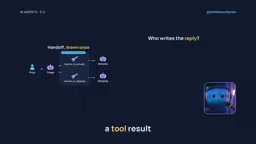
Two Collaboration Patterns: Transferring a Call vs. Asking a Colleague
The video uses two phone scenarios as analogies. In the first scenario, the front desk transfers the call to a colleague, after which the colleague communicates directly with the customer and the front desk drops off—this is Handoff. In the second scenario, the manager asks the customer to hold, separately consults two colleagues, and then synthesizes a single answer to reply to the customer—this is Agent-as-Tool.
The key insight is: to the model, these two approaches look exactly the same—both are a tool call. The real difference lies in what the code does after the call. In Handoff mode, the triage agent calls transfer to refunds, the run ends with stop reason handoff, the output is empty, and triage writes no reply. Control is fully transferred to the receiving refunds agent. In Agent-as-Tool mode, the manager agent calls ask refunds, each specialist starts as an independent run, receives only a task string, and the final answer is returned as a string to the manager, who writes the unified reply.
Tool Call and Stop Reason
In agent frameworks based on large language models, a tool call is a structured instruction in the model's output indicating that the model wants to execute some external function (such as querying an order or transferring a conversation). The model does not execute the function directly; instead, it returns a call request containing the function name and parameters, which the runtime environment executes and appends the result as a new message to the conversation, then hands it back to the model to continue reasoning. Stop reason identifies why a model run ended: common values include end_turn (the model naturally finished its reply), tool_use (the model requested a tool call), and handoff as mentioned in this article (the model requested transfer of control). In Handoff mode, after the runtime recognizes stop reason handoff, it no longer returns control to the original agent; instead, it starts the receiving agent and inherits the conversation history, so the original agent's output is empty. Understanding stop reason is key to distinguishing the two collaboration patterns—it determines which branch the code takes after the tool call.
Differences in Message Count and Context Inheritance
Priya's refund case in the demo provides a quantifiable comparison. A single agent handling the refund requires 9 messages. With Handoff, the refunds run contains 11 messages—the extra 2 are triage's transfer request and the "transferred to refunds" result. Note that the handoff run in the demo omits triage's system prompt; if retained, the total would be 12 messages.
What refunds sees after taking over includes: its own system prompt (not triage's), Priya's original message, triage's transfer request and its result, and only then does it begin its own get order work. This shows that Handoff passes the complete conversation context, but the receiver uses its own instruction set.
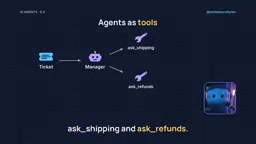
In the dual-issue ticket scenario, A1002 has not arrived and A1001 does not fit. The manager agent calls shipping and refunds separately. The shipping run contains 5 messages and the refunds run contains 9 messages, but the manager only sees one final answer string from each specialist. The manager's complete message list contains only the instructions, the ticket, one turn that asks both specialists simultaneously, two specialist replies, and the final merged reply it writes itself.
System Prompt and Context Inheritance
A system prompt is the highest-priority instruction message injected at the start of a conversation, defining the agent's role, available tools, and behavioral boundaries. In multi-agent collaboration, each agent typically has its own system prompt. When a Handoff occurs, the receiving agent starts a new run with its own system prompt while inheriting prior user messages and the handoff record, but it does not inherit the original agent's system prompt (unless explicitly passed). This is why in the demo, when the handoff run omits triage's system prompt the total is 11 messages, and if retained it would be 12. Agent-as-Tool mode is different: the specialist agent receives only a task string as a user message, and its context is deliberately isolated; the parent run's full conversation state is not automatically passed in. This isolation reduces token consumption and context contamination, but it also means the specialist cannot see any details beyond the task string, so the caller must provide sufficient information in the string.
Who Owns the Conversation: The Core of the Design Decision
The core question repeatedly emphasized in the video is "who writes the reply and who owns the next turn of the conversation." The answer depends on the pattern choice:
- Handoff: The receiver owns it; the receiver writes the reply and handles subsequent interactions. Suitable for scenarios where a single specialist takes over, such as Priya's straightforward refund request.
- Agent-as-Tool: The caller retains ownership; the caller synthesizes multiple specialists' answers and then replies uniformly. Suitable for scenarios requiring multiple specialist opinions to be combined into one coherent reply, such as the dual-issue ticket.
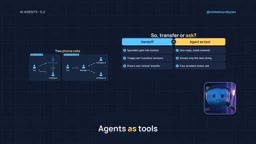
Each pattern has its costs. Handoff gives the specialist full context, but triage cannot merge multiple answers. Agent-as-Tool can produce coherent replies with lean context, but the specialist only knows what is in the task string—if the string omits details, the specialist has no way to know them.
Implementation in the OpenAI Agents SDK
The demo shows how the two patterns map to code in the OpenAI Agents SDK. Triage gets a handoffs list (shipping and refunds); you can pass agent objects directly or wrap them with handoff() to customize handoff behavior. Either way, the SDK presents each handoff to the model as a tool named like transfer to refunds.
The manager gets a tools list, i.e., tools like ask refunds. According to the documentation, this allows one agent to call another without a handoff, and the parent run does not automatically inherit the conversation state. For the next turn after a handoff, the SDK provides result.last_agent, which is usually the most suitable agent to reuse.
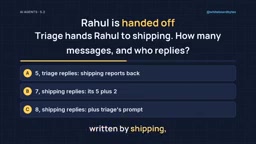
The final quiz uses Rahul's order inquiry to verify understanding: after triage transfers to shipping, shipping's run contains 7 messages (its own 5 plus the transfer request and result, 2), and shipping writes the reply rather than triage. This again confirms the fixed rule of 11-9=2 and 7-5=2—each handoff adds exactly 2 messages.
Handoff and Agent-as-Tool in the OpenAI Agents SDK
The OpenAI Agents SDK is a lightweight framework for building multi-agent workflows, with core abstractions including Agent, Runner, and Handoff. In the SDK, each element in the handoffs list is automatically wrapped as a tool exposed to the model, with the default tool name transfer_to_<agent_name>; when the model calls it, control transfer is triggered. The handoff() function allows customizing handoff behavior, such as overriding the tool name, description, or adding callbacks. Agents in the tools list are converted into ordinary tools via the agent.as_tool() method; when called, they start an independent sub-run and return only the final output string to the parent agent, without inheriting the parent run's conversation state. After a run ends, result.last_agent points to the agent that actually handled the request last, making it easy to reuse the correct agent instance when continuing the conversation after a handoff. At the API level, both mechanisms appear as tool calls, so the model-side behavior is completely identical; all differences are determined by the SDK runtime's post-processing logic.
Design Implications
Choosing Handoff or Agent-as-Tool is essentially answering "who should own the answer." This decision directly affects the completeness of context passing, the consistency of replies, and the composability of the system. The video ends by previewing that the next lesson will discuss orchestration, least privilege, and protocols—i.e., what each specialist can do and what it can see—which is also a key dimension of multi-agent system design.
Related articles
Build a Reasoning Model from Scratch: An 11-Hour Open-Source Course Breakdown
Sebastian Raschka releases a free 8-episode, ~11-hour video course teaching you to build a reasoning model from scratch with Python and PyTorch—from a small Qwen3 model through Verifier, Inference Time Scaling, GRPO, and distillation, with open-source code on GitHub.

An 11-Hour Reasoning Model Course in Practice: How Small Models Learn to Think
Starting from Sebastian Raschka's 11-hour reasoning model course and HN buzz, this analyzes small-model training, legal text version control, Anthropic data policy, and product reliability reviews.

Lightpanda: A Headless Browser Built for AI and Automation
Lightpanda is a headless browser built from scratch in Zig for AI and automation, with 37,852 GitHub stars. This analysis covers its technical approach, design choices, and use cases.