AI Agent in Practice: Building an Intelligent Work Assistant with WorkBuddy

Chat LLMs give plans; AI Agents execute and deliver—WorkBuddy is a low-barrier office-oriented example.
Using a Bilibili creator's livestream demo, the article contrasts ordinary chat LLMs with AI Agents: Doubao understands requests and provides code and steps but can't operate the local computer, while WorkBuddy, once granted full access, reads folders, batch-converts DOCX to PDF, and auto-archives in three minutes for 1.55 credits. It positions WorkBuddy as Tencent's low-barrier, office-focused general Agent with daily free credits, notes a clear performance gap versus Codex on complex tasks requiring trading time for cost, and concludes that the Agent's value lies in its execution loop and that general-purpose and development-oriented Agents are converging.
From "Thinking" to "Doing": Why You Need an AI Agent
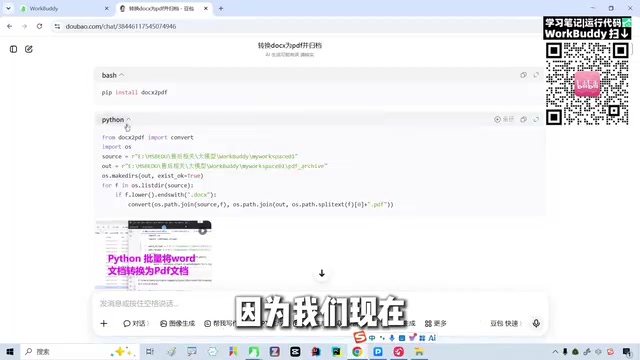
Most people's first encounter with AI tools was through chat LLMs like Doubao, DeepSeek, and Qwen. They can understand questions, break down tasks, and propose solutions—but when you ask, "Convert all the DOCX files in a folder on my computer to PDF and archive them," all they can do is tell you the steps and hand you a Python script. They can't actually operate your computer.
This is the dividing line between an ordinary chat LLM and an AI Agent: the former is an intelligent consultant, the latter an intelligent assistant. According to a Bilibili creator's live-stream demo, Doubao could accurately understand the request and offer a complete set of suggestions—dependency installation, code execution, fallback options—but the user still had to do all the execution themselves. An AI Agent like WorkBuddyAd, once authorized, can directly read local files, invoke tools, run commands, and ultimately deliver results.
AI Agent is a key direction in the evolution of LLM applications today. Put simply, an ordinary chat LLM is a "stateless conversational interface"—you feed it text, it returns text, with no memory, no tools, and no permission to operate the environment. An Agent layers three critical components on top of the LLM: Planning, which breaks vague goals into executable steps; Tool Use / Function Calling, which invokes external capabilities like the file system, command line, browser, and APIs through structured interfaces; and Memory & Reflection, which stores intermediate results, evaluates execution outcomes, and self-corrects. Widely cited paradigms include ReAct (interleaving reasoning and action) and Plan-and-Execute. It is these three layers that let AI cross from "generating suggestions" to "changing the environment"—and precisely because of that, permission granting and security boundaries are issues Agent products must confront head-on.
WorkBuddy in Practice: Batch File Conversion in Three Minutes
A Comparison in a Real Scenario
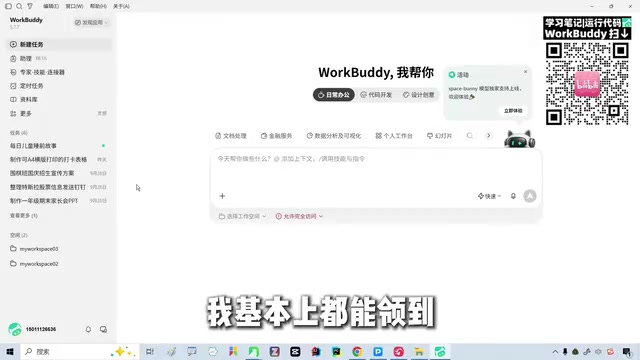
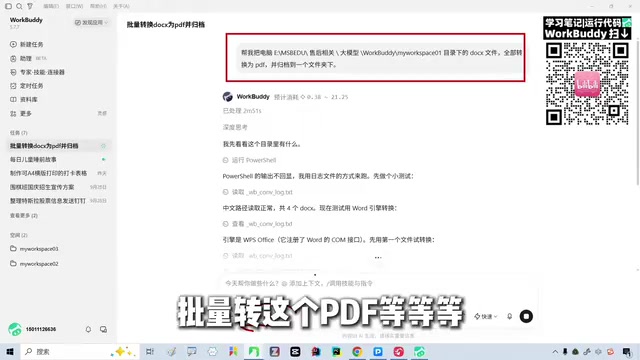
In the livestream, the creator ran a side-by-side experiment on the same request: batch-convert DOCX files on a certain drive to PDF and archive them into a folder. Sending the request to Doubao yielded a plan and some code; sending the same natural-language request to WorkBuddy, it simply got to work.
WorkBuddy's chat interface is essentially a prompt input area. After the creator entered the request, the Agent began processing immediately, with elapsed time and credit consumption displayed in real time. In the demo, the first file was converted quickly, the remaining files were processed in batch, and everything was automatically archived into a timestamped folder. The whole process took about three minutes and consumed 1.55 credits.
The Authorization and Execution Loop
Before starting, WorkBuddy requests permission. The creator chose "Allow full access," after which the Agent could access local folders, inspect documents, and batch-convert formats. This "authorize once, then execute autonomously" model turns AI from answering questions into executing tasks, and from giving suggestions into delivering results.
Even more important is the execution loop capability. With an ordinary chat LLM, if a step produces a poor result, the user must keep conversing and manually shuttle results back and forth; an AI Agent, by contrast, can try fallback approaches on its own when it hits problems, self-debug, and ultimately deliver. The creator noted in the demo that even if the first attempt falls short, you can have it revise through multiple rounds of dialogue until the requirement is met.
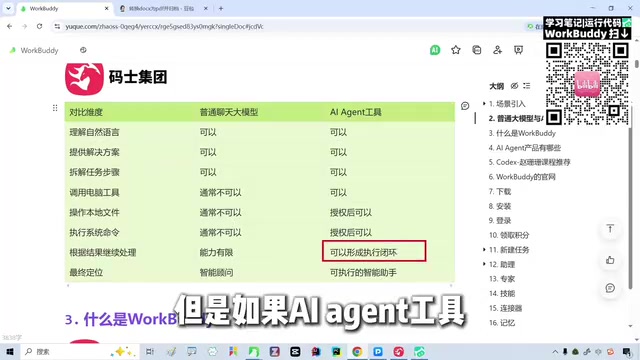
Execution Loop refers to an Agent cycling through "perceive—decide—act—observe results" until the task is complete or judged a failure. Unlike one-shot Q&A, the key to a loop is that every action produces new environmental feedback (did the file convert successfully? did the script error out?), and the Agent adjusts its next step accordingly. In engineering terms, this is usually implemented as a multi-turn cycle of "think—call tool—read return—think again," with circuit breakers such as maximum steps, timeouts, and human confirmation. The stronger the loop capability, the better the Agent can handle long-chain, multi-branch real office tasks—but that also means higher token consumption and more complex error handling, which is exactly why users see time and credit costs updating in real time.
WorkBuddy's Positioning and Capability Boundaries
A General-Purpose Agent for Office Scenarios
WorkBuddy is launched by Tencent and positioned as an AI Agent tool for office scenarios, differentiating it from development-oriented Agents like Codex and Claude Code. The creator stated explicitly in the livestream that WorkBuddy can also write code and do design/creative work—its interface includes a code development option when building new tasks—but programming is not the product's focus. For users with no coding needs who simply want AI to boost efficiency in office work, WorkBuddy is the better fit.
Low installation and usage barriers are a clear advantage: no VPN needed, just register and log in. It grants 100 credits daily, with 2,000 credits for first-time registration. After using it for about half a month, the creator still had 3,900 credits and considered that plenty for short-term learning.
A Real Performance Gap vs. Codex
The creator shared an Excel design case: giving WorkBuddy and Codex the same image of an Excel table from Xiaohongshu and asking them to design a table matching the image. WorkBuddy took 23 minutes and the result was unsatisfactory; Codex met the requirement in just two and a half to three and a half minutes. The gap is real, but so is the cost difference—Codex runs about 200 yuan per month and requires extra effort to solve network issues. The creator's advice: users who don't want to spend more can use WorkBuddy, collect daily credits, trade time for cost, and close the performance gap through repeated dialogue.
The Codex mentioned above needs disambiguation: the early Codex was a family of OpenAI models trained to turn natural language into code—the technology behind GitHub Copilot; in today's context, Codex more often refers to OpenAI's software-engineering-oriented Agent product form, capable of reading and writing code, running tests, and iterating fixes locally or in the cloud. Claude Code is Anthropic's in-terminal coding Agent, which can directly read projects, modify files, and execute commands from the command line. Such development-oriented Agents are typically deeply optimized for code repositories, test feedback, and long contexts, so they perform better on highly structured, automatically verifiable tasks (like generating a table from an image)—but their pricing and network-access barriers are also higher, which constitutes the classic trade-off against office-oriented Agents.
The Core Difference Between Ordinary LLMs and AI Agents
In the livestream class, the creator laid out a clear comparison framework:
- Understanding natural language, breaking down tasks, providing solutions: both can do this—it's table stakes for AI tools.
- Calling local tools, executing system commands, operating local files: ordinary chat LLMs can't; AI Agents can once authorized.
- Continuing to handle follow-up tasks based on execution results: ordinary LLMs require a human to pass results along step by step; AI Agents can form an execution loop.
This is why Agents are like "all kinds of little employees"—they don't just answer questions, they actually do the work for you.
Multi-Source Observation: Agent Products Are Converging
The creator repeatedly made one judgment during the livestream: domestic and international AI Agent products will converge sooner or later. Taking Doubao as an example, he noted that its interface already features entries like "Work," "Projects," "Plugins," and "Cloud Computer." Although he hadn't tried them yet, it shows that chat LLMs are also moving toward Agent capabilities. The functional boundaries between general-purpose Agents (WorkBuddy, OpenClawAd) and development-oriented Agents (Codex, Claude Code, Trae) will gradually blur, with differences showing up more in product focus and ecosystem.
This judgment aligns with observations from multiple industry watchers: competition in the Agent space is shifting from "can it do it" to "how smoothly, how cheaply, and how close to real scenarios can it do it." For ordinary users, this means there's no need to agonize over capability checklists when choosing an Agent—focus instead on whether your core scenarios are covered and whether the cost is acceptable.
Who Should Use WorkBuddy
If you're an office worker without a computer-science background whose daily needs center on file processing, format conversion, spreadsheet design, and document archiving, WorkBuddy's free-credit model and low installation barrier are worth a try. If you have high-frequency programming needs or extremely high demands on execution precision, a development-oriented Agent like Codex remains the better choice—at the cost of more money and network hassle. The creator's attitude is pragmatic: use the free tool to get things done first, adjust through multiple rounds of dialogue if results fall short, and only consider paid tools as a last resort.
The value of an Agent isn't how many things it gets right on the first try—it's that it transforms "humans doing the work" into a new workflow of "humans describe the need, machines execute, humans verify the result." That shift itself is more noteworthy than any single feature.
Related articles
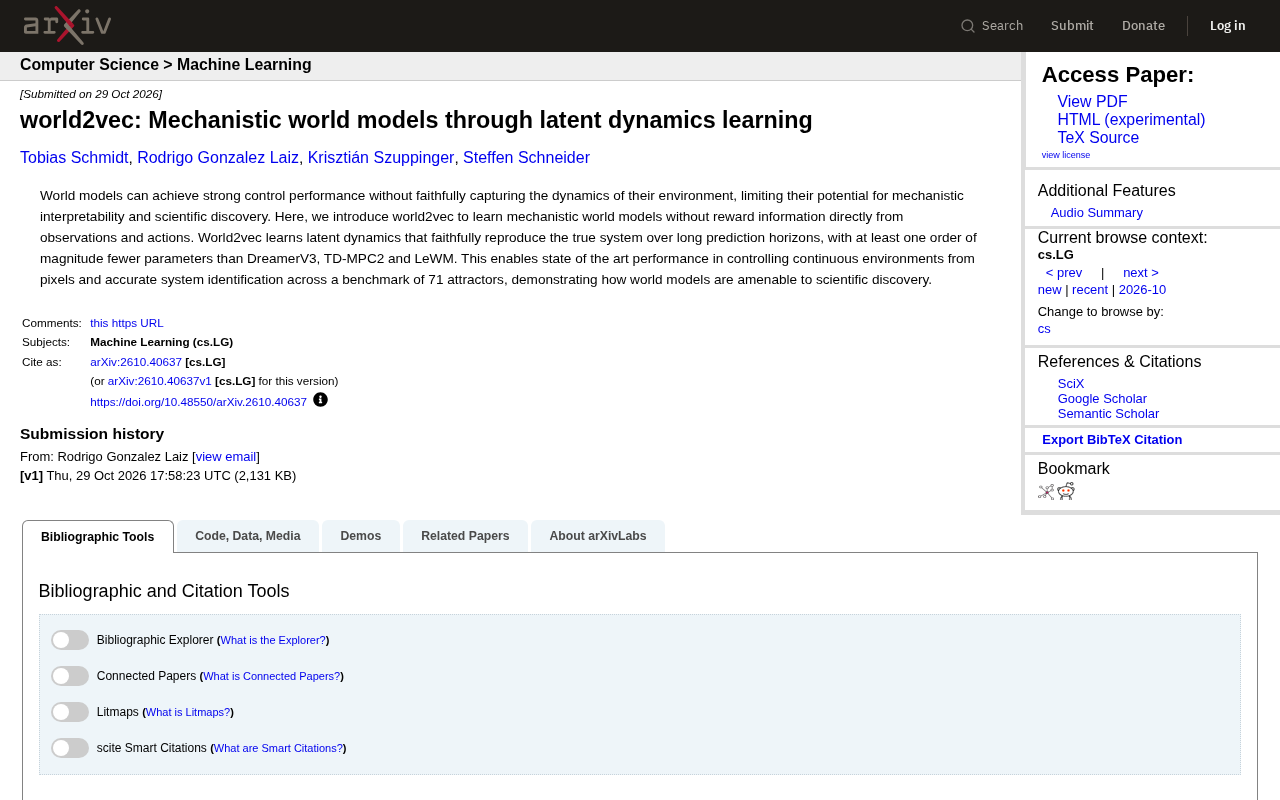
world2vec: Building Mechanistic World Models with Latent Dynamics Learning
world2vec proposes a reward-free method for learning mechanistic world models via latent dynamics, faithfully reproducing systems over long horizons with at least an order of magnitude fewer parameters than DreamerV3, TD-MPC2, and LeWM, and achieving accurate system identification on 71 attractor benchmarks.

A New KL-DRO Paradigm: Adaptive Scenario Generation Around a Learned Density Model
KL-DRO research proposes centering the KL ball on a learned density model instead of the empirical distribution, with adaptive scenario generation guiding sampling toward the worst case. Experiments show lower cost under distribution shift when records are scarce and the model can extrapolate, with comparable in-distribution cost.

ODE Samplers for Discrete Diffusion Models: Exponential Residual Flows Accelerate Generation
Discrete diffusion models lack deterministic ODE sampling? This article introduces Exponential Residual Flows (ERFs), which introduce continuous residual variables per token to construct piecewise ODEs for deterministic sampling and support consistency distillation acceleration. Superior to prior methods on code and text generation tasks.