AI Agent Inference Mechanisms Explained: How They Work and How to Benchmark Them

Agentic inference brings stateful, long-chain, context-bloated loads that demand system-level co-design to balance throughput-per-megawatt and interactivity.
The article explains that as AI evolves from Q&A bots into agents that autonomously plan, call tools, and iterate, the underlying compute load and evaluation logic are fundamentally rewritten. Agentic traces are stateful, unpredictable, and long-chained, with single requests taking about 15x longer than ordinary chat and main-Agent context growing from 60K to 400K tokens. Traditional benchmarks fail, so real production traces must be replayed while preserving growing context and tool-call gaps. The core metric is the balance between throughput-per-megawatt and interactivity, not a single throughput number. Gains come from full-stack co-design—NVLink, Dynamo, TensorRT-LLM: GB300-NVL72 delivers 15x throughput and 10x cost reduction, and Vera Rubin pushes throughput-per-megawatt up to 30x higher, keeping ultra-large models interactive.
When AI evolves from a simple question-answering bot into an agent capable of autonomous planning, tool invocation, and iterative refinement, the underlying compute load and performance evaluation logic are fundamentally rewritten.
From Q&A to Execution: The Essential Difference of Agentic Inference
Traditional inference is like a simple game of catch—one prompt in, one answer out. But an Agent is entirely different: it reasons, plans, calls tools, runs code, then interprets results and iterates until the task is complete. This autonomy brings an entirely new set of compute loads and performance challenges.
At the trace level, an ordinary chatbot's call trajectory is as regular as a metronome: the user speaks, the model responds, and the cycle repeats. An agentic trace, by contrast, is chaotic—model calls, tool calls, tool responses, more reasoning, then new tool calls triggered again. This chain can be long, stateful, and unpredictable.
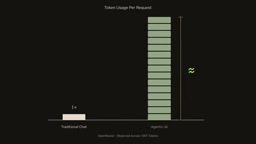
More critically, there's the scale difference. According to real usage data from OpenRouter across hundreds of trillions of tokens, a single Agent request consumes roughly 15 times the time of an ordinary chat request.
Trace is the key concept for understanding Agent inference loads. A trace refers to the complete record of the call chain from when a user initiates a request to task completion, including every model inference, tool call, tool return result, and the intermediate reasoning steps produced along the way. In traditional chat scenarios, trace structure is highly regular: one model forward pass completes one round of interaction, and the chain is short and stateless. In Agent scenarios, the trace unfolds in a tree or graph shape—the main Agent may sequentially call a search tool, a code execution sandbox, and a file-reading interface; after each tool return, it must re-enter model inference and decide based on the result whether to initiate the next round of calls. Such a trace can reach dozens or even hundreds of steps, and each step carries and accumulates historical context, causing the KV cache to continuously occupy VRAM. This directly determines the service's VRAM capacity planning, batching strategy, and scheduling complexity.
Multi-Agent Collaboration: The Challenge of Context Bloat
Modern Agents don't work alone. The main Agent acts as an orchestrator, carrying conversation history, plans, and learned information. When it encounters a subtask—such as searching a codebase, running tests, or checking documentation—it launches an independent sub-Agent to complete it, then reports back the result.
In a real coding session case, the main Agent's context grew from about 60K tokens all the way to 400K tokens, because each new round of interaction carried history forward.
To understand this visually: standard chat inference is like an area continuously expanding on a two-dimensional plane, while Agentic AI adds an entirely new dimension—what we face is no longer area, but volume.
MoE (Mixture of Experts) is the mainstream architecture for today's ultra-large-parameter models. Its core idea is to split a single dense feed-forward network into multiple "expert" sub-networks, activating only a few of them per forward pass through a routing mechanism, thereby keeping the number of activated parameters per computation manageable while the total parameter count reaches trillions. In Agent scenarios, MoE's advantages are especially pronounced: because Agent input contexts are extremely long and outputs diverse, the model needs broad knowledge coverage, and MoE can expand capacity without significantly increasing the FLOPs of a single inference. The cost, however, is enormous VRAM usage—all expert weights must reside or be efficiently swapped in, which places extremely high demands on GPU interconnect bandwidth and VRAM pooling. This is also a key reason why the article connects 72 GPUs into a unified scale-up domain with NVLink, and why Dynamo separates pre-fill and decode: only system-level co-design can keep a trillions-parameter MoE model running at high throughput and low latency under Agent loads.
Agentic Benchmarking: Why Traditional Methods Fail
Traditional benchmarking is relatively simple: send an 8000-token input, require a 1000-token output, and report tokens per second (TPS). This is useful for understanding clean, single-turn interactions, but it has almost no reference value for Agent workloads.
Agentic benchmarking takes a completely different approach:
- Replay real production traces: play back real coding Agent trajectories, capture new data, and report TPS
- Preserve growing context: maintain variable input lengths, variable outputs, and the original tool-call gaps. These gaps matter—the Agent may be waiting, but its context still occupies the KV cache
- Unify traffic: every system receives exactly the same recorded traffic, with differences coming only from hardware and the serving stack, not from specially tuned benchmark prompts
KV cache is a core optimization mechanism in large-model inference. During autoregressive generation, each layer of attention needs the Key and Value vectors of all previous tokens; if all history were recomputed for every new token, compute would grow quadratically with sequence length. The KV cache approach is to cache the already-computed Keys and Values, so subsequent tokens only need to compute the current step and concatenate with the cache, reducing the complexity of each step to linear. The cost is that VRAM usage grows linearly with context length, and each concurrent request must maintain its own independent cache. Under Agent loads, where context expands from 60K to 400K tokens, it means the KV cache for a single session can occupy tens of GB of VRAM; meanwhile, during tool-call gaps the request is waiting but the cache cannot be released, further reducing the effective batch size. Therefore, VRAM management, cache reuse, and scheduling strategies for Agentic inference are far more complex than traditional single-turn Q&A.
The Metrics That Actually Matter: Throughput, Interactivity, and Concurrency
For an AI factory, the core number is throughput per megawatt—how much useful Agent work can be produced under a fixed power budget.
But efficiency itself can mask a poor user experience. It needs to be cross-evaluated with interactivity: the TPS each user actually sees, end-to-end latency, and time to first token. The concurrency dimension must also be included—as more Agents are added, each one slows down; but serve too few, and the machine sits at low utilization.
The optimal system is not simply the one with the biggest throughput number, but the one with the highest throughput per megawatt while satisfying the responsiveness Agents require.
System-Level Co-Design: Where Performance Gains Really Come From
Performance gains don't come from some trick in a single chip, but from full-system co-design:
- NVLink connects 72 GPUs into a single high-bandwidth scale-up domain, letting a trillions-parameter MoE model run like one coordinated machine
- Dynamo separates pre-fill and decode, independently scaling each pool, and enabling context reuse rather than recomputation
- TensorRT-LLM adds NVFP4 precision and wide expert parallelism, keeping Tensor cores busy while thousands of Agents run simultaneously
Each layer eliminates a different bottleneck, but the final effect only appears when the entire system works in concert.
Performance Data: From GB300 to Vera Rubin
In Agentic workloads, GB300-NVL72 achieves up to a 15x throughput improvement, translating into up to a 10x reduction in cost per million tokens.
Vera Rubin pushes the curve again. On a DeepSeekAd V4 Pro workload, targeting 160 tokens/sec per user for interactivity, Vera Rubin-NVL72 delivers up to 30x higher AI factory throughput per megawatt than GB300-NVL72.
The gap becomes even more pronounced on larger models. On the 2.8-trillion-parameter KimiK3, GB300-NVL72 delivers roughly 80x the throughput per megawatt of H200, while pushing interactivity to about 215 tokens/sec/user—beyond what the previous generation of systems could reach.
The key conclusion is not a simple bar-chart comparison of highs and lows, but that the new system expands the usable range of the performance curve—allowing even ultra-large models to remain interactive.
Agents as Workloads: System-Level Problems Require System-Level Answers
Agents have become a mainstream workload, and they're here to stay. But serving them well is a system-level problem—requiring full-stack co-design from chip interconnect and inference scheduling to precision optimization. Simply piling on compute or optimizing a single point cannot address the statefulness, unpredictability, and scale bloat that Agentic inference brings.
Related articles

Chain of Thought Isn't Just for AI: How Humans Can Use CoT to Improve Thinking Quality
Chain of Thought isn't just a prompt trick for large models. Starting from a Hacker News discussion, this article analyzes why CoT works for human thinking too, breaks down actionable ways to transfer it, and highlights the key differences between human CoT and machine CoT.
Cloudflare Teams Up with OpenAI: Closi…
Cloudflare Teams Up with OpenAI: Closing the Loop from Vulnerability Discovery to Defense with AI
Cloudflare uses OpenAI Daybreak to investigate security vulnerabilities and generate reviewable remediation plans, while developers use Codex to boost coding efficiency and quality.

Orca Multi-Agent Orchestration in Practice: A Guide to Parallel Collaboration with Claude and Codex
Orca is Stable AI's free open-source agent workbench supporting 34 agents like Claude Code and Codex in parallel. Learn its Git worktree isolation, multi-model orchestration, and mobile management.