AI Agent Lifecycle Decisions in Production: How to Measure Value and Manage Risk

Forgotten AI agents still hold credentials and data access — here's how to evaluate whether to keep, fix, or shut them down.
Idle AI agents in production may cost little in tokens but carry real security risk — still holding credentials, data access, and scheduled tasks. This article reviews five methods for measuring agent business value (cost-accuracy evaluation, reliability benchmarking, residual human workload, operational outcomes, and usage-based estimation), analyzes each method's limitations, and argues that none can support a keep/fix/decommission decision alone. The key takeaway: value reviews must be combined with access reviews, and the Principle of Least Privilege should govern the entire agent lifecycle.
Forgotten Agents Are the Real Security Risk
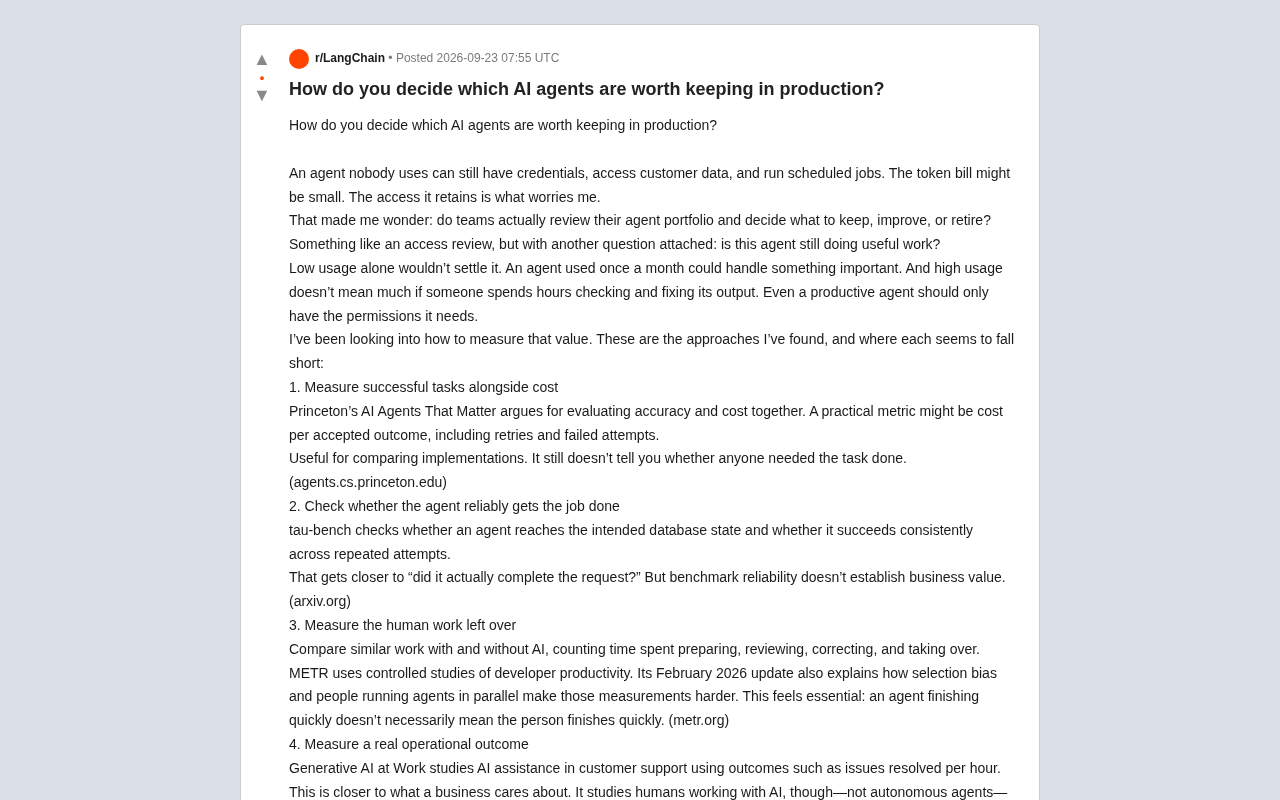
An AI agent that nobody uses might barely register on your token bill — but the risks it carries are seriously underestimated. It may still hold system credentials, retain access to customer data, and continue running scheduled tasks on autopilot. A practitioner on Reddit raised a pointed question: do teams actually conduct regular reviews of their agent portfolios to decide what to keep, improve, or shut down?
This isn't just an access review — it comes bundled with a harder question: is this agent still doing useful work? As enterprises deploy more and more autonomous agents in production, "who gets to stay" is evolving from a technical question into a governance one. Low usage alone can't be the deciding factor: an agent that runs once a month might be handling a critical task. Conversely, high call frequency doesn't mean much either — if someone has to spend hours reviewing and correcting its outputs, that "productivity" is actually a burden.
Five Methods for Measuring Agent Value — and Their Limitations
The original post systematically reviewed five evaluation approaches currently proposed by academia and industry. Each has genuine merit, and each has clear blind spots. Together they span the full spectrum from technical benchmarking to real-world business outcomes.
Start with a Joint Evaluation of Accuracy and Cost
Princeton University's research AI Agents That Matter advocates evaluating accuracy and cost together. A useful metric here is cost per accepted outcome — counting retries and failed attempts in full. This is well-suited for comparing the efficiency of different implementations side by side, but it can't answer a more fundamental question: does anyone actually need this task to be completed?
Test Whether Tasks Are Completed Reliably
The tau-bench benchmark focuses on whether an agent reaches the expected database state and whether it succeeds consistently across repeated attempts. This gets closer to answering "did it actually complete the request?" than raw accuracy alone. But reliability on a benchmark doesn't translate to business value — performing well in testing doesn't mean the work matters to the organization.
tau-bench is an agent evaluation benchmark developed by Stanford and collaborating institutions, specifically designed to assess the reliability of tool-use agents in real database interaction scenarios. Its core design principle: success or failure isn't judged by the content of a single conversation turn, but by whether the system state after execution matches what was expected — and whether the agent can succeed consistently across repeated runs of the same task, measuring consistency rather than one-off performance. This design effectively surfaces agents that "occasionally get the right answer but have unstable process logic" — a category that tends to be a latent source of incidents in real production environments.
Measure the Residual Human Workload
This is what the original poster considered the most fundamental approach: compare the difference in completing similar work with and without AI, tracking time spent on preparation, review, error correction, and takeovers. METR does this through controlled studies of developer productivity, and their February 2026 update explained how selection bias — and the practice of running multiple agents in parallel — makes such measurements increasingly difficult. The core insight: an agent completing a task quickly doesn't mean a human completed their work quickly.
METR (Model Evaluation & Threat Research) is an independent research organization focused on AI capability and risk assessment. Their developer productivity research uses a controlled experimental design, randomly assigning identical tasks to "AI-assisted" and "unassisted" developer groups and comparing actual completion times to quantify the real speedup AI provides. The February 2026 update highlighted two measurement challenges: selection bias — developers tend to use AI on tasks they believe AI handles well, making samples unrepresentative — and a parallelization effect, where developers running multiple agents simultaneously means individual "wall-clock time" savings no longer directly reflect the value contribution of any single agent, rendering traditional time-comparison methods unreliable.
Measure Real Operational Outcomes
Generative AI at Work examined AI assistance in customer support using outcome metrics like issues resolved per hour. This is closest to what organizations actually care about. But it studies human-AI collaboration, not fully autonomous agents, and isolating AI's contribution from other concurrent changes requires careful experimental design.
Estimate Time Savings from Usage Data
Anthropic's Estimating AI Productivity Gains uses models to estimate task duration with and without AI from conversation logs — a more scalable approach than timing individual employees. But estimated savings aren't the same as observed savings, and a conversation log can't capture everything that happens downstream.
From Measurement to Decision: The Hard Part
The original poster was candid about where the real confusion lies: how do you connect these measurements to a concrete, actionable decision — keep this agent, fix it, or shut it down and revoke its permissions?
Each of the five methods solves one piece of the puzzle, but none can support this decision on its own. Technical benchmarks tell you whether it can do the job. Operational metrics tell you whether doing the job is worth it. Residual human workload reveals the hidden costs that are easiest to overlook. An agent that appears highly productive might have negative net value if it requires substantial human backstopping.
More critically, the security dimension is often excluded from value assessments entirely. Value evaluation answers "should we keep it," while access review answers "what does it have that it shouldn't." These two questions need to be handled together: even a high-performing agent should hold only the minimum permissions it needs. A "zombie agent" — one that provides no value but still holds customer data access — is exactly the thing that should be prioritized for cleanup.
The Principle of Least Privilege (PoLP) is a foundational principle in information security: every system component — including user accounts, service processes, and automated agents — should hold only the minimum permissions necessary to perform its designated function, not a single permission more. For AI agents, this means an agent that generates weekly reports should not hold credentials to write to a production database or access full customer records, even if those permissions were conveniently bundled in during initial configuration. As the number of enterprise agents grows, permission creep accumulates silently — each individual authorization seems reasonable, but the aggregate attack surface expands significantly. This is precisely why merging value reviews with access reviews matters institutionally: a decommissioning decision isn't just "stop running" — it must include credential revocation and access reclamation.
A Practical Checklist for Production Teams
Drawing from the original post discussion, here's a pragmatic framework for conducting agent portfolio reviews:
- Conduct regular agent inventory audits: Don't just look at token bills — document every agent's credentials, data access permissions, and scheduled tasks.
- Use cost per accepted outcome to measure efficiency: Count retries and failures, and avoid being misled by surface-level success rates.
- Explicitly track the human backstop cost: Time spent on review, error correction, and takeover is critical to understanding net value — and the most commonly overlooked.
- Tie value to a real operational metric: Something like "issues resolved per hour" in a support context anchors value to actual business outcomes.
- Run value reviews and access reviews together: Regardless of the outcome, the Principle of Least Privilege should apply throughout an agent's entire lifecycle.
The original post's closing appeal is worth reflection for anyone in this field: a concrete example — what this agent does, what you measured, and what decision that measurement changed — is more persuasive than any framework. And a manually maintained monthly review spreadsheet might be just as valuable as a dedicated monitoring platform. As the number of agents continues to grow, the ability to actively retire them may matter just as much as the ability to build them.
Related articles

Cursor Can Now Control Your Computer: AI Agents Can Drive Desktop Apps for Testing
Cursor adds desktop control: AI agents can drive desktop apps like the iOS Simulator to test their own features. We analyze the impact on dev workflows, possible technical approaches, and reliability concerns.

Vibecoding a Custom Inference Engine: High Hopes, Harsh Reality
A Reddit developer shares the real experience of vibecoding a custom inference engine: running GGUF Q4 models in the browser with WebGL2 and GLSL, only to fall into tokenizer debugging hell. This article analyzes the engineering challenges of browser-side LLM inference and why cloning llama.cpp is the more rational choice.

How High Are Anthropic's Early Investor Paper Returns Ahead of IPO?
Anthropic's early investor paper returns draw attention ahead of IPO. This article analyzes sources of book gains, capital structure, pre-IPO games and risks, and implications for the AI startup ecosystem.