AI Agent Memory Optimization in Practice: Moving Beyond Context Window Stuffing

Replace context-window stuffing with a persistent memory layer to cut Token costs and enable cross-session continuity in AI Agents.
A developer building multi-step diagnostic AI Agents found that dumping full execution history into the context window caused latency spikes and runaway Token costs. The solution was a standalone persistent memory layer enabling cross-session recall and precise retrieval of only what the current step needs. The post compares three memory implementation paths — vector RAG, graph-based, and custom metadata filtering — each with different trade-offs. The core takeaway: production-grade Agents should treat memory as an independent system component, the key engineering leap from a working demo to a stable product.
The Root Problem: Every Session Starts at Day Zero
When building multi-step diagnostic AI Agents, a commonly overlooked bottleneck gradually surfaces — Agents have no memory. Every session starts from scratch, and problems solved yesterday get stumbled over again today.
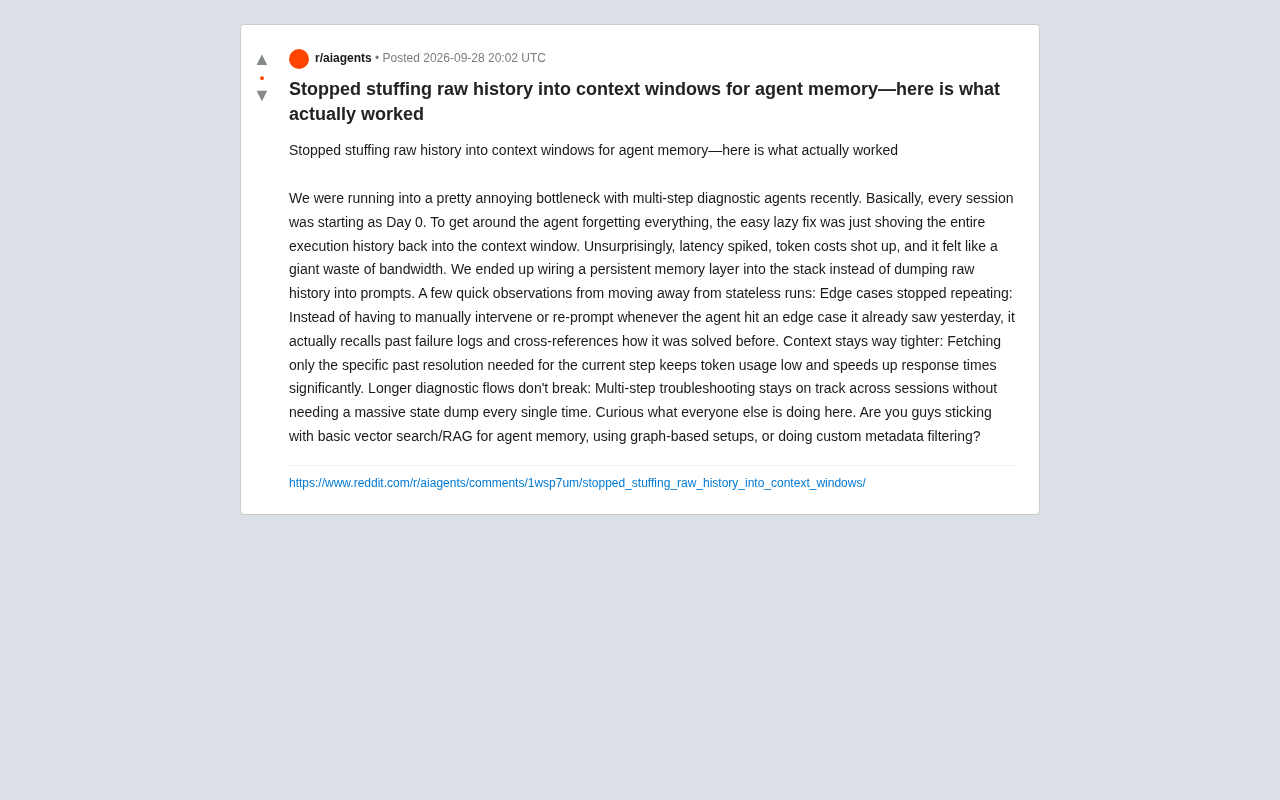
As one Reddit developer shared from their hands-on experience, their team initially took the path of least resistance: dumping the entire execution history back into the context window, hoping the Agent would "remember" what had happened before. The result was predictable — latency spiked, Token costs exploded, and the whole workflow felt like a massive waste of bandwidth.
The problem with this approach is that it equates "memory" with "re-feeding raw data." Context windows are inherently limited. Cramming large amounts of irrelevant historical logs dilutes the critical information needed for the current task, making every API call slower and more expensive.
The Solution: Introducing a Persistent Memory Layer
This developer ultimately abandoned the "dump history into the Prompt" approach and integrated a persistent memory layer into their stack. The core shift: the Agent no longer runs stateless — it can retain and recall past experiences across sessions.
This change produced several immediately noticeable improvements worth noting for anyone doing Agent engineering.
Edge Cases Stop Recurring
Previously, whenever the Agent encountered an edge case it had already handled the day before, an engineer had to intervene manually or re-prompt. With the memory layer, the Agent can proactively look back through past failure logs and cross-reference how the issue was resolved at the time. This dramatically reduces repetitive manual intervention, allowing the Agent to self-correct when facing familiar problems.
Context Stays Lean
The key difference lies in the retrieval strategy. Rather than stuffing all history into the context, the persistent memory layer fetches only the specific past solution truly needed for the current step. This precise retrieval keeps Token usage low and noticeably improves response speed. In other words, the value of memory isn't in how much you remember — it's in how accurately you retrieve.
Long Diagnostic Workflows No Longer Break Down
For multi-step troubleshooting scenarios, continuity across sessions is critical. With a memory layer, the Agent can maintain consistent task trajectory across different sessions without requiring a massive state dump every time, keeping long diagnostic chains from falling apart.
In engineering terms, a persistent memory layer typically exists independently from the LLM itself, operating as an external service or database. Its core responsibilities cover three things: writing (storing key events and solution summaries from each session in a structured format), retrieval (proactively pulling relevant memories based on current task context when a new session begins), and forgetting or updating (preventing outdated or invalidated solutions from misleading the Agent). Unlike ordinary conversation history caches, data in a persistent memory layer survives process restarts and session endings, and can be shared across users and task instances. Common implementation approaches in the community include building a custom layer at the application level, using LangChain/LlamaIndex Memory modules, or integrating dedicated memory-as-a-service products like Mem0. The quality of this layer's design directly determines whether an Agent can evolve from a "one-off tool" into a system that gets smarter with use.
An Open Discussion on Technical Choices
The post closes with a thought-provoking question: there is currently no unified best practice for implementing Agent memory. The developer outlined several mainstream approaches:
- Basic Vector Search / RAG: The most common entry-level approach — using vector similarity to recall relevant memories. Simple and straightforward, but may struggle with complex relationships.
- Graph-based approaches: Modeling relationships between memories using a graph database, suited for scenarios that require understanding entity relationships and causal chains.
- Custom metadata filtering: Tagging memories and adding metadata to enable precise filtering during retrieval, balancing flexibility and accuracy.
Each approach involves trade-offs. Vector search wins on generality and ease of adoption; graph-based approaches shine when handling diagnostic chains with explicit associations; metadata filtering gives engineers the most control, but requires more upfront design work.
The basic principle behind vector search and RAG (Retrieval-Augmented Generation) is to convert memory content into high-dimensional vector embeddings and store them in a vector database (such as Pinecone, Weaviate, or Chroma). At retrieval time, the query is also vectorized, and the closest historical records are found using metrics like cosine similarity. RAG then takes this further by stitching the retrieved snippets into the Prompt as reference material for the model's generation. The limitation of this approach is that it's fundamentally "semantic similarity matching" — if two historical records are semantically similar but logically different (e.g., the same error code has completely different root causes in different contexts), vector search struggles to distinguish them. Graph-based approaches explicitly model causal chains and dependency relationships between memories through nodes (entities) and edges (relationships), making them well-suited for diagnostic scenarios that require tracing associative paths — think "Fault A caused Anomaly B, which then triggered Alert C." Representative tools include Neo4j as well as frameworks designed specifically for AI memory like Mem0 and Zep.
Takeaways for Agent Development
This case highlights an engineering principle that is becoming widely accepted: Agent memory should not be a raw pile of history — it should be organized, precisely retrievable knowledge.
Stuffing an entire history into the context window is essentially substituting "brute force" for "design." It might barely work during the demo stage, but once you hit production — with longer task chains and higher concurrency — cost and latency issues become impossible to ignore.
The truly scalable approach is to treat memory as an independent system component: decide what to store, how to store it, and how to retrieve it. Whether you ultimately go with vectors, graphs, or metadata, the core idea remains the same: let the Agent precisely retrieve that one piece of information it actually needs in the moment, rather than replaying the entire history every time. For teams building production-grade Agents, this may be the critical step between "a Demo that runs" and "a product that holds up."
Related articles

Felix Rieseberg Personal Homepage
Felix Rieseberg's personal homepage sparks attention on Hacker News. This article covers the Slack engineer's technical background, the rise and fall of nativefier, and the value of a developer homepage as a tech calling card.

@ai-sdk/vue 3.0.306 Patch Release Syncs with [email protected] Update
@ai-sdk/vue 3.0.306 released, synced with [email protected]. A routine patch release for the Vercel AI SDK ecosystem with no public API changes; the Vue adapter layer stays version-aligned with the core package.

Gemini 4 Argon API Launches: The Era of Million-Token Output Begins
Google launches Gemini 4 Argon with sparse MoE architecture, up to 1M output tokens, and a 68.90% Vals Index score, available across API, AI Studio, and the Gemini app.