AI Agent Performs Mouse Brain Surgery: Claude Sonnet 5 Succeeds and Patient Recovers

Reddit reports a Claude Sonnet 5-powered AI agent completed mouse brain surgery, but details lack peer-review verification.
The article discusses a viral Reddit report: Ex Therapeutics allegedly used a Claude Sonnet 5-powered AI agent team to complete mouse brain surgery, with the mouse recovering. The author notes LLMs excel at reasoning and planning rather than motor control, so the AI agent likely handled workflow decisions and tool coordination while a robotic system performed the operations. Currently sourced only from the Reddit post and social media account OcanaSantero, it lacks peer-reviewed papers or official press releases, and sources disagree on the degree of AI autonomy. If reproducible, it would advance AI in precision surgery, but ethical review, decision interpretability, and animal-to-human translation challenges remain, calling for cautious optimism.
Event Overview
Recently, a post on Reddit drew attention: an AI agent team powered by Claude Sonnet 5 completed brain surgery on a mouse, and the mouse recovered postoperatively. The post cited social media links and the website of Ex Therapeutics, and quickly spread through the tech community.
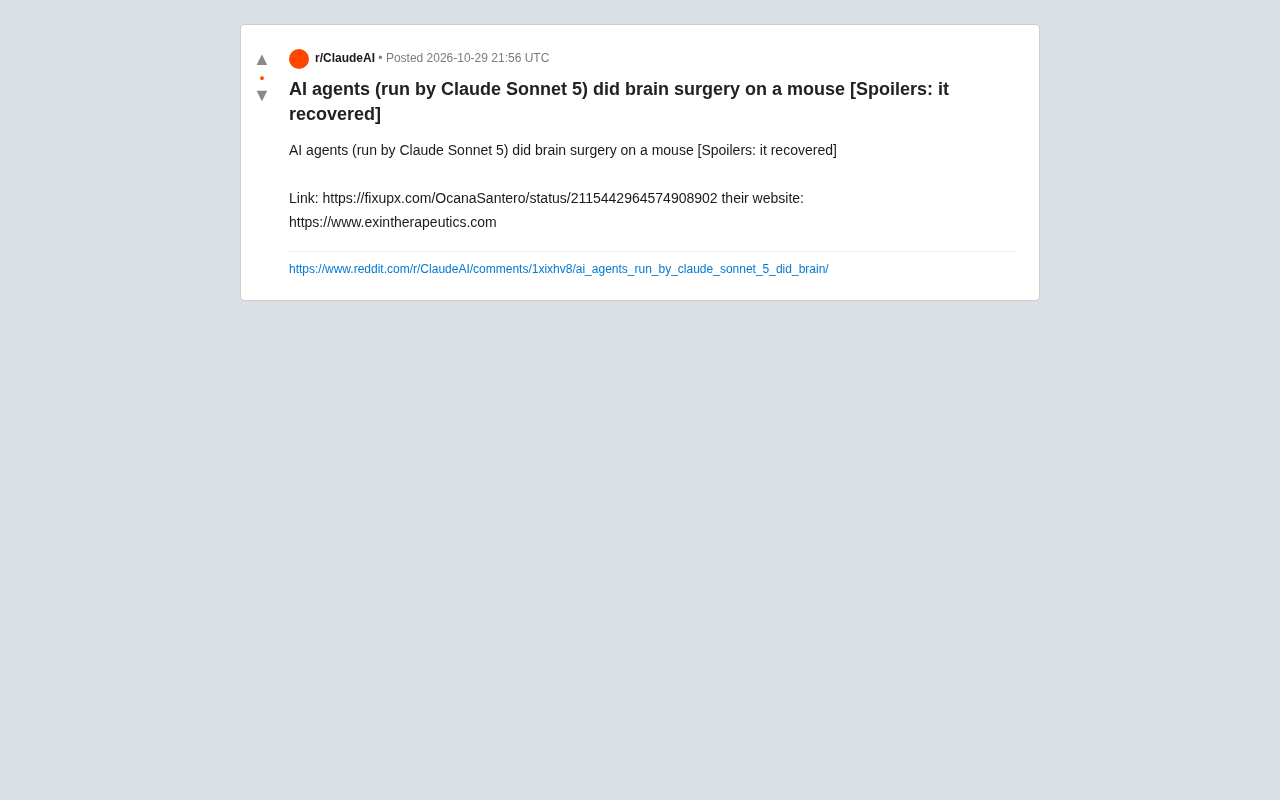
According to the post, the experiment was conducted by Ex Therapeutics, with the AI agent handling key operations during the surgery. Although details are limited, the combination of "AI agent + brain surgery" is enough to evoke a new phase of autonomous robotic surgery.
Technical Background: How AI Agents Intervene in Surgery
AI agents generally refer to intelligent systems capable of perceiving their environment, formulating plans, and executing actions. In the medical field, AI agents have already been used to assist with diagnosis, image analysis, and surgical planning. But directly manipulating surgical instruments to perform brain operations on a living animal places extremely high demands on real-time responsiveness, precision, and safety.
As a large language model, Claude Sonnet 5's strengths lie in natural language understanding and reasoning, not direct motor control. Therefore, a reasonable inference is that the AI agent may have been responsible for surgical workflow decisions, tool selection, or step coordination, while the actual movements were executed by a robotic system. The Ex Therapeutics website may offer more technical details, but currently available public information is limited.
How large language models combine with robotic control
A large language model itself does not output motor commands; it outputs text or structured data. To have a model like Claude Sonnet 5 drive physical operations, an "interface layer" is usually required: the model generates step plans, calls tool function signatures (function calling), or produces code snippets based on task goals, and then a lower-level controller translates the plan into motion commands for the robot's end effector. In robotics, this architecture is known as "LLM as high-level planner," with representative works including SayCan and Code as Policies. Its limitation lies in the semantic gap between high-level planning and low-level control—the model can articulate "incise the dura mater," but millimeter-level force feedback and tremor suppression still depend on specialized control algorithms. Therefore, a more accurate understanding of the article's claim that "the AI agent completed the surgery" is: the LLM handled workflow orchestration and exception decisions, while motion precision was ensured by conventional robotic systems.
Cross-Verification of Multi-Source Information
Currently, the news comes primarily from the Reddit post and the social media links it cites. According to Reddit users and the social media account OcanaSantero, the experiment was completed by Ex Therapeutics. However, no peer-reviewed paper or official press release has yet been seen.
Different sources describe the surgical details inconsistently: some emphasize the AI agent's autonomy, while others point out that human supervision may have been involved. Such divergence is common in early technology reporting. We should treat it with caution and wait for more verifiable information.
The difference between peer review and preprints
Peer review means that research results are reviewed by independent experts for methodology, data, and conclusions before publication, and is an important threshold for academic credibility; preprints (such as manuscripts on arXiv or bioRxiv) have not undergone this process—they spread quickly but vary in quality. Surgical studies also involve approval records from animal ethics committees (IACUC), and such information typically appears only in the methods section of formal papers. Therefore, "no peer-reviewed paper or official press release has yet been seen" means outsiders cannot verify key parameters such as surgical scale, success rate, and postoperative observation period. In the biomedical field, between a social media post and a credible conclusion, there usually lie additional steps such as experimental replication, sample size disclosure, and conflict-of-interest statements—which is the core reason for treating early reports with caution.
Potential Impact and Challenges
If the experiment is reproducible, it would mark an important step forward for AI in precision surgery. Brain surgery is extremely sensitive to tissue damage, and if an AI agent can operate stably, it could improve surgical consistency and reduce human error.
However, the challenges are equally obvious: ethical review of live animal experiments, the interpretability of AI decisions, and the difficulty of translating from animals to humans. In addition, the boundaries of the AI agent's role in surgery—whether it assists or leads—need clear regulation.
What animal experiment ethics and AI interpretability specifically mean
Live animal brain surgery must follow the "3Rs" principles (replacement, reduction, refinement) and undergo review by an institutional animal ethics committee, including anesthesia protocols, postoperative pain management, and euthanasia criteria. If AI participates in decision-making, ethical review will also ask: when an operation suggested by the AI conflicts with a veterinarian's judgment, who has the final veto? Regarding interpretability, every decision in brain surgery (such as incision angle and timing of hemostasis) requires traceable attribution, yet the reasoning chains of current large language models do not guarantee a faithful reflection of their actual computational processes—constituting a substantive obstacle in a high-stakes scenario like surgery. Moreover, the mouse brain differs from the human brain by two orders of magnitude in size, and tissue mechanical properties also differ, so success in animal experiments cannot be linearly extrapolated to clinical practice.
Conclusion
The AI agent powered by Claude Sonnet 5 completing mouse brain surgery with recovery is a signal worth noting. It demonstrates the potential of AI agents in complex physical tasks, but also reminds us to remain cautiously optimistic in the absence of detailed technical disclosure. In the future, only as Ex Therapeutics publishes more data will we be able to assess its true value.
One-line Summary
Reddit reports that a Claude Sonnet 5-powered AI agent completed mouse brain surgery, but details have not been verified by peer review.
Paragraph Summary
The article centers on a widely circulated Reddit report: Ex Therapeutics allegedly used an AI agent team powered by Claude Sonnet 5 to complete mouse brain surgery, with the mouse recovering postoperatively. The author notes that large language models excel at reasoning and planning rather than motor control, so the AI agent may have handled workflow decisions and tool coordination while a robotic system executed the actual operations. The news currently has only the Reddit post and the social media account OcanaSantero as sources, lacks a peer-reviewed paper or official press release, and sources differ on the degree of AI autonomy. The article argues that if the experiment is reproducible, it would advance AI in precision surgery, but ethical review, decision interpretability, and the animal-to-human translation challenge remain unresolved, warranting cautious optimism.
Related articles

WebMCP Security Guide: Three Hints That Make AI Agents Safer
The Chrome team demonstrates three security hints for WebMCP tools: readOnlyHint eliminates invalid confirmation dialogs, consequentialHint forces human confirmation for high-risk operations, and untrustedContentHint defends against indirect prompt injection—improving AI agent security with one or two lines of code.

Why Turbulence Is the Hardest Problem in Fluid Mechanics — and How AI Could Crack It
Why is turbulence the hardest problem in fluid mechanics? This article, based on a Lex Fridman podcast conversation, explores turbulence's multi-scale nature, comparisons with classical thermodynamics, and how AI might simplify turbulence description by discovering coordinate transformations — examining the intersection of vortex formation with mathematics and physics.

R.L. Stine Google Talk: How the Master of Horror Ignites Kids' Passion for Reading
At a Google talk, R.L. Stine shares his accidental pivot from comedy to horror, his principles for children's horror, how phones impact storytelling, and how Goosebumps motivates kids to read.