AI Agent Practical Guide: From Content Generation to Enterprise Applications

A comprehensive guide to AI Agents covering content generation for consumers and enterprise applications.
This article provides a complete breakdown of AI Agent applications across two major directions: consumer-facing content generation (text, images, GIFs, video) and enterprise applications (RAG knowledge bases, multi-agent orchestration with AutoGen, and large model integration). It covers the theoretical foundations from cybernetics to ReAct, includes real entrepreneurship cases, and offers a practical learning path from beginner to advanced.
Why Everyone Should Learn About AI Agents
AI Agents have evolved from exclusive tools for tech enthusiasts into practical instruments that help professionals and entrepreneurs boost efficiency and create value. Unlike standard large language models (LLMs) that handle one-off Q&A, Agents possess a closed-loop capability of "planning-execution-feedback." They can invoke external tools (such as search engines, code executors, and API endpoints), break down complex tasks into multiple sub-steps, and complete them sequentially—AI is no longer just "answering questions" but "completing tasks."
It's worth noting that AI Agents didn't appear out of thin air. The concept originated from classical artificial intelligence's "agent" theory—as early as 1995, Russell and Norvig defined an agent in Artificial Intelligence: A Modern Approach as "a system that perceives its environment and takes actions to achieve goals." Looking deeper into history, Agent theory traces back to Norbert Wiener's Cybernetics in the 1950s: systems continuously adjust their behavior through perception-action-feedback loops to approach goals. This idea forms the philosophical foundation of modern Agent architectures. Wiener's cybernetics originally stemmed from research on shared regulatory mechanisms between biological neural systems and mechanical systems—he discovered that both the human brain and automated navigation systems rely on negative feedback loops of "goal deviation detection → corrective action → re-detection" to maintain stability. This insight transcended the boundary between biology and machines, providing a unified theoretical framework for later AI system design: a truly intelligent system should not passively respond to inputs but actively perceive its environment, assess deviation from goals, and continuously take corrective action.
The Deep Connection Between Cybernetics and Modern Agents: The core cybernetic concept of "negative feedback loops" is directly embodied in modern AI Agent architectures. Take the ReAct framework as an example: after each action, the Agent immediately observes environmental feedback, compares actual results with expected goals, and adjusts its strategy in the next reasoning round if deviations exist—this is precisely a digital implementation of negative feedback loops. On a deeper level, cybernetics elevated "goal-oriented adaptive behavior" from a biological concept to a universal systems principle, transforming the question "Can machines autonomously pursue goals like organisms?" from philosophical speculation into engineering practice. Concepts like "objective functions," "reward signals," and "policy optimization" in modern Agent frameworks all find their theoretical roots in Wiener's cybernetic framework.
Early symbolic AI (such as the STRIPS planning system) attempted to implement "goal-driven action sequence generation," but was limited by rigid knowledge representation—relying on manually written rule bases that couldn't flexibly handle the endless new situations in an open world—making real-world deployment in complex environments difficult.
The explosion of modern AI Agents is thanks to the qualitative leap in reasoning capabilities of large language models: models like GPT-4 acquired the ability to decompose natural language instructions into executable steps, making the "planning-execution-feedback" closed loop possible. Notably, early Agent frameworks (like AutoGPT) adopted a linear "plan first, execute later" approach, generating a complete execution plan upfront before task initiation. This approach lacked error-correction capability when plans deviated. The ReAct framework, proposed jointly by DeepMind and Google in 2023, interweaves Reasoning and Acting—the Agent observes environmental feedback immediately after each action and dynamically adjusts its next reasoning step. This "think while doing" approach significantly improves Agent robustness in real-world tasks.
The name ReAct itself reveals its core mechanism: the alternating cycle of Re (Reasoning) and Act (Acting). In implementation, each cycle contains three steps: "Thought" (the model reasons about the current state), "Action" (invoking tools or executing operations), and "Observation" (obtaining action results and incorporating them into context). These three steps repeat until the task is complete. Compared to linear planning, ReAct's key advantage lies in "context-aware dynamic error correction": when an action's result doesn't match expectations, the model can identify deviations in the next "Thought" step and adjust its strategy, rather than blindly executing pre-made subsequent plans.
The Engineering Value of ReAct: ReAct's "Thought-Action-Observation" three-step cycle is not just an algorithmic design but also an explainability tool. Since each "Thought" is output in natural language, developers can directly read the Agent's "inner monologue" and quickly pinpoint reasons for task failure—something nearly impossible in traditional black-box AI systems. From a software engineering perspective, this is equivalent to the Agent automatically generating detailed execution logs, greatly reducing debugging costs. Experiments show that ReAct improves performance by approximately 10-20 percentage points over pure reasoning baselines on multi-step information retrieval QA tasks (such as HotpotQA), with even more significant improvements on interactive decision-making tasks (such as ALFWorld), validating the effectiveness of the "reasoning and action synergy" design philosophy.
ReAct's core insight is: real-world tasks are full of uncertainty, and pre-made perfect plans often fail during execution. Continuous "observation-reasoning-action" cycles are the correct approach for handling complex environments. Since 2023, frameworks like ReAct, AutoGPT, and BabyAGI have emerged in succession, marking a paradigm shift of AI from "conversational tool" to "autonomous execution system."
This article, based on a systematic AIGC beginner tutorial, outlines the two core application directions of AI Agents, helping readers establish a clear technical cognitive framework.
The tutorial author shared a real case: during a business trip at a conference, while the boss was speaking on stage, they used speech-to-text for real-time transcription, then had AI generate a summary, and within one minute after the speech ended, sent the polished transcript to the entire company group chat. This kind of "real-time productivity" is the direct change AI tools bring to the workplace.
From a broad categorization perspective, AI Agent applications can be divided into two directions: the consumer-facing 2C direction (content generation) and the enterprise-facing 2B direction (complex problem solving). Understanding this distinction is the first step in learning about AI Agents.
2C Direction: Various Approaches to AI Content Generation
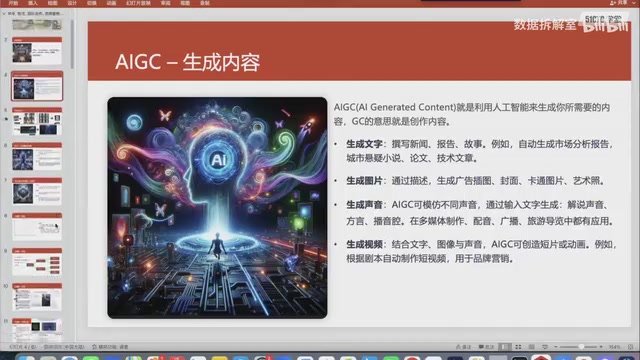
Content generation is currently the lowest-barrier, fastest-to-start AI application scenario, covering four major categories: text, images, audio, and video.
Text Generation: Workplace Essentials and Side Income Opportunities
Text output is the most universal workplace need—writing reports, organizing meeting minutes—AI can dramatically improve efficiency. The tutorial also mentions a real student case: someone learned the skills and started writing short stories on fiction websites, leveraging AI-assisted content creation. Each piece could sell for 20-30 yuan, carving out a low-cost monetization path.
Image Generation: Prompt Engineering Is Key
Image generation covers advertising illustrations, cartoon images, artistic photos, and more. The core lies in Prompt Engineering. Prompt Engineering refers to the technical method of carefully designing input text to guide large language models toward desired outputs—since large models are extremely sensitive to input phrasing, different expressions of the same question can lead to vastly different output quality.
The underlying logic of this technique deserves deeper understanding: large language models are essentially estimators of conditional probability distributions P(output|input), and input phrasing directly affects the model's "sampling path" in probability space. Mainstream techniques include: Zero-shot prompting, Few-shot examples (guiding output format by providing 2-5 examples), Chain-of-Thought (CoT, asking the model to "think step by step" to activate reasoning capabilities), and role-playing (setting an expert identity in the System Prompt). Google's 2022 CoT paper demonstrated that the single phrase "Let's think step by step" alone could multiply the model's accuracy on mathematical reasoning tasks several times over. These techniques have gradually developed into an independent engineering discipline.
The Cognitive Science Foundation of Prompt Engineering: The effectiveness of prompt engineering isn't magic—it has cognitive science underpinnings. During pretraining, large models extensively encounter human "step-by-step reasoning" text patterns (such as math problem-solving processes and code comments). CoT prompting essentially activates the model's "memory" of these reasoning patterns, causing it to reproduce similar reasoning structures during generation. From an information theory perspective, prompts serve as "prior constraints" for the model's generation process—a well-designed prompt can dramatically narrow the output space the model needs to search, concentrating probability mass in the expected output region. This also explains why prompt engineering yields far greater improvements for reasoning-intensive tasks (math, logic) than for creative writing tasks—the former has abundant structured reasoning demonstrations in training corpora, while the latter relies more on the model's creative sampling. It's worth mentioning that as model capabilities improve, "prompt engineering" is evolving toward "prompt design": from manually tweaking phrasing to using automated tools (such as the DSPy framework) to systematically optimize prompts—this field itself is rapidly developing.
Although official prompt documentation has been released, it's lengthy and has a high comprehension cost. Practical advice: distill the core points into two PPT slides and apply them directly—no need to read the original documentation word by word.
Cartoon avatar generation is a proven small-scale business case. There are numerous "real photo to cartoon AI avatar" services on Taobao: users upload real photos, which are combined with prompts to generate cartoon avatars. After completing the course, some students opened their own shops, priced at 9.9 yuan, getting around ten orders a day in the beginning—this is a typical AI micro-business landing path.
GIFs and Video: Creative Uses of the Code Interpreter
GIF generation requires ChatGPT's Code Interpreter: have AI write code to split a nine-grid image into 9 pieces, order them sequentially for playback, and synthesize a downloadable GIF. The Code Interpreter (now renamed "Advanced Data Analysis") is a sandboxed execution environment launched by OpenAI in 2023, allowing the model to write and execute code in an isolated Python runtime, directly process uploaded files (images, CSV, PDF, etc.), and return execution results. Its core value lies in bridging the gap between "language understanding" and "program execution"—users need no programming background, just describe requirements in natural language, and the model automatically generates, runs, and debugs code, returning results as files or visualizations.
From a technical architecture perspective, the Code Interpreter's "sandbox isolation" design is crucial: each session runs in an independent container environment (typically implemented using Docker technology), with each session having its own file system, memory space, and network permissions. This prevents malicious code from affecting the host system while ensuring different users' data don't interfere with each other.
Core Principles of Docker Container Technology: The core of Docker container technology is OS-level virtualization—unlike traditional virtual machines, containers share the host machine's OS kernel but achieve complete isolation of processes, file systems, and networking through Linux's Namespace and cgroup mechanisms. They start dozens of times faster than VMs with lower resource overhead. The Namespace mechanism makes each container "think" it has its own independent OS, while the cgroup mechanism limits the CPU, memory, and other resource ceilings available to each container, preventing a single container from exhausting host resources. This enables OpenAI to instantly create independent runtime environments for each user session, completing container startup and destruction in milliseconds. When a session ends, the container is destroyed and data is not persisted—this "use and discard" design ensures security but also means users need to download required files during the session, otherwise generated artifacts will disappear when the session closes. This design makes "having AI directly operate on real data" a safe and feasible approach, and is the core distinction between the Code Interpreter and ordinary code generation features.
Processes that previously required manual operations can now be completed with a single prompt.
The approach for video generation is: have ChatGPT first generate a script, then hand the script to tools like CapCut (Jianying), combined with images to synthesize video. This type of content, paired with Douyin, Xigua Video, and Toutiao's Medium Video Program—uploading three or more one-minute horizontal (16:9) videos, with monetization available at 17,000 views—is practically a zero-cost content entrepreneurship path.
2B Direction: Three Core Technologies for Enterprise AI Agents
When requirements exceed what "a single prompt can solve," we enter the enterprise AI application domain. There are three key technologies here: RAG, AI Agents, and LLM integration.
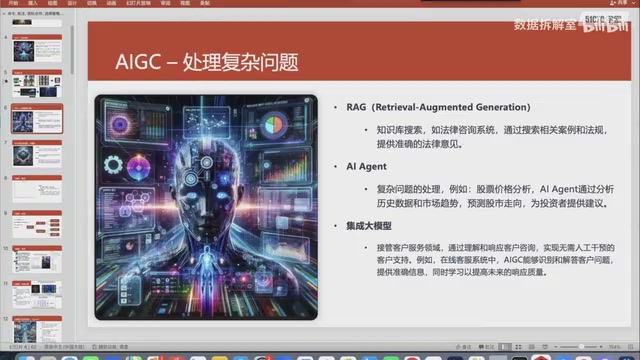
RAG: Ending Large Model "Hallucinations"
RAG (Retrieval-Augmented Generation) is a search-enhanced technology, with its most typical application being enterprise knowledge base search. Its core value lies in solving the large model "hallucination" problem—where models generate content that appears reasonable but is actually inaccurate or completely wrong, typically expressed in an extremely confident tone. This phenomenon stems from the nature of large models: they are probabilistic prediction systems trained on massive text, aiming to generate "statistically plausible" text rather than guaranteeing factual accuracy, making them particularly dangerous in professional domains like healthcare, law, and finance.
RAG's working principle has two phases: first, the "indexing phase," where documents are split into small chunks, converted into high-dimensional vectors through an Embedding Model, and stored in a vector database; second, the "retrieval-generation phase," where user questions are similarly converted to vectors, similarity search is performed in the database, the most relevant text fragments are injected as context into the large model's prompt, and the model generates the final answer.
Intuitive Understanding of Vector Similarity Search: Understanding this mechanism requires grasping the core principle of "vector similarity search." Embedding models (such as OpenAI's text-embedding-ada-002 or the open-source BGE series) map text to high-dimensional vector spaces (typically 768 to 1536 dimensions), where semantically similar texts are closer in distance. Vector databases (such as Pinecone, Weaviate, and China's Milvus) are specifically optimized for Approximate Nearest Neighbor (ANN) search algorithms in high-dimensional vectors, completing similarity searches across millions of documents in milliseconds. The intuitive understanding of this process is: the vector distance between "cat" and "dog" is much closer than between "cat" and "car"—the model learns semantic associations between words and concepts through massive text and encodes them as computable geometric distances. Notably, the quality of the embedding model directly determines the retrieval ceiling of a RAG system: a good embedding model can capture not only lexical-level similarity but also understand the semantic correspondence between "questions" and "answers" (even when they use completely different wording)—this capability is called "cross-semantic retrieval" and is one of the core metrics for evaluating embedding model quality.
It's worth understanding deeply that RAG is essentially a fusion architecture of "parametric knowledge" and "non-parametric knowledge." The model's parameters store general knowledge learned during training (parametric knowledge), but this knowledge is "frozen" after training ends and cannot be updated; documents stored in vector databases are "non-parametric knowledge" that can be added, deleted, modified, and queried at any time without retraining the model. RAG dynamically combines both through a retrieval mechanism: the model provides reasoning and language generation capabilities, while the database provides the latest and most accurate domain knowledge. The elegance of this architecture lies in decoupling "knowledge storage" from "knowledge reasoning," allowing enterprises to give AI access to the latest business information simply by updating the knowledge base without modifying model parameters—particularly important for industries with frequent knowledge updates (such as legal regulations, product manuals).
RAG's limitations are also worth noting: when questions require comprehensive reasoning across multiple document fragments, simple similarity retrieval may miss critical information, spawning advanced solutions like "GraphRAG" (graph-based augmented retrieval). GraphRAG was proposed by Microsoft Research in 2024, with its core approach being to pre-build entity relationship graphs (knowledge graphs) on top of traditional vector retrieval—each node in the graph represents an entity (person, company, event), and edges represent relationships between entities—enabling the system to perform multi-hop reasoning along entity relationship chains, answering complex questions like "What's the connection between Company A's CEO and Company B?" that require cross-document relational reasoning. GraphRAG and traditional RAG are not substitutes but complements: for precise factual queries, vector retrieval is more efficient; for complex questions requiring relational reasoning, graph retrieval is more accurate. Production systems often combine both, building "hybrid retrieval" architectures that balance performance and coverage.
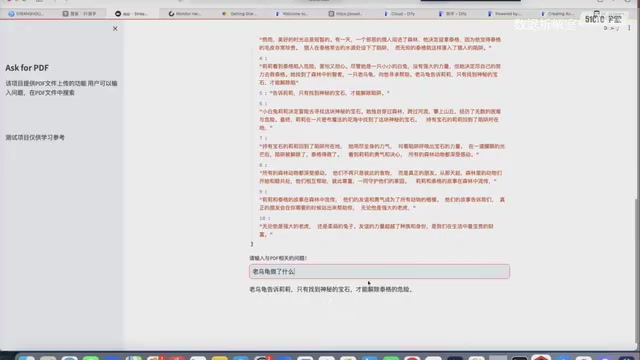
Here's a concrete example: upload a fairy tale PDF, and the system automatically chunks it to build a knowledge base. If you directly ask a large model "What is the relationship between Lily and Tiger?" it doesn't know; but with knowledge base retrieval, it can accurately answer "friends."
RAG is particularly valuable in customer service systems. Directly asking a large model about product introductions yields generic information; but after uploading brand product materials as a knowledge base, the model prioritizes retrieval and provides targeted answers aligned with the merchant's intent—this is exactly the core enterprise need for AI customer service to "only recommend what I want customers to know."
AI Agent: Automatically Orchestrating Multi-Step Complex Tasks
AI Agents are powerful tools for handling truly complex problems. Take stock price analysis as an example—a seemingly simple "analyze this stock" request involves behind the scenes:
- Locating data source websites
- Writing code to download price data (including debugging)
- Historical data comparison and analysis
- Automatically generating visualizations
- Outputting an investment recommendation report
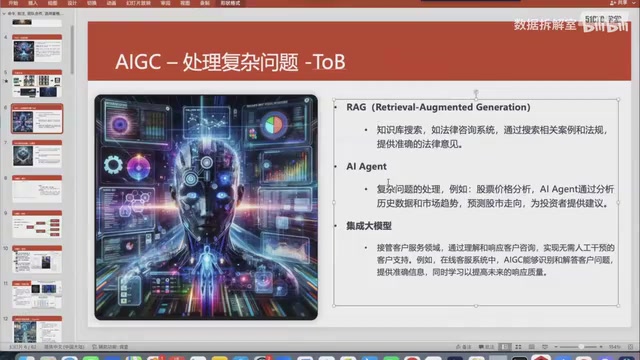
This chain of steps is exactly where AI Agents excel. Microsoft's AutoGen architecture can implement this kind of automated complex task orchestration. AutoGen is an open-source multi-agent dialogue framework from Microsoft Research, with its core design philosophy being to complete complex tasks through collaboration between multiple Agents with different roles: a "user proxy" receives requirements, a "code generation Agent" writes code, a "code execution Agent" runs code and provides feedback—the three form an automated dialogue loop until the task is complete.
From an engineering architecture perspective, AutoGen borrows from the "microservices architecture" design philosophy in software engineering—each Agent focuses on a single responsibility, communicating through standardized message protocols. Errors can be automatically detected and corrected within the loop (similar to CI/CD pipelines in software development), and different Agents can call different underlying models (e.g., GPT-4 for code tasks, a more economical model for text summarization), balancing performance and cost.
The Theoretical Foundation of Multi-Agent Systems: From a broader perspective, the theoretical foundation of Multi-Agent Systems (MAS) comes from the distributed artificial intelligence field. Its core insight is: complex problems often cannot be efficiently solved by a single agent, while collective intelligence emerging through role division and collaboration often exceeds the simple sum of individual capabilities. This theory has direct analogies in nature: no single ant in a colony "understands" the entire nest construction plan, but through simple local interaction rules, the colony can exhibit highly complex collective behavior—this "Emergent Intelligence" is the core research topic of MAS. AutoGen combines this theory with LLM's natural language interaction capabilities, making it possible to "define Agent roles and collaboration rules in natural language," dramatically lowering the development barrier for multi-agent systems. It's worth noting that multi-Agent systems also bring new challenges: communication overhead between Agents, coordination costs for task allocation, and the amplification effect of errors propagating through Agent chains are all engineering issues that require careful consideration in actual deployment.
AutoGen's emergence marks a paradigm shift in AI applications from "single model invocation" to "multi-agent collaboration," an architectural philosophy widely adopted by subsequent frameworks like LangGraph and CrewAI.
Large Model Integration: Injecting New Capabilities into Legacy Enterprise Systems
The third direction is connecting large models to existing enterprise systems. Many companies still use OA systems, internal management platforms, or apps developed years ago—integrating large models can revitalize them with new capabilities.
A typical customer service system case: traditional AI customer service can only handle fixed Q&A; after integrating a large model, the system can analyze customer chat records, assess purchase intent, filter out high-intent customers, and organize the data into datasets for continuous model fine-tuning, thereby improving conversion rates—this is the substantive business value that large model integration delivers.
From a technical implementation perspective, large model integration is typically achieved through two paths: API calls (such as OpenAI API or domestic alternatives like ERNIE Bot, Tongyi Qianwen) or private deployment (deploying open-source models like LLaMA or Qwen on enterprise intranets). For industries with high data security requirements like finance and healthcare, private deployment is the mainstream choice; for SMEs, calling cloud APIs is the most cost-effective starting point. Notably, large model integration isn't simply "connecting interfaces"—it also requires solving prompt engineering (how to translate business scenarios into effective instructions), output structuring (how to parse the model's natural language output into structured data processable by systems), and safety filtering (preventing inappropriate model outputs) challenges.
Among these, "output structuring" is an often-overlooked but critical component: large models output natural language by default, while enterprise systems typically require structured formats like JSON or XML. Mainstream solutions include Function Calling (having the model output in predefined function parameter formats) and Structured Output (forcing the model to follow a specified JSON Schema).
The Underlying Implementation Mechanism of Function Calling: Function Calling's working mechanism is particularly worth understanding: developers pre-define a set of "tool functions" and their parameter specifications, the model determines during inference whether a tool needs to be called, and if so, outputs the function name and parameters in strict JSON format. The external system executes it and returns results to the model, which then generates the final answer. From an implementation perspective, Function Calling doesn't mean the model truly "calls" an external function—it's a carefully designed "formatted output protocol": the model was specifically fine-tuned during training to recognize when to output a tool-calling format and how to correctly fill in parameters. The external system parses this formatted output, executes the actual function call, then appends the result as a "tool return value" to the conversation context for the model to reference in its next generation. This cycle of "model output → external execution → result return → model continues generating" is precisely the underlying implementation mechanism of AI Agent tool-calling capabilities. It's particularly important to note that Function Calling and AI Agent tool-calling capabilities highly overlap: the "tool calling" step in Agent frameworks is implemented through the Function Calling mechanism at the bottom layer. This means mastering Function Calling is actually a key step in understanding how AI Agents work—from enterprise integration to autonomous Agents, both share the same underlying logic of "model-driven external execution." This mechanism essentially upgrades large models from "language generators" to "task schedulers," enabling them to reliably drive external systems to perform specific operations.
These technologies collectively form the core skill stack of the emerging "AI Engineer" profession.
Summary: The Complete Value Landscape of AI Agents
The value of AI Agents can be summarized in two major areas:
2C Content Generation—generating text, images, GIFs, and videos. Suitable for personal productivity and small-scale entrepreneurship, with low costs and quick start.
2B Enterprise Applications—enterprise knowledge bases (RAG), complex task handling (AI Agents), and large model integration. Targeting enterprise-level productivity improvement.
For beginners starting from zero, building intuition through 2C content generation first, then gradually diving into the 2B technology stack, represents a relatively smooth growth path. The essence of AI Agents is providing systematic support through human-understandable means across text generation, image creation, knowledge base construction, and production efficiency improvement.
Related articles

Kimi K3 Deep Dive: 2.8 Trillion Parameter Open-Source Model Closes the Gap with Closed-Source Frontier for the First Time
Moonshot AI releases Kimi K3 open-weight model with 2.8T parameters and 1M token context. Our deep dive covers coding, 3D dev, agent capabilities, and safety concerns.

How to Choose an AI Agent Platform for Your Team: 5 Evaluation Dimensions and a Decision Framework
Choose the right AI Agent platform by evaluating model flexibility, observability, tool integration, security compliance, and total cost. A complete decision framework to help technical leaders avoid vendor lock-in.

Legora's Legal AI Practice: How Vertical AI Empowers Law Firms and Corporate Legal Transformation
Explore Legora's legal vertical AI practice, covering AI model selection strategies, enterprise legal transformation challenges, and the path to deploying vertical AI in the legal industry.