AI Agent Security Testing: A Developer's Take on Integration Approaches and Privacy Trade-offs

As AI agents gain financial execution powers, security testing faces new prompt injection threats and real privacy trade-offs.
As AI agents gain permission to execute payments, refunds, and transfers, a new class of threats emerges — prompt injection, unauthorized tool calls, and payment tampering that exploit semantic vulnerabilities rather than code bugs. A developer building AgentPaySec, a purpose-built security testing platform, is soliciting community input on integration approaches ranging from APIs and SDKs to MCP, proxy layers, and local runners. The central tension is data boundaries: effective testing requires access to tool schemas and call traces, which are highly sensitive for financial teams, making self-hosting a prerequisite rather than an option. The discussion reveals that agent security testing lacks established standards, and friction costs alongside privacy constraints will determine whether any tool achieves real-world adoption.
When AI Agents Start Moving Money, Security Testing Becomes Essential
As AI agents evolve from simple conversational assistants into autonomous systems capable of taking real-world actions, a long-overlooked problem is surfacing: when an agent can initiate purchases, payments, refunds, or even transfers, who ensures it can't be maliciously manipulated?
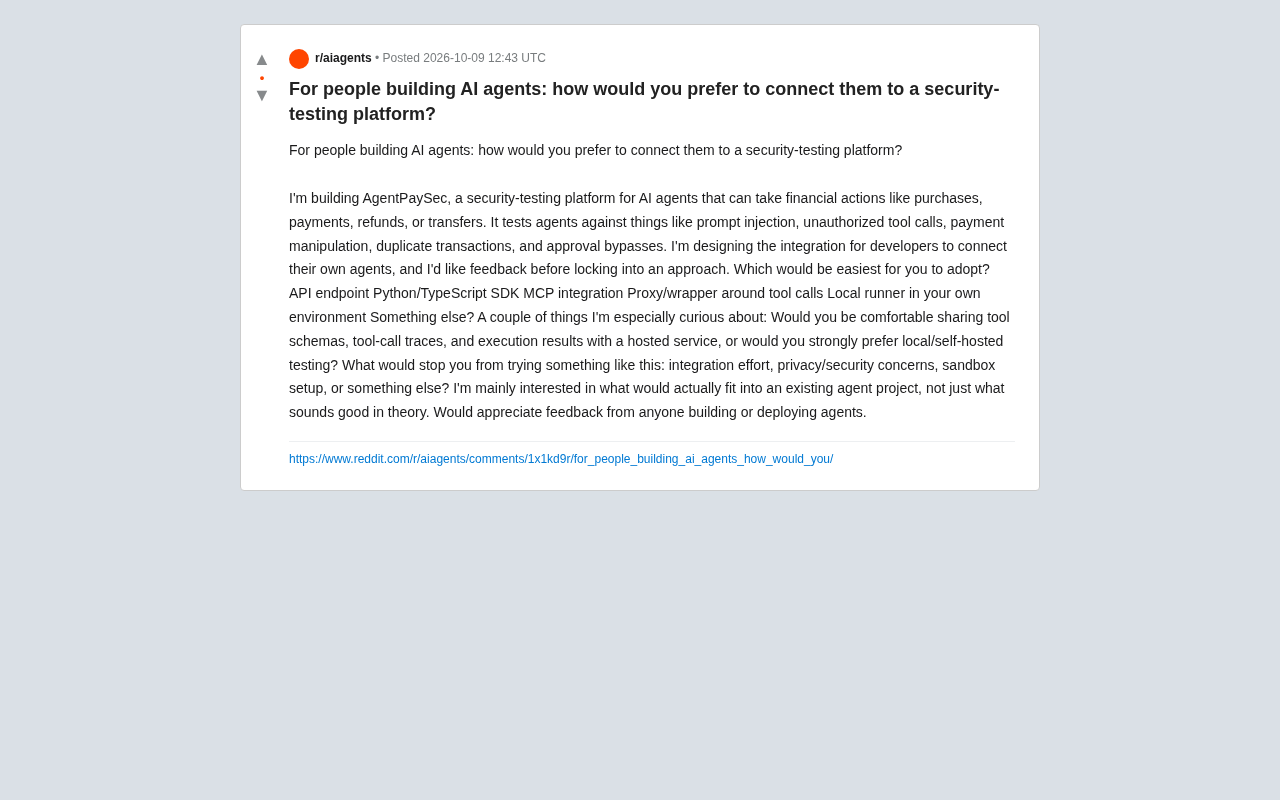
A developer recently sparked a discussion on Reddit, sharing a security testing platform called AgentPaySec that he's building. The platform is specifically designed for AI agents that execute financial operations, testing their resilience against prompt injection, unauthorized tool calls, payment tampering, duplicate transactions, and approval bypass attacks.
This topic deserves attention not because of any particular product, but because it exposes a real challenge in the agent security space — one without a consensus answer: how do you build security guardrails for autonomously operating AI without sacrificing privacy or developer efficiency?
The Attack Surface Is Larger Than You Think
Traditional software security testing has well-established methodologies, but AI agents introduce an entirely new attack surface. When an agent is granted permission to call payment APIs, process refunds, or execute transfers, natural language understanding — an inherently uncertain element — becomes embedded in its decision-making chain.
Prompt injection is the most representative threat: an attacker might craft inputs that trick an agent into performing actions it shouldn't. For example, a seemingly ordinary email could contain hidden instructions that cause a mail-processing agent to quietly initiate a transfer. Each attack scenario listed in the original post — unauthorized tool calls, payment tampering, duplicate transactions, approval bypass — can cause real financial losses in practice.
What makes these risks unique is that they're often not code-level vulnerabilities but rather semantic-layer manipulations. Conventional penetration testing tools struggle to cover them, which is precisely the justification for purpose-built agent security testing platforms.
Prompt injection attacks can be further divided into two categories: direct injection (the attacker sends malicious instructions directly to the agent) and indirect injection (malicious instructions are embedded in external data the agent processes, such as web content, documents, or email bodies). The latter is more dangerous because agents often cannot distinguish between "content to be processed" and "instructions to be followed" — especially when a model has been trained to comply with instructions appearing in context. Since 2023, researchers have demonstrated the viability of indirect injection on several major large language models, including getting internet-connected assistants to execute attacker-planted instructions while browsing web pages. The damage in financial contexts is particularly severe: a tampered vendor invoice or a confirmation email with hidden instructions could both become entry points for hijacking payment operations.
The Integration Debate: An Engineering Choice With No Clear Answer
At the heart of the post is an open question for developers: how would you prefer to connect your agent to a security testing platform? The author laid out several candidate approaches:
Common Integration Paths
- API endpoint: The most universal option, suitable for cross-language use, but requires developers to handle request formatting themselves.
- Python/TypeScript SDK: Most developer-friendly for teams using mainstream language stacks, significantly reducing onboarding overhead.
- MCP integration: Leverages the emerging Model Context Protocol standard, making tool-call testing more aligned with the agent's native interaction model.
- Proxy/Wrapper for tool calls: Inserts an interception layer into the tool-call chain without requiring changes to the agent's core logic.
- Local Runner: Executes tests entirely within the developer's own environment, keeping data on-premises.
Each option reflects different engineering trade-offs. SDKs are fast to integrate but language-specific; proxy layers require minimal changes but may affect performance; local runners offer the best privacy profile but carry higher deployment and maintenance costs. For teams with mature agent projects, "can this fit seamlessly into our existing architecture" typically matters more than "does this approach sound sophisticated" — the author himself emphasized he wants to know what actually integrates into real projects, not what sounds ideal in theory.
MCP (Model Context Protocol) is an open standard proposed by Anthropic in late 2024, designed to unify how AI models interact with external tools and data sources. Its core idea is to standardize the capability descriptions (schemas), invocation patterns, and permission controls of tools, enabling models and tools from different vendors to interoperate — essentially acting as a "USB interface" for AI. In the context of security testing, MCP's value lies in the fact that it natively carries structured tool-call metadata: a testing platform can intercept and analyze every tool-call request through a standard interface without needing custom adapters for each agent framework. Claude, several open-source frameworks, and a number of enterprise AI platforms have announced MCP support, though the ecosystem remains early-stage and less mature than REST APIs or mainstream language SDKs.
Privacy and Hosting: The Trust Threshold That Can't Be Ignored
The sharpest question in this discussion is data boundaries. For a security testing platform to work effectively, it typically needs access to the agent's tool schemas, tool-call traces, and execution results. These happen to be the most sensitive data — they expose the agent's capability scope, business logic, and transaction details.
The author directly raised this dilemma: would developers be willing to hand this information to a hosted service, or would they strongly prefer local or self-hosted testing?
For most teams handling financial operations, the answer likely skews toward the latter. Uploading transaction traces to a third-party service is itself a security risk and may also trigger compliance violations. This explains why the "Local Runner" option appears on the candidate list — in the security tooling category, self-hosting is often not a nice-to-have feature but a prerequisite for adoption.
The sensitivity of tool-call traces is often underestimated. A complete trace contains not just input parameters and return values, but also the agent's reasoning path, the conditions that triggered business rules, and exception handling logic. Combined, this information is nearly equivalent to an executable business process document. For financial institutions, such data may also fall under PCI-DSS (Payment Card Industry Data Security Standard), GDPR, or local financial regulations — uploading it to a third party without anonymization could constitute a direct compliance violation. This is the fundamental reason the "Local Runner" option holds decisive appeal for serious financial applications: tests run in a controlled environment, sensitive data never leaves the organization's boundary, and the security testing process itself does not become a new attack vector.
The Real Barriers to Adoption
The author also asked: what would stop you from trying a tool like this? He listed several potential obstacles: integration effort, privacy and security concerns, and the complexity of setting up sandbox environments.
These factors collectively point to a single conclusion: the bottleneck to adopting security testing tools usually isn't the features themselves — it's friction costs. A tool that requires developers to spend half a day setting up a sandbox and then hand over sensitive data will struggle to gain real-world traction, no matter how strong its testing capabilities. By contrast, a solution that integrates with a few lines of SDK code or a transparent proxy layer, and that supports local execution, actually stands a chance of being adopted by teams.
Takeaways for Agent Developers
Setting aside any specific product, this discussion offers useful reference points for developers building or deploying agents:
- Build security testing into the design early: Especially when granting agents execution permissions (payments, transfers, refunds), prompt injection and tool-call abuse must be treated as default threat models.
- Evaluate data boundaries first: Before adopting any third-party security service, clarify which data can leave your environment and which must stay on-premises.
- Integration cost determines tool viability: No matter how powerful a testing capability is, it won't be used sustainably if it can't fit into existing pipelines with minimal friction.
Agent security testing remains a young and rapidly evolving field without established standards. Open discussions like this one from first-hand builders reflect the industry's genuine state of exploration. For any developer giving AI access to real-world operations, thinking through these questions proactively is far wiser than remediation after the fact.
Related articles

Chain of Thought Isn't Just for AI: How Humans Can Use CoT to Improve Thinking Quality
Chain of Thought isn't just a prompt trick for large models. Starting from a Hacker News discussion, this article analyzes why CoT works for human thinking too, breaks down actionable ways to transfer it, and highlights the key differences between human CoT and machine CoT.
Cloudflare Teams Up with OpenAI: Closi…
Cloudflare Teams Up with OpenAI: Closing the Loop from Vulnerability Discovery to Defense with AI
Cloudflare uses OpenAI Daybreak to investigate security vulnerabilities and generate reviewable remediation plans, while developers use Codex to boost coding efficiency and quality.

Orca Multi-Agent Orchestration in Practice: A Guide to Parallel Collaboration with Claude and Codex
Orca is Stable AI's free open-source agent workbench supporting 34 agents like Claude Code and Codex in parallel. Learn its Git worktree isolation, multi-model orchestration, and mobile management.