AI Agent Skill Stack Fully Decoded: Building Professional Agents with 16 Pluggable Skills

A breakdown of 16 pluggable Skills that turn AI Agents from generic assistants into professional collaborators.
This article dissects a developer's 16-skill Agent stack spanning engineering, evaluation, design, communication, memory, and automation. It explains how modular, pluggable Skills — from code review and TDD workflows to browser automation and SEO auditing — address real pain points in Agent-driven workflows, and why building a customized skill stack matters more than model choice alone.
From General-Purpose Assistant to Professional Collaborator
AI Agents have evolved from simple conversational tools into intelligent entities capable of executing complex workflows. The concept of an AI Agent originates from the "autonomous agent" theory in artificial intelligence research, referring to software entities that can perceive their environment, formulate plans, and autonomously execute actions. Early AI assistants (such as Siri and Alexa) were essentially intent-recognition-based reactive systems, whereas modern Agents possess Chain-of-Thought reasoning, Tool Use, and multi-step planning capabilities. Since 2023, as large language models like GPT-4 and Claude have demonstrated powerful reasoning and code generation abilities, the industry has begun exploring the use of LLMs as the "brain" of Agents, combined with external tools and memory systems to build end-to-end autonomous workflows. This paradigm, known as "Agentic AI," represents a fundamental shift from passive Q&A to proactive execution.
An increasingly clear trend is emerging: Agent capabilities are no longer solely determined by the foundation model, but are extended through pluggable "skill packs" (Skills). These skill packs transform an Agent from a generic assistant that speaks in generalities into a collaborator with professional expertise in specific domains.
Recently, a Reddit developer shared their custom-built "Agent skill stack," encompassing 16 skills across multiple dimensions including engineering, evaluation, design, communication, memory, and automation. This list is more than just a collection of tools — it reflects a mature path toward productionizing Agents in practice, where each skill addresses a specific pain point.
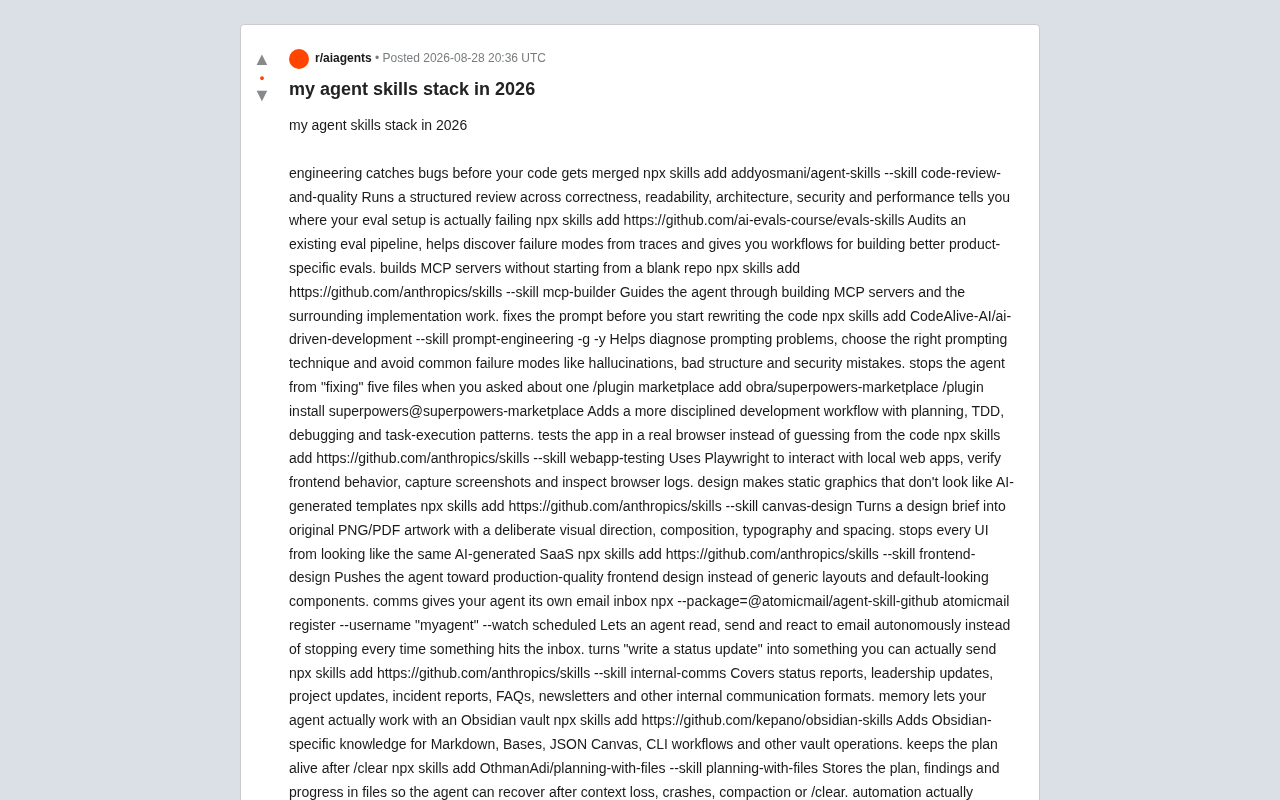
This article systematically examines this skill stack and analyzes the design logic behind it. Most of these skills can be installed with a single npx skills add command, reflecting how the Skills ecosystem is moving toward standardization and modularity.
Engineering Skills: Code Quality and Development Discipline
The engineering domain is where Agents are most commonly used — and where things are most likely to go wrong. Fittingly, engineering-related skills make up the largest share of this skill stack.
Code Review and Quality Gatekeeping
code-review-and-quality (from addyosmani/agent-skills) performs structured reviews before code merges, covering five dimensions: correctness, readability, architecture, security, and performance. This addresses a classic problem: AI-generated code often runs, but doesn't necessarily meet engineering standards. Having the Agent self-review before submission is essentially building in a CI quality gate.
In traditional software engineering, Code Review is a core practice for ensuring code quality, typically involving senior engineers inspecting code changes line by line. However, the bottleneck of manual review lies in reviewers' limited attention and susceptibility to cognitive biases (such as relaxed scrutiny of familiar code). Introducing AI into the review process isn't meant to replace human reviewers, but rather to serve as a "first line of defense" that filters out obvious standard violations and potential security risks, allowing human reviewers to focus on higher-level concerns like architectural decisions and business logic.
Development Discipline and Scope Control
A widely known Agent pain point is "over-fixing" — you ask about an issue in one file, and it goes ahead and modifies five. The workflows offered through the superpowers plugin marketplace inject development discipline into the Agent by introducing planning, TDD (Test-Driven Development), debugging, and task execution modes, preventing it from going rogue with well-intentioned but destructive "help."
TDD (Test-Driven Development) is a software development methodology that requires writing test cases before writing functional code, then implementing the minimum code needed to pass the tests, and finally refactoring. Introducing TDD into Agent workflows holds special significance: AI tends to generate code in a "one-shot" fashion, lacking the discipline of incremental verification. This means the generated code may appear locally correct but introduce unexpected side effects at the system level. By forcing the Agent to write tests before implementation, its behavior is constrained within clearly defined acceptance criteria, dramatically reducing runaway behaviors like "over-fixing" and "cascading changes."
MCP Server Building
mcp-builder (from anthropics/skills) targets the currently popular MCP (Model Context Protocol) ecosystem, guiding the Agent to build MCP servers and accompanying implementations from scratch, eliminating the paralysis of facing an empty repository.
MCP is an open protocol proposed by Anthropic in late 2024, aimed at standardizing communication between AI models and external data sources and tools. Before MCP, different AI applications had to write custom integration code for each external service (such as databases, APIs, and file systems), leading to massive duplication of effort and a fragmented ecosystem. MCP uses a client-server architecture: AI applications act as MCP clients to initiate requests, while MCP servers encapsulate access to specific data sources or tools. This design is similar to how the USB protocol standardized hardware connections — developers only need to implement an MCP server once for it to be callable by all MCP-compatible AI applications. As of mid-2025, MCP has gained support from major vendors including OpenAI, Google, and Microsoft, becoming the de facto standard for Agent tool integration. The significance of the mcp-builder skill is that it dramatically lowers the barrier for developers to plug into this ecosystem.
Evaluation and Prompt Engineering: Upstream Quality Governance
If code review is post-hoc gatekeeping, then Evals and prompt engineering are proactive governance.
evals-skills (from ai-evals-course) can audit existing evaluation pipelines, discover failure modes from traces, and provide workflows for building better evaluations tailored to specific products. This strikes at a weak spot for many teams: they have an eval system, but don't know where their evals are actually failing.
Evals (evaluations) are systematic methods for measuring AI system quality, covering dimensions such as accuracy, consistency, safety, and latency. Unlike traditional software unit tests, AI evaluation faces unique challenges: model outputs are non-deterministic, meaning the same input may produce different results; judgment criteria are often subjective (e.g., "is the answer helpful?"); and evaluation datasets may suffer from distribution shift relative to real usage scenarios. Current industry best practices include: using "LLM-as-Judge" to have another model score outputs, building evaluation sets that match production traffic distributions, and tracking evaluation metrics as time trends rather than point-in-time values. However, the pain point for many teams is "eval blind spots" — they've built evaluation pipelines but can't identify which failure modes are being missed or which evaluation metrics have become misaligned with product goals. evals-skills is specifically designed to address this systemic blind spot.
Meanwhile, prompt-engineering (from CodeAlive-AI) emphasizes "fix the prompt before rewriting the code." It helps diagnose prompt issues, select appropriate prompting techniques, and avoid common failure modes such as hallucinations, structural confusion, and security risks. This philosophy is quite illuminating — many so-called "model capability limitations" are fundamentally prompt design problems.
Prompt engineering has evolved from the early days of "writing good questions" into an engineering discipline with systematic methodologies. Mainstream prompting techniques include: few-shot prompting (providing examples to guide output format), Chain-of-Thought prompting (requiring the model to show its reasoning process), the ReAct pattern (alternating between reasoning and action), and structured output constraints (using JSON Schema or XML tags to standardize output format). Research has shown that prompt design quality, in many scenarios, has a greater impact on model output effectiveness than differences in model capability itself. For example, a well-designed prompt can enable a medium-sized model to outperform a much larger model on specific tasks. Common prompt failure modes include: hallucinations caused by ambiguous instructions, format chaos from a lack of output constraints, and instruction-following degradation from overly long system prompts. Understanding these failure modes is the key step in moving prompt engineering from "trial and error" to true engineering discipline.
Frontend and Design Skills: Escaping the "AI Template Look"
With the proliferation of AI-generated content, a new problem has emerged: every product looks like it was generated from the same AI SaaS template. This skill stack specifically targets this phenomenon.
webapp-testing uses Playwright to test applications in a real browser rather than merely guessing behavior from code, verifying frontend interactions, taking screenshots, and checking browser logs. This shifts the Agent from "armchair reasoning" to "real-world validation."
Playwright is an open-source browser automation framework developed by Microsoft, supporting three major browser engines: Chromium, Firefox, and WebKit. Compared to the earlier Selenium, Playwright adopts a more modern architectural design: it communicates directly with browsers through native protocols like CDP (Chrome DevTools Protocol), avoiding the latency and instability introduced by the WebDriver layer; it supports automatic waiting mechanisms that intelligently determine when page elements are interactable, dramatically reducing "race condition" issues in testing. In Agent scenarios, Playwright's value lies in enabling AI to validate its own generated frontend code in a real browser environment — not just checking DOM structure, but simulating user interactions (clicks, inputs, scrolling), capturing network requests, detecting console errors, and even taking screenshots as baselines for visual regression testing.
On the design front, two skills complement each other: canvas-design can transform design briefs into original PNG/PDF works with clear visual direction, composition, typography, and spacing, breaking free from template graphics; frontend-design pushes the Agent to produce production-grade frontend designs rather than cookie-cutter default component layouts.
The value of this set of skills is that they inject "aesthetics" and "uniqueness" as executable objectives into the Agent, rather than allowing it to output mediocre results. This approach reflects an important cognitive shift in AI-assisted design: the design problem with AI isn't insufficient technical capability, but rather a lack of clear aesthetic constraints and brand differentiation guidance. When all teams use the same defaults, the "AI template look" becomes inevitable. By injecting design standards and visual specifications through skill packs, Agents can move from outputs that are merely "functional" to outputs that are "usable and distinctive."
Communication and Memory Skills: Keeping the Agent Running Continuously
For an Agent to truly work autonomously, it must solve two infrastructure problems: how to communicate with the outside world and how to remember what it has done.
Communication Capabilities
The atomicmail skill equips the Agent with its own mailbox, enabling it to autonomously read, send, and respond to emails without having to pause and wait for human intervention every time an email arrives. internal-comms (from anthropics/skills) covers internal communication formats such as status reports, leadership updates, incident reports, FAQs, and newsletters, turning "write a progress update" into a genuinely deliverable product.
Giving Agents communication capabilities is a critical step toward achieving true autonomy. In the traditional human-machine collaboration model, every external interaction by the Agent requires human review and forwarding, creating a severe efficiency bottleneck. When an Agent can directly handle email and internal communications, it can work asynchronously — continuing to process tasks, respond to queries, and advance workflows during hours when humans are offline. However, this also raises new challenges around Agent permission boundaries and accountability: who does an email sent by the Agent represent? How is accountability handled for misdirected messages? These questions are driving "Agent governance" to become a new area of engineering concern.
Memory and Persistence
obsidian-skills (from kepano) enables the Agent to operate an Obsidian knowledge base, mastering Markdown, Bases, JSON Canvas, and CLI workflows. Obsidian is a knowledge management tool based on local Markdown files, renowned for its bidirectional links, graph view, and powerful plugin ecosystem. Unlike cloud-based tools like Notion, Obsidian stores all data as plain text files locally, making it a natural fit for AI Agent integration: Agents can read and write Markdown files directly through the file system API without complex authentication or API calls. Obsidian's Bases feature provides database-like structured data management, while JSON Canvas supports visual mind maps and flowcharts. When an Agent gains the ability to operate an Obsidian knowledge base, it can persist research notes, project documentation, decision records, and more as structured knowledge assets, forming a continuously accumulating "second brain."
Even more critical is the planning-with-files skill — it stores plans, discoveries, and progress in files, allowing the Agent to recover its work after context loss, crashes, compression, or running /clear.
This design directly addresses a core Agent weakness: the limited context window causes frequent "amnesia" during long-running tasks. The context window refers to the maximum number of tokens a large language model can process in a single inference. Although the context windows of the latest models have expanded to hundreds of thousands or even millions of tokens, context management remains a core challenge in real-world Agent workflows. Long-running Agent tasks continuously accumulate conversation history, tool call results, and intermediate states, potentially exceeding window limits or causing the model to forget early critical information due to the "Lost in the Middle" effect. The industry's countermeasures fall into two categories: "compression" strategies that streamline context through summarization and selective forgetting; and "externalization" strategies that persist critical information to files, databases, or knowledge bases, loading it back on demand. planning-with-files is a textbook implementation of the externalization strategy — it writes the Agent's plans and progress to the file system, freeing it from reliance on the volatile context window to maintain task continuity.
Automation and Growth Skills: From Advice to Execution
Finally, there are the automation and growth skills, which share a common theme: evolving from "telling you how to do it" to "doing it for you."
agent-browser (from vercel-labs) gives the Agent real browser automation capabilities, covering navigation, form filling, screenshots, data extraction, authentication, and even systematic exploratory testing. Compared to an assistant that only provides step-by-step instructions, this type of skill lets the Agent truly "operate websites hands-on."
Browser automation is an important milestone in the Agent's journey from "conversational AI" to "action-oriented AI." Traditional RPA (Robotic Process Automation) tools rely on predefined UI element locators and fixed process scripts, making them extremely fragile when page layouts change. In contrast, LLM-based browser Agents possess semantic understanding capabilities — they can locate elements and determine action steps based on the semantic meaning of page content (rather than fixed CSS selectors), giving them far greater robustness and adaptability than traditional RPA when facing dynamic pages and unforeseen scenarios.
On the growth front, seo-audit (from kostja94/marketing-skills) transforms the vague request to "check the website's SEO" into a proper audit — checking technical SEO, indexing, on-page issues, content, and off-site factors in a defined sequence, rather than randomly listing a bunch of suggestions.
SEO (Search Engine Optimization) auditing is a systematic undertaking involving multiple technical layers. Technical SEO focuses on infrastructure issues like crawlability, load speed, mobile responsiveness, and structured data markup; on-page SEO focuses on content-level optimizations such as title tags, meta descriptions, heading hierarchy, and keyword density; off-site factors include backlink quality, brand mentions, and social signals. A thorough SEO audit typically requires combining multiple tools (such as Google Search Console, Screaming Frog, Ahrefs, etc.) and methodically investigating layer by layer in a logical sequence. Packaging this process as an Agent skill means teams can obtain structured diagnostic reports without an SEO specialist — though final strategic decisions still require human judgment.
The Methodology Behind the Skill Stack
Looking across all 16 skills, the most noteworthy item is skill-creator at the end of the list. It can transform one-off workflows into reusable skills and test whether they actually work. This effectively reveals the construction philosophy behind the entire skill stack:
- Modularity: Each skill focuses on solving one specific problem and can be independently installed and combined
- Verifiability: Whether it's eval auditing or browser testing, the emphasis is on "real testing" rather than "guessing"
- Reusability: Through skill-creator, individual experience is distilled into shared assets
The existence of skill-creator embodies a deep engineering principle: meta-programming. Just as meta-programming in programming languages allows programs to generate and manipulate other programs, skill-creator gives the Agent the ability to "create its own capabilities." This forms a positive feedback loop — the Agent accumulates experience while completing specific tasks, crystallizes that experience into reusable skills through skill-creator, and these new skills in turn further enhance the Agent's ability to handle similar tasks. This self-evolving mechanism transforms the skill stack from a static toolbox into an organic ecosystem that grows with use.
For developers, the competitive edge in Agent development may no longer be about "whose model is more powerful," but rather "whose skill stack better fits real workflows." This list provides an invaluable starting point — but the more important takeaway is: build and continuously iterate your own skill stack around your own pain points.
Key Takeaways
Related articles

Chain of Thought Isn't Just for AI: How Humans Can Use CoT to Improve Thinking Quality
Chain of Thought isn't just a prompt trick for large models. Starting from a Hacker News discussion, this article analyzes why CoT works for human thinking too, breaks down actionable ways to transfer it, and highlights the key differences between human CoT and machine CoT.
Cloudflare Teams Up with OpenAI: Closi…
Cloudflare Teams Up with OpenAI: Closing the Loop from Vulnerability Discovery to Defense with AI
Cloudflare uses OpenAI Daybreak to investigate security vulnerabilities and generate reviewable remediation plans, while developers use Codex to boost coding efficiency and quality.

Orca Multi-Agent Orchestration in Practice: A Guide to Parallel Collaboration with Claude and Codex
Orca is Stable AI's free open-source agent workbench supporting 34 agents like Claude Code and Codex in parallel. Learn its Git worktree isolation, multi-model orchestration, and mobile management.