AI Agent Terminology Too Confusing? One Interactive Concept Map to Untangle 40+ Core Terms
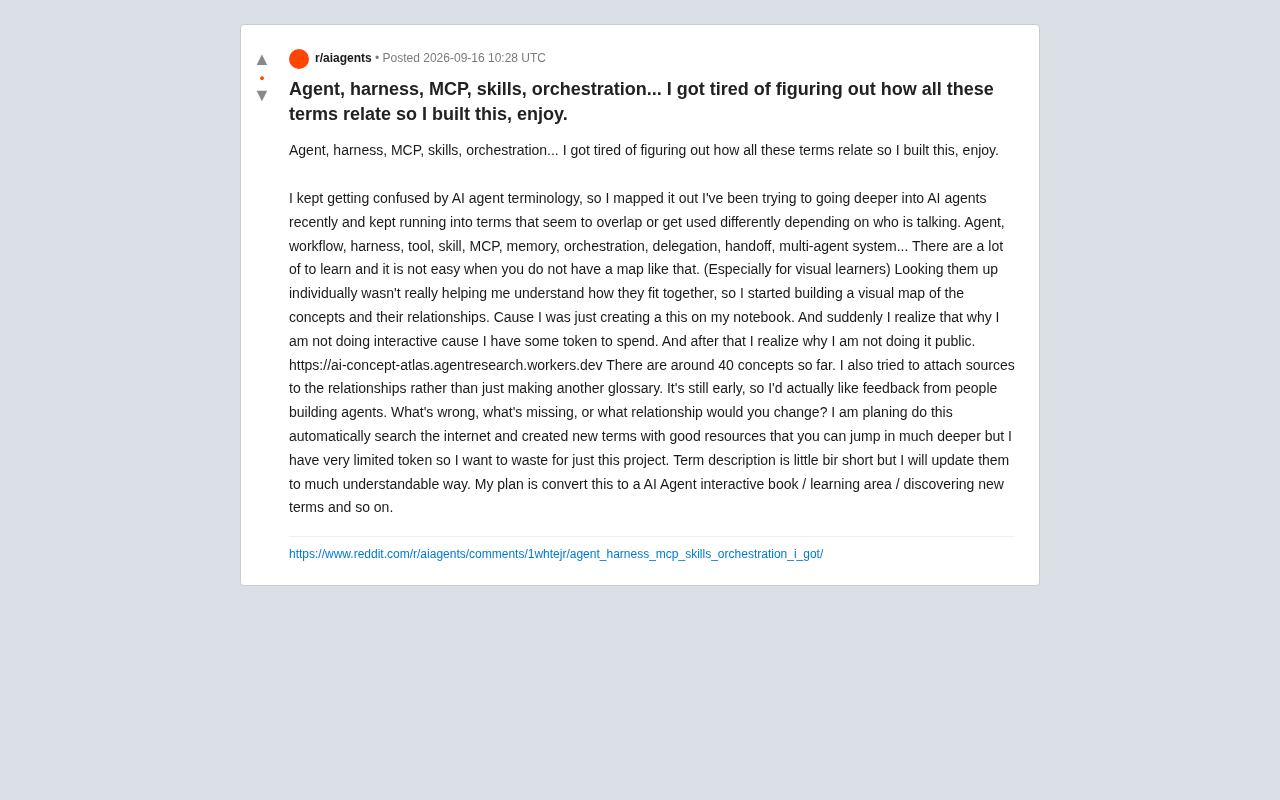
An interactive concept map helps developers untangle 40+ confusing AI Agent terms by visualizing their relationships.
AI Agent terminology is expanding rapidly, with terms like MCP, harness, orchestration, and handoff used inconsistently across frameworks and communities. One developer built AI Concept Atlas — an interactive concept relationship map on Cloudflare Workers covering ~40 terms. Unlike traditional glossaries, it focuses on cited relationships between concepts rather than isolated definitions, helping users build structural understanding. The project is in early stages, with plans to evolve into a full AI Agent learning platform that auto-discovers new terms and resources.
The vocabulary surrounding AI Agents is expanding at a breathtaking pace. Agent, workflow, harness, tool, skill, MCP, memory, orchestration, delegation, handoff, multi-agent system — for developers just entering this space, simply figuring out what each term means and how they relate to one another is already a significant barrier.
Recently, a developer shared their solution on Reddit: instead of looking up concepts one by one like a dictionary, why not map them out as an interactive concept relationship diagram? The project, called AI Concept Atlas, attempts to answer — visually — a question that keeps coming up: how do all these terms actually fit together?
Why AI Agent Terminology Is Such a Headache
The author admits that while diving deep into AI Agents, they kept running into words that "seemed to overlap, but were used differently by different people." This is an accurate reflection of the current Agent ecosystem: technology evolves too fast, and vendors, open-source communities, and researchers each coin their own terms — meaning the same concept can be expressed in completely different ways depending on the context.
For example, "tool" and "skill" are nearly interchangeable in some frameworks, while in others they have clearly distinct roles. "Orchestration," "delegation," and "handoff" all involve multi-agent collaboration, but each emphasizes something different. Looking up individual definitions rarely builds the structural understanding needed to see how they connect.
This problem is especially acute for visual learners. A flat list of term definitions is hard to organize into a coherent mental model, but a map that shows connections between concepts can intuitively convey "who calls whom" and "who is part of what."
From Notebook Sketch to Public Tool
Interestingly, this project came about quite casually. The author started by sketching concept relationships by hand in a notebook — and midway through, realized: with some available token credits on hand, why not make it interactive? And once it was done, why not just make it public?
The result is an online tool deployed on Cloudflare Workers (ai-concept-atlas.agentresearch.workers.dev), currently covering around 40 concepts.
MCP (Model Context Protocol) is one classic example of an easy-to-confuse term — it's an open protocol proposed by Anthropic to standardize how AI models interact with external tools and data sources, often described as "the USB standard for AI tool calls." "Harness," borrowed from software testing, refers in the Agent context to a scaffolding framework that wraps model capabilities and drives their execution. "Orchestration" typically refers to a central coordinator that schedules the execution order of multiple agents or tasks; "handoff" refers to the transfer of control between agents, emphasizing decentralized relay-style collaboration; "delegation" sits between the two, referring to a parent agent authorizing a subtask to a child agent. The specific meanings and implementations of these terms vary significantly across different frameworks (such as LangGraph, AutoGen, and CrewAI), and this is a major source of terminological confusion.
How This Map Differs from a Standard Glossary
There's no shortage of AI glossaries out there, but most are static lists of "term + explanation." What this project tries to do differently is put the emphasis on relationships, not just definitions.
The author specifically notes that they attached source citations to the relationships between concepts, rather than simply rewriting a dictionary. In other words, when you see a connection like "Agent uses Tool," there's supporting material behind it — it's not an arbitrary assertion. This is valuable for learners who want to trace things back to their roots and read more deeply.
That said, the author is candid about the project's limitations: the descriptions are currently quite short and need to be refined into more accessible explanations.
The "concept relationship map" approach has theoretical backing in knowledge management — it draws on "Schema Theory" from cognitive science, which holds that the human brain stores and retrieves knowledge more effectively through associative networks than through isolated entries. Traditional glossaries use a linear structure that's good for looking up individual word meanings, but can't capture topological relationships like "A depends on B," "C is a subset of D," or "E and F compete functionally." In the AI Agent domain, these relationships are precisely what's needed to understand how systems work — for instance, "Tool extends the capability boundary of an Agent," "Memory is divided into short-term context and long-term external storage," and "Workflow is the explicit representation of an Agent's decision sequence." Visualizing these relationships is essentially building a Domain Ontology — a structure that more closely reflects real knowledge than any dictionary can.
The Author's Long-Term Plans
Starting from a concept map, the author clearly has bigger ambitions. They plan to enable the tool to automatically search the internet, discover new terms, and attach quality learning resources — so users can follow any concept as deep as they want to go.
The ultimate goal is to evolve it into an "interactive AI Agent e-book / learning space / terminology exploration platform" — not just a lookup tool, but a place for systematic learning and continuous discovery.
The practical constraints are real too: the author repeatedly mentions limited token credits, so they'll be cautious about expanding features and don't want to burn resources on any single project. This is a familiar situation for many independent developers building AI tools.
The Value of Community Feedback
The author actively solicits feedback in the post, asking very specific questions: What's wrong? What's missing? Which relationships need adjusting? This open posture is exactly what determines whether a tool like this can become reliable.
The reason Agent terminology is so chaotic is fundamentally because the field is still rapidly taking shape. A concept map that is community-audited and continuously supplemented with citations is far more likely to keep pace with the field's evolution than any single authoritative definition.
Conclusion
For developers learning about AI Agents who feel lost in a sea of jargon, this kind of visual concept map offers a practical entry point. Its core value isn't telling you what each word means — it's helping you see how they form a coherent system.
Of course, as an early-stage personal project, there's obvious room for improvement in content completeness and depth of description. But the idea of "replacing flat glossaries with relationship maps" is genuinely worth borrowing as an approach to understanding this fast-moving field.
Related articles
From Enterprise Practice to a Reusable Template: Lessons from Building an AI Agent
A developer shares an open-source AI Agent template built from an enterprise project, covering natural language data Q&A, analysis, auto-generated PPTs, and email distribution.
Nintendo's Open-World Design Evolution: Breaking Down Fire Emblem Fortune's Weave
Nintendo brings the open-world design philosophy of Breath of the Wild to Fire Emblem with the massive Switch 2 title Fortune's Weave. Here's what it means.
AI-Generated Food Photos Are Ruining Menus: How the Uncanny Valley Kills Appetite
AI-generated food images are flooding restaurant menus and delivery apps, but uncanny details kill appetite instead of sparking it. Here's why the uncanny valley effect hurts brands.