AI Agent Vendor Onboarding: Compressing a 12-Day Process into 1 Day

The Elixir platform uses AI Agents to compress vendor onboarding from 12 days to 1 day, solving AI "confident errors" through context graphs, permission boundaries, and auditable decisions.
The Elixir platform introduces Agentic Vendor Onboarding, cutting the vendor onboarding process from an average of 12 days to 1 day with just one human decision. The core is building a shared context for AI Agents: requests, registration information, sanctions lists, and vendor master data are unified into the Elixir Data layer. An orchestrator schedules Intake, Verification, Risk, and Audit Agents to work together, while the Onboarding Control Agent executes actions within predefined decision boundaries and escalates high-risk operations to the compliance officer. All decisions generate tamper-proof records mapped to SOX compliance, and AgentOps monitors each Agent in real time.
Vendor onboarding is one of the most tedious steps in enterprise procurement. Every week, procurement departments submit a flood of new vendor admission requests to finance. Most are unremarkable, but there are always a few that demand extra scrutiny. Under the traditional process, completing a single vendor onboarding takes an average of 12 days—and even then, risk can slip through the cracks.
Licenses, tax certificates, and bank letters are scattered across emails, portals, and paper mail, while critical background information lives only in a few people's heads. Worse still, when a vendor finally gets approved, no one can clearly show who approved the risk or on what basis.
The Elixir platform offers an AI Agent-based solution: Agentic Vendor Onboarding. It compresses the onboarding process from 12 days to 1 day, while making every decision traceable.
Why AI Agents Need Context to Make the Right Decisions
Dropping an AI Agent straight into the vendor onboarding process often produces a chain of "confident errors":
- A common name triggers a sanctions list hit
- The bank account holder doesn't match the vendor name
- The vendor already exists in the system
- An approval rule was never formally documented
The root cause of these problems isn't insufficient model capability—it's that the Agent lacks context, boundaries, and decision records. Elixir's approach: first unify requests, registration information, sanctions lists, and vendor master data into the Elixir Data layer to build a shared context. On top of that, the orchestrator in Elixir Claw handles reasoning and scheduling, invoking skills from Elixir Hub, with four Agents—Intake, Verification, Risk, and Audit—each handling information collection, verification, risk assessment, and audit recording. The Onboarding Control Agent executes actions—but strictly adheres to predefined decision boundaries, proactively requesting human intervention when encountering high-risk operations.
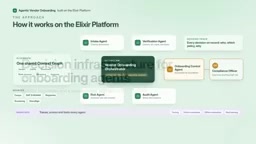
Sanctions Screening is one of the most critical and error-prone steps in vendor admission. Regulators around the world (such as US OFAC, the EU, and the UN) maintain dynamically updated sanctions lists, and companies must screen every new vendor or risk hefty fines. The difficulty: a list hit doesn't equal real risk—common names, similar spellings, and different people with the same name all generate a large number of False Positives. Traditional systems often only flag a hit without explaining why, leaving compliance staff to either blindly clear it or over-block. For an AI Agent to handle these judgments correctly, it must simultaneously grasp the vendor's complete identity information (such as date of birth, nationality, place of registration), historical screening records, and the specific fields that triggered the hit—only then can it distinguish real risk from noise.
Context Graph is a structured knowledge representation of entities and their relationships, distinct from simple data tables or document repositories. In the vendor onboarding scenario, the graph establishes associative edges between "request—vendor—owner—bank account—screening result—approval record," enabling the Agent to reason along relationship chains rather than viewing each piece of data in isolation. For example, when the system finds that a bank account holder doesn't match the vendor name, the graph can immediately trace whether that account is shared by other vendors and who the holder's other associated entities are. This relationship reasoning capability is precisely the key to avoiding "confident errors": the Agent no longer relies on surface-level matching but makes judgments based on the complete entity network.
The Complete Flow of a Real Request
The video showcases a typical case: Request Venn 3018—Alnor Medical Supplies, a hospital supplier with $2.4 million in annual supply volume, requesting cooperation to start in 10 days.
Interestingly, the system doesn't order requests by arrival time but by risk and spend amount. Each request shows which Agent is currently handling it.
The Verification Agent completes checks on licenses, tax IDs, bank accounts, and sanctions lists in under four minutes. Two checks require further attention. At this point, the system already knows the entity's contract ownership and risk ownership, and the Risk Agent extracts complete information from the context graph: the owner's date of birth and nationality, the corporate entity behind the bank account, and a similar name match that appeared only in February.
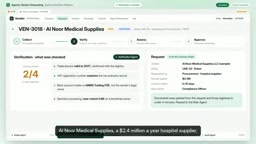
The Risk Agent walks through the timeline item by item and concludes: the sanctions list match is likely a false positive, but payment must go to the vendor's own account.
Next, the Onboarding Control Agent takes action. It creates the vendor record and flags it as payment-blocked—a low-risk operation within the decision boundary, executed immediately. Procurement can begin preparing the contract.
However, clearing the sanctions alert and activating payment are outside its authority. The Agent stops and escalates the reason, relevant policies, and evidence to the compliance officer. After reviewing the evidence, the compliance officer grants conditional approval: upon receiving a bank letter in the vendor's own name the next day, the vendor goes live.
One day, one human decision, replacing what was originally a 12-day process.
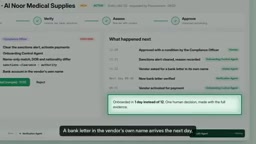
Auditability: Every Decision Is Recorded
The Audit Agent automatically generates evidence packages mapped to SOX compliance, sanctions policy, and segregation of duties requirements. Every decision produces a tamper-proof record—who, based on which policy, and why the decision was made.
Auditors can ask directly: "Why was the sanctions alert cleared? Who approved it?" The answer comes straight from the decision trail. The system can also work backward to discover another vendor using the same bank account.
Every Agent is continuously measured: what it did, how accurate it was, and where humans intervene. AgentOps monitors every Agent in production in real time, scoring reasoning capability, tool usage, and safety, and alerting immediately when quality degrades.
Engineering Implementation: Ontology, Knowledge Graph, and Permission Boundaries
In Elixir Data, the ontology defines unified semantics for vendors, owners, screening results, and approvals—consistent across all Agents. The knowledge graph links Request Venn 3018 to all necessary information: owner, lists, vendor list entries, bank account holder, and registration records.
In Elixir Claw, the vendor onboarding orchestrator runs five Agents uniformly behind a single endpoint called by the frontend. The frontend contains no Agent logic. Each Agent is configurable without writing code: instructions, model selection via the LLM gateway, and skills from Elixir Hub. Tools come from MCP servers, and each Agent is granted only the tool permissions it needs.
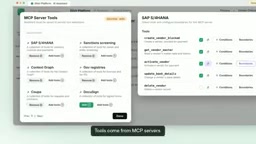
Permission boundaries are set very specifically: creating a frozen vendor is allowed, deleting a vendor is simply not enabled. For activation tools, the permission boundary explicitly states: when unresolved sanctions alerts exist, compliance officer approval is required. The human-in-the-loop mechanism pauses the Agent at exactly this point and requests confirmation.
Elixir Hub serves as the skill registry, where each capability is signed, versioned, and reusable across different Agents. The complete version history ensures you always know what changed and when.
Before a new version goes live, it undergoes offline testing on hundreds of historical requests. Red team attacks hit the Agent before fraudsters do—for example, an email claiming compliance has already approved, yet the boundary holds firm.
The "single responsibility" principle from SOLID also applies to Agent design: each Agent receives only the minimal toolset needed to complete its task. The MCP (Model Context Protocol) server mentioned in the article is a standardized tool access protocol that lets Agents call external capabilities (such as querying sanctions lists, reading bank letters, writing vendor master data) in a unified way, while the platform centrally manages permissions. Ontology, on the other hand, defines the formal specification of domain concepts and their relationships—for example, a "vendor" must have an "owner," and a "screening result" must be linked to a "request." Without a unified ontology, different Agents may develop different understandings of the same concept, causing collaboration to break down. By combining ontology with the knowledge graph, Elixir Data provides a shared semantic foundation for all Agents, making reasoning results interoperable and auditable.
Key Takeaways
The value of this solution isn't in replacing humans with AI, but in redistributing the human-machine division of labor. Agents handle information-intensive, rule-clear verification work, while humans focus on high-risk judgments. The context graph solves the fundamental problem of Agents "confidently making mistakes," permission boundaries and human-in-the-loop mechanisms ensure controllability of critical decisions, and complete decision tracking turns compliance auditing from "post-hoc investigation" into "real-time visibility."
For procurement and finance teams processing dozens of vendor onboarding requests every week, this architectural approach is worth studying in depth.
SOX Compliance (Sarbanes-Oxley Act) requires public companies to document and audit internal controls related to financial reporting. Vendor admission, as the starting point of the procurement-to-payment chain, naturally falls within its scope. SOX emphasizes Segregation of Duties: initiation, approval, execution, and recording should be performed by different roles to prevent a single person or system from monopolizing the entire process. In the AI Agent solution, the Onboarding Control Agent can only execute low-risk actions within boundaries, while high-risk operations must be manually approved by the compliance officer—precisely a technical implementation of this principle. The tamper-proof records automatically generated by the Audit Agent satisfy SOX's requirement for "traceability"—every decision can answer "who, when, based on what policy, and what was done."
One-line Summary
The Elixir platform uses AI Agents to compress vendor onboarding from 12 days to 1 day, solving AI "confident errors" through context graphs, permission boundaries, and auditable decisions.
Paragraph Summary
The Elixir platform introduces Agentic Vendor Onboarding, cutting the vendor onboarding process from an average of 12 days to 1 day with just one human decision. The core of the solution is building a shared context for AI Agents: requests, registration information, sanctions lists, and vendor master data are unified into the Elixir Data layer, with an orchestrator scheduling four types of Agents—Intake, Verification, Risk, and Audit—to work together. The Onboarding Control Agent executes actions within predefined decision boundaries, automatically escalating high-risk operations to the compliance officer. The system orders requests by risk and spend amount rather than arrival time. All decisions generate tamper-proof records mapped to SOX compliance requirements, and audits can be traced directly. AgentOps monitors each Agent's performance in real time, and new versions undergo offline testing and red team attack validation before going live.
Related articles

Chain of Thought Isn't Just for AI: How Humans Can Use CoT to Improve Thinking Quality
Chain of Thought isn't just a prompt trick for large models. Starting from a Hacker News discussion, this article analyzes why CoT works for human thinking too, breaks down actionable ways to transfer it, and highlights the key differences between human CoT and machine CoT.
Cloudflare Teams Up with OpenAI: Closi…
Cloudflare Teams Up with OpenAI: Closing the Loop from Vulnerability Discovery to Defense with AI
Cloudflare uses OpenAI Daybreak to investigate security vulnerabilities and generate reviewable remediation plans, while developers use Codex to boost coding efficiency and quality.

Orca Multi-Agent Orchestration in Practice: A Guide to Parallel Collaboration with Claude and Codex
Orca is Stable AI's free open-source agent workbench supporting 34 agents like Claude Code and Codex in parallel. Learn its Git worktree isolation, multi-model orchestration, and mobile management.