AI Agent vs. Automation Scripts: Goal-Driven vs. Fixed Workflows

AI Agents pursue goals and adapt dynamically — scripts just execute fixed instructions.
A common misconception treats AI Agents as "smarter scripts," but the difference is paradigmatic: scripts execute deterministic, pre-written workflows, while Agents operate on goals — planning, calling tools, observing results, and continuously self-correcting via a ReAct-style feedback loop. Using Linux system administration as a case study, this article explains when to use each and why the two are complementary rather than competitive.
A Common Misconception: Is an Agent Just a Fancy Script?
As AI Agents become a buzzword in tech circles, a widespread misconception is taking hold — many people simply think of AI Agents as "smarter automation scripts." This is the most common pitfall for beginners, and the biggest obstacle to truly understanding what Agents are worth.
The difference between scripts and Agents isn't about which one is "more advanced" — it's that their working paradigms are fundamentally different. A script executes a pre-written, fixed workflow. An Agent is given a goal, and it must plan, execute, and adjust based on feedback on its own. This distinction sounds abstract, but once you put it in a real-world context — like Linux system administration — it becomes critically important.
How Scripts Work: Determinism and Fixed Boundaries
What Scripts Are Good At
The defining characteristic of automation scripts is determinism. When you write a Shell script, it executes each line of instructions in strict order — do A, then do B, evaluate condition C, and finally output D. The entire flow is fully determined at the time of writing; there's no improvisation at runtime.
This makes scripts ideal for tasks that are stable, repetitive, and have clear boundaries — for example, scheduled database backups, batch file renaming, or monitoring disk usage and triggering alerts. These tasks share a common profile: inputs are predictable, workflows can be enumerated, and results are verifiable. In these scenarios, scripts are not only efficient but reliable — because their behavior is completely predictable.
The Ceiling of Scripts
But the very strength of scripts is also their limitation. The moment a task exceeds its predefined boundaries, a script is helpless. It can't understand a goal — only instructions. When the environment changes, an unexpected error occurs, or dynamic decision-making is required based on intermediate results, a script will either exit with an error or execute the wrong action. In short, scripts have execution power but no judgment.
How Agents Work: Goal-Driven and Adaptive
How an AI Agent Operates
Fundamentally unlike scripts, an AI Agent isn't given a list of instructions — it's given a goal. To achieve that goal, the Agent goes through a cyclical process:
- Plan: Break down the high-level goal into a series of executable sub-steps
- Use tools: Select and invoke appropriate tools (commands, APIs, search, etc.) based on current needs
- Observe: Read the feedback from each tool's execution
- Adjust: Dynamically revise the plan for subsequent actions based on what was observed
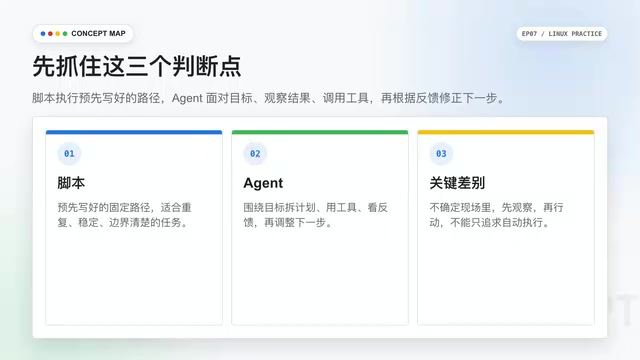
This "Plan → Execute → Observe → Adjust" feedback loop is precisely what sets AI Agents apart from scripts. A script is a straight line — it runs to the end and stops. An Agent is a continuously adapting loop that keeps recalibrating its path based on reality.
Background: The ReAct Framework and the Theoretical Foundation of the Loop
This "Plan → Execute → Observe → Adjust" cycle didn't emerge from nowhere — it has rigorous academic backing. The ReAct framework (Reasoning + Acting), jointly proposed by Princeton University and Google Research in 2022, formally established the theoretical foundation for this paradigm. ReAct interweaves a language model's reasoning with external tool invocations: each reasoning step produces an action, each action returns an observation, and that observation triggers the next round of reasoning. This is distinct from pure Chain-of-Thought (CoT) prompting — CoT only reasons internally within the model, while ReAct genuinely interacts with the external environment. It is precisely this "Think → Act → Observe" loop that gives Agents the ability to handle open-ended tasks, and that makes the "advanced script" misconception so clearly off-base.
Tool Calling: The Underlying Engine of Agent Capabilities
An Agent's ability to "call tools" relies on the Function Calling mechanism of large language models. OpenAI first rolled this out at scale in GPT-4 in 2023: developers describe a set of available tools to the model — their names, parameters, and capabilities — and the model autonomously decides during inference whether to invoke a tool, what arguments to pass, and returns a structured call instruction to the application layer for execution. The application layer executes the call, gets real results, and injects those results back into the conversation context for the model to continue reasoning. This mechanism allows heterogeneous tools — Shell commands, REST APIs, database queries, and more — to be unified into an Agent's "toolbox." Anthropic's Claude and Google's Gemini both support similar mechanisms today, and the industry is gradually converging on standardized protocols like MCP (Model Context Protocol) to further lower the barrier to tool integration.
The Cost of Flexibility
Of course, this flexibility introduces new challenges. An Agent's behavior is no longer fully predictable — it can go off course due to misunderstandings of the goal, tool invocation errors, or misinterpretation of feedback. As a result, Agent systems typically require more robust constraint mechanisms, permission controls, and human confirmation steps, especially when critical system operations are involved.
The mainstream engineering responses currently operate on three levels: permission sandboxes (restricting the commands an Agent can invoke — for example, blocking high-risk operations like rm -rf), Human-in-the-Loop confirmation (requiring human approval before executing irreversible actions), and action logging with rollback capability (recording every step for auditing and rollback). Stanford University's 2024 "Agent Safety Evaluation Framework" notes that the most common failure mode in current Agent systems is "goal generalization drift" — where an Agent, in pursuit of its objective, takes intermediate actions that exceed the intended scope. This is precisely why "controllability" has become one of the central challenges in bringing Agents to production.
In Practice: The Difference in Linux System Administration
System administration is exactly the kind of arena where the gap between the two approaches is magnified — and it's the best entry point for understanding the real-world value of AI Agents.
Consider a concrete scenario: a server's CPU suddenly spikes, and you need to find out why.
With a script, you'd have to pre-define every possible diagnostic path — run top to check processes, kill any process with high usage, check disk if it looks like an I/O issue... But in reality, failure causes are endlessly varied, and it's nearly impossible to enumerate every scenario in advance. Scripts are often powerless when facing unknown failures.
An AI Agent, by contrast, operates more like an experienced ops engineer: it first runs diagnostic commands to observe system state, interprets the output to determine the direction of the problem, then decides what to investigate next. If it discovers an anomalous process, it analyzes that process's behavior rather than mechanically executing a preset action. The entire investigation is dynamically generated, not hard-coded in advance.
This is the most fundamental dividing line: scripts are suited for standardized handling of known problems, while Agents are suited for exploratory resolution of unknown problems.
Choosing the Right Tool: Not Replacement, but Division of Labor
With this distinction in mind, the more mature view is: AI Agents are not here to replace scripts. The two are complementary, each with its appropriate domain.
For tasks with fixed workflows that demand extreme stability and efficiency — scheduled jobs, standard steps in CI/CD pipelines — scripts remain the optimal choice: reliable, transparent, and low-cost. For tasks where the goal is clear but the path is uncertain, requiring real-time judgment — fault diagnosis, complex environment configuration, cross-system coordination — Agents are where the real value lies.
You might not have noticed that mature Agent systems often call scripts extensively as tools internally. In other words, scripts become one of the "weapons" in an Agent's arsenal. Understanding this makes the pseudo-question of "is an Agent just an advanced script" irrelevant — they operate at different levels of abstraction: scripts are execution units, Agents are the decision-making brain.
This maps directly to the classic concept of abstraction layers in software engineering. In traditional automation, ops engineers manually switch between different abstraction levels: at the bottom are Shell commands, in the middle are configuration management tools like Ansible and Puppet, and at the top are ops platforms and alerting systems. The emergence of Agents essentially adds a new semantic layer at the very top of this stack — one that can automatically map a natural-language-described goal ("investigate the server CPU anomaly") to a specific sequence of operations at the lower levels. This layered architecture has deep roots in computer science, from OS system calls to the TCP/IP protocol stack — each layer focuses on its own level of abstraction. The relationship between Agents and scripts is simply the latest expression of this timeless idea in the age of AI.
Conclusion
Thinking of AI Agents as "advanced scripts" is, at its core, trying to understand a new paradigm through an old lens. The worldview of a script is deterministic process execution. The worldview of an Agent is goal-oriented exploration. The former answers "how to do it"; the latter answers "what needs to be achieved."
As Agent capabilities continue to grow, domains like operations, software development, and data analysis will all undergo deep structural changes in how work gets done. But no matter how the technology evolves, understanding this foundational difference — from the closed-loop reasoning of the ReAct framework, to the tool-calling mechanics of Function Calling, to the real-world engineering challenges of controllability — remains the essential first step to using AI Agents effectively and avoiding misuse.
Key Takeaways
Related articles
Deep Dive into vLLM Worker-Side GPU KV Cache Initialization
Deep dive into vLLM's Worker-side KV Cache GPU memory allocation, covering the full pipeline from KVCacheConfig generation to physical memory binding via ModelRunner.
Zepto Builds AI Customer Service with MLflow: An Evaluation-Driven Practice Guide
Deep dive into how Zepto built an evaluation-driven AI customer service system using MLflow and Databricks, achieving 60% faster responses and 40% less manual handling. From technical architecture to practical insights.

Iran Captures U.S. Underwater Drone in Strait of Hormuz: A Comprehensive Analysis
Iran announces capture of U.S. Navy underwater drone in Strait of Hormuz. In-depth analysis of the incident, strategic value of UUVs, U.S.-Iran geopolitical competition, and implications for global energy security and military dynamics.