AI Agent + Vue3 in Practice: A Complete Guide to Building an Intelligent Conversation App

Build an AIGC app using Coze agents + Vue3, with tailored paths for AI trainers and frontend developers.
"Luxun" is an AIGC application integrating AI image, copywriting, and video generation. Its architecture has two layers: an agent layer built on Coze's visual workflow platform (requiring virtually no hand-written code), and a frontend layer using Vue 3, TypeScript, Pinia, and Element Plus, focused on integrating the agent API. The course offers differentiated paths — AI trainers should focus on Coze agent development, while frontend developers should prioritize Vue 3 and API integration. Together, understanding both sides forms a complete skill set for modern AI product development.
Project Overview: A Dual-Module Architecture for AI Applications
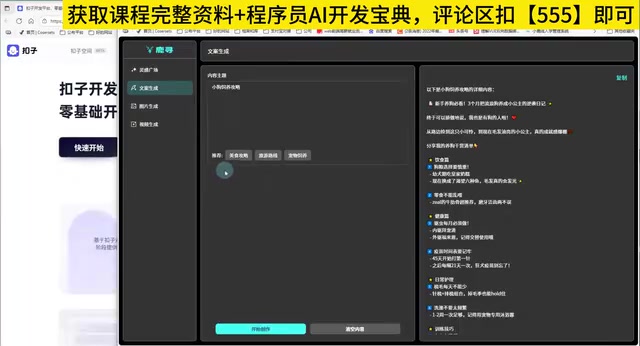
This AI project, named "Luxun," showcases a typical modern AI application development paradigm — combining agent capabilities with a frontend interface to deliver a complete, user-facing product. The entire project is clearly divided into two main modules: the agent layer and the frontend deployment layer. This division reflects the real-world layering of AI product development: the agent handles generative capabilities at the bottom, while the frontend manages the interaction experience on top.
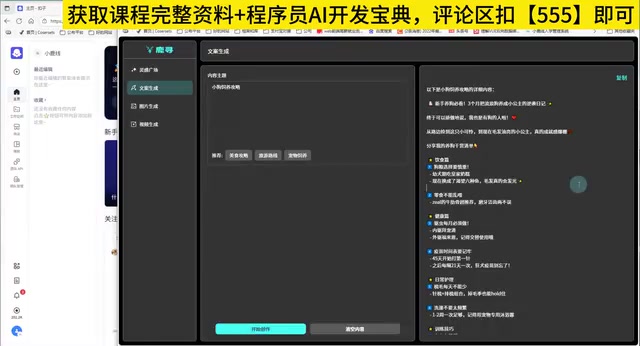
From a feature perspective, the frontend integrates multiple AI generation capabilities, including AI image generation, copywriting generation, and video generation. Users simply enter a topic, and the underlying agent handles the content creation. This "input a topic → AI generates results" interaction pattern has become the standard form for AIGC-type products.
The Agent Layer: Coze Platform at the Core
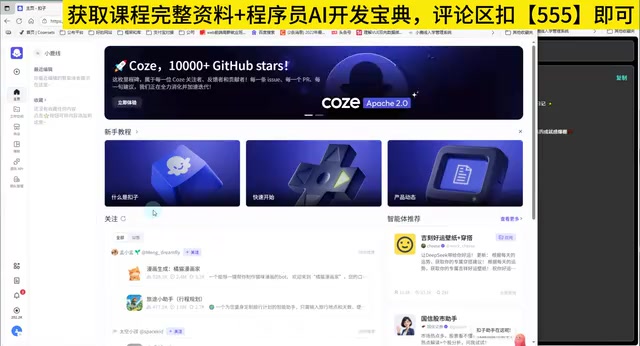
The core tool for the agent portion of this project is Coze (referred to as the "Code platform" in the video). Developers can use this platform to quickly build agents and configure the workflows needed for the project. One particularly notable point emphasized in the video is that "over 95% of agent development requires no hand-written code."
This statistic highlights the key value of low-code/no-code AI development — through visual workflow orchestration, AI application logic that previously required strong engineering skills can now be achieved through drag-and-drop configuration. For practitioners without a development background, this dramatically lowers the barrier to participating in AI product development. Of course, a small amount of code occasionally appears in the workflow; the author advises learners to "understand it well enough, without needing to go too deep."
About Coze: Coze is an AI agent development platform launched by ByteDance. It supports visual workflow orchestration, plugin and knowledge base configuration, and allows built agents to be published as APIs for external use. The platform includes a rich library of preset plugins (such as image generation, web search, text processing, etc.) that developers can combine like building blocks. Its workflow engine is one of its core features, allowing developers to define a complete chain of "trigger → processing node → output result," where each node can be an LLM call, plugin execution, or conditional branch. This graphical orchestration approach enables complex, multi-step AI logic without writing code. Coze also offers both domestic and international versions to accommodate different regional model resources and compliance requirements.
The Frontend Layer: The Vue 3 Full-Stack
The frontend uses a mainstream modern technology stack: Vue 3, TypeScript, Pinia, Element Plus, and Hooks. This combination is the standard setup in the Vue ecosystem — Vue 3 provides the reactive framework foundation, TypeScript ensures type safety, Pinia handles state management, and Element Plus offers a mature UI component library.
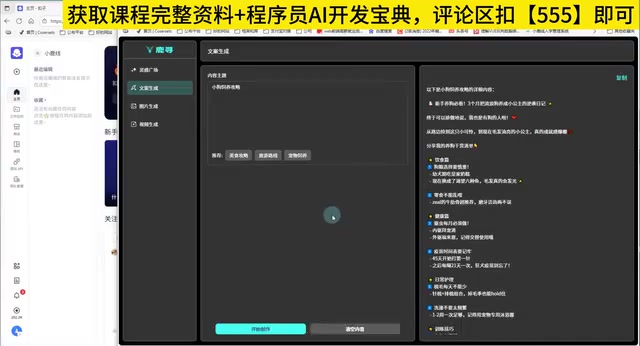
For frontend developers, the core training focus of this project is how to integrate the agent's API. This is a capability that frontend engineers in the AI era need to develop: it's no longer just about rendering static data, but about exchanging data with AI services and handling requests and responses for generative content. Mastering API integration means the frontend can truly invoke the underlying AI generation capabilities.
About Pinia: Pinia is the officially recommended state management library for Vue 3, used to share and persist data across components. It is the successor to Vuex, with a cleaner API design and more native TypeScript support. In AI application frontends, Pinia is commonly used to store user-entered topics, AI-generated results, and request states (loading/success/failure) as global state. When integrating with agent APIs, the frontend needs to handle asynchronous patterns such as streaming responses or polling — AI-generated content is often not returned all at once but is output progressively. The frontend must update the UI in real time, which is fundamentally different from the request-response model of traditional REST APIs and represents a new challenge for frontend development in the AI era.
Differentiated Learning Paths for Two Types of Learners
The course outlines different learning focuses for two target audiences — a distinction worth noting.
The AI Trainer Path
For learners pursuing the AI trainer direction, the focus should be on the agent (Coze platform) portion. The frontend project can be explored as supplementary material. The author's advice is to build a solid understanding of the agent-related knowledge, treating the code portions as secondary — "take it as it comes in the course, no need to go deep."
There's a practical rationale here: agent-related roles are gradually emerging as independent positions, becoming new career opportunities in the AI industry. At the same time, AI trainers entering companies may also be expected to write some basic code, and having foundational ability is sufficient.
The Frontend Developer Path
Learners coming from a frontend background should focus primarily on the Vue 3 project portion, including TypeScript usage, Pinia, and agent API integration. The agent portion can be reviewed at a faster pace. The author notes that frontend developers who additionally acquire agent development skills can make their résumé more competitive — in an era where AI products are increasingly prevalent, a frontend developer who understands AI is clearly more sought after.
About the AI Trainer Role: AI trainers (also known as AI prompt engineers or agent developers) are an emerging job category that has risen alongside the deployment of large model applications in recent years. Their core responsibilities include designing and optimizing agent workflows, prompt strategies, knowledge base configurations, and tool-calling logic, enabling AI systems to consistently produce high-quality outputs in specific business scenarios. The role does not strictly require a programming background, but does require a deep understanding of large model capabilities, hallucination issues, and context management. Compared to traditional software roles, AI trainers place greater emphasis on a "human-machine collaboration design" mindset — that is, how to break down business requirements into task chains that AI can execute.
Learning Order and Overall Approach
The course is structured to cover the agent portion first, followed by the frontend. This inside-out organization aligns with the development logic: build the AI generation capabilities first, then construct the interface that calls upon those capabilities.
From a broader perspective, the "Luxun" project is an excellent microcosm of AI application development — it fully demonstrates the dual engine of AI products: agent orchestration + frontend engineering. Whether you're a frontend engineer looking to transition into AI, or an AI trainer hoping to build up your engineering skills, you can find your own growth entry point within this layered architecture. Understanding how agents and frontends collaborate may ultimately be more valuable in the long run than mastering either side in isolation.
Related articles

JobRunner MCP Server: AI Agents Can Now Fix Failed Java Jobs
JobRunner launches an open-source MCP server enabling AI agents to view cluster status, diagnose failures, and recover Java jobs—incident response from any cloud coding environment or existing agent.

MLAI Digital Launches 9 Security Agents: MCP Server Safeguards the Full Lifecycle of Agentic AI
MLAI Digital launches Security MCP Server with nine built-in specialized security agents covering vulnerability discovery, attack simulation, prompt injection detection, API and infrastructure assessment, and accelerated remediation—embedding security validation across the full Agentic AI lifecycle from development to production.

Running Isaac Lab on H100 GPUs: Exploring Better Approaches
Exploring optimization methods for running Isaac Lab on NVIDIA H100 GPUs, including MIG configuration, mixed precision, TensorRT acceleration, and community experience to improve robotics simulation and reinforcement learning efficiency.