AI Agents 101: The Core Difference Between LLMs and Agents, and How They're Built

A clear breakdown of what AI agents are, how they differ from LLMs, and how they're built.
AI agents are more than just large language models — they can perceive, decide, and act. This article explains the fundamental difference between LLMs and agents, introduces the core formula (LLM + Workflow + Knowledge Base), and provides practical guidance on choosing between tools like Dify, LangChain, and LlamaIndex for agent development.
In an era where AI is reshaping every industry, "Agent" has become one of the hottest buzzwords in tech. But for newcomers, one fundamental question remains stubbornly hard to answer: What exactly is an AI agent — and how is it fundamentally different from the AI large language models we use every day?
This article systematically breaks down the core concepts, tooling ecosystem, and architectural logic of AI agents, giving you a clear mental framework from the start.
The AI Agent Tooling Ecosystem
Before diving into the concept itself, let's survey the major development tools available today. Agent development falls into two broad categories: low-code tools and code frameworks.
Low-Code Tools: Coze and Dify
Low-code tools have a lower barrier to entry and are ideal for quickly prototyping and validating ideas.
Coze (扣子), launched by ByteDance, is a typical cloud-based platform — currently free to use, though its purely online nature makes it less suitable for enterprises requiring on-premises deployment.
Dify, by contrast, is the most widely adopted low-code tool in enterprise settings, reportedly achieving very high penetration among enterprise users. It supports both visual workflow orchestration and private deployment — the two factors that make it the de facto industry choice. If you can only pick one low-code tool, Dify is almost always the right answer.
Code Frameworks: LangChain and LlamaIndex
For development teams that need deep customization, code frameworks offer far greater flexibility. LangChain has long dominated this space, with a mature ecosystem and an active community. Open-sourced in late 2022, LangChain's core design philosophy is "chaining" — connecting LLM calls, tool invocations, and memory management into reusable pipelines. It boasts over 600 ecosystem plugins covering nearly every scenario from data ingestion to multi-agent collaboration.
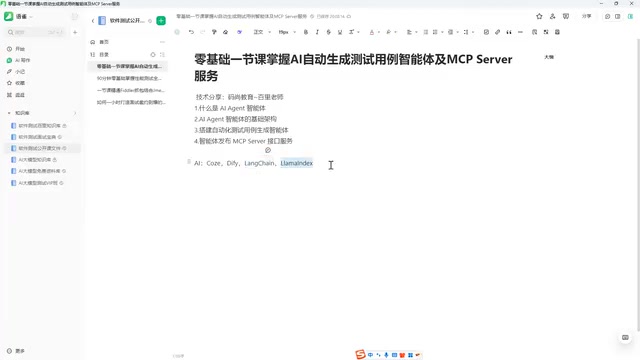
Worth watching closely is LlamaIndex, which has been shipping updates at a noticeably faster pace recently — rapidly catching up to, and in some areas surpassing, LangChain in terms of feature richness and capability expansion. Originally called GPT Index, LlamaIndex started with a focus on data ingestion and index construction. It has invested more deeply in diverse index structures (vector indexes, tree indexes, keyword indexes) and advanced retrieval strategies (such as HyDE — Hypothetical Document Embeddings, multi-path recall, and Reranking), giving it finer-grained control in knowledge-intensive RAG scenarios. The two frameworks aren't purely competitive — they're often used together in real projects. For developers focused on RAG (Retrieval-Augmented Generation) and knowledge base use cases, LlamaIndex deserves particular attention.
A simple rule for tool selection: choose Dify for fast deployment, choose LangChain or LlamaIndex for deep customization.
What Is an AI Agent?
With the tooling landscape in mind, let's tackle the core question: what exactly is an agent?
Agents Are a "Digital Mapping" of Human Capabilities
Artificial intelligence is fundamentally a biomimetic technology — one that models itself after human beings. An AI agent, then, is a technical implementation that digitally maps the way humans think and act.
We can break down a person's capabilities into four dimensions:
- Perception: Interacting with the world through hearing (voice) and sight (images)
- Decision-making: The brain handles thinking, learning, and judgment
- Action: Writing, speaking, executing concrete operations
- Memory: Storing and retrieving past experiences
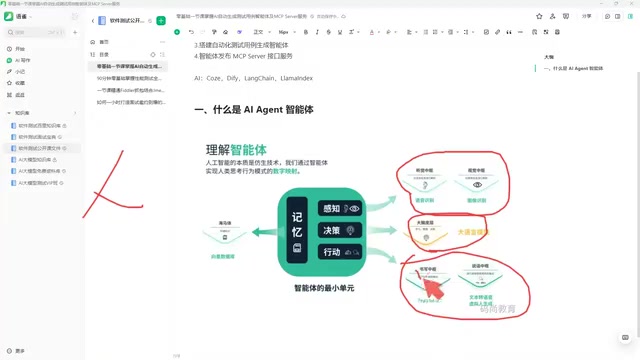
Agents are built around this exact capability model. They interact with users through natural language while maintaining a complete perceive–decide–act loop. Any application that fits this description can be called an agent.
The Core Difference Between Agents and LLMs
Confusing agents with large language models is the most common misconception among newcomers. Let's use a concrete example to unpack the fundamental difference.
LLMs Can "Answer" — Agents Can "Act"
Take a model like DeepSeek: it operates on natural language understanding — you ask, it answers. But it can only "answer" — it cannot truly "act."
At its core, a large language model (LLM) is a probabilistic predictor trained on a Transformer architecture: given an input sequence, it predicts the most likely next token. This makes it naturally strong at tasks within "language space" — text comprehension, logical reasoning, code generation — but it cannot proactively initiate any system call or network request. The emergence of Function Calling / Tool Use capabilities allows LLMs to output structured "intent instructions," which an external execution layer (the agent framework) captures and uses to actually operate on systems — bridging the gap between language space and the real world.
Here's an example: ask an LLM to order food delivery for you. Can it do it? No. It can't open an app, search for items, or complete a payment. An LLM is fundamentally a natural language interaction tool — excellent at solving information-level problems, but unable to reach into real-world operations.
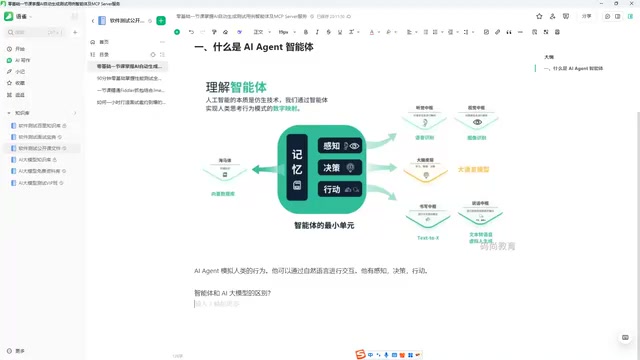
An agent, on the other hand, is entirely different. Given the same "order food delivery" request, an agent can:
- Open the delivery app
- Search for the target item
- Submit the order
- Complete payment
It can perceive the need, decide on a path, and execute actions — completing an end-to-end task in full. This is the core value that distinguishes agents from LLMs: evolving from "knowing how to talk" to "knowing how to act."
The Agent Architecture Formula
How do agents achieve this capability leap on top of large language models? A simple formula captures it:
AI Agent = LLM + Workflow + Knowledge Base

The LLM: The Agent's "Brain"
A large model (such as DeepSeek) is the core engine of an agent, responsible for language understanding and logical reasoning. But it is only one component of an agent — not the whole thing.
Workflow: The Perceive–Think–Act Execution Chain
The workflow is what gives an agent its ability to "act." It breaks complex tasks into a clear sequence of steps — the concrete implementation of the perceive–think–act loop. In the agent context, workflows aren't just linear sequences of task steps; they involve complex control logic including conditional branching, parallel execution, and error fallback. Modern agent frameworks (such as LangGraph and Dify's DAG orchestration) model workflows as Directed Acyclic Graphs (DAGs), where each node represents an atomic operation (calling a tool, querying a knowledge base, invoking an LLM) and edges define execution order and conditions. This graph structure enables dynamic path planning in complex tasks, rather than simple fixed-order execution.
Using the food delivery example, the workflow execution path looks like this:
- Step 1: Open the delivery app
- Step 2: Search for items
- Step 3: Submit the order
- Step 4: Complete payment
This structured process allows the agent to autonomously complete complex end-to-end tasks.
Knowledge Base: Filling the LLM's "Knowledge Gaps"
LLMs are trained on historical data and cannot cover the latest information or specialized domain content. A knowledge base exists precisely to fill this gap.
The core technology powering knowledge bases is RAG (Retrieval-Augmented Generation), introduced by Meta AI in 2020. The core idea: before generating a response, retrieve the most relevant document chunks from an external vector database, then inject those chunks into the prompt as context — guiding the model to answer based on accurate, up-to-date information. This approach avoids the high cost of full model fine-tuning, enables real-time supplementation of knowledge beyond the training cutoff date, and significantly reduces the probability of model hallucinations.
Take a medical scenario: a top institution like Xiangya Hospital has accumulated decades of clinical cases and treatment data — specialized assets that general-purpose LLMs know nothing about. By connecting this data to an LLM via RAG, an agent can deliver genuine value in highly specialized vertical domains.
Summary
To truly understand AI agents, keep two things in mind:
First, recognize the fundamental difference from LLMs — LLMs "answer," agents "act." Their capability boundaries are entirely distinct.
Second, grasp the agent's architectural logic — the LLM provides intelligence, the workflow provides execution capability, and the knowledge base provides domain expertise. All three are indispensable.
For those looking to get started with agent development, the recommended path is: start with a low-code tool like Dify to run through a complete end-to-end example and build an intuitive feel for the perceive–decide–act loop, then gradually move to code frameworks like LangChain or LlamaIndex for deeper customization. Understanding the underlying logic will always matter more than chasing the latest tools.
Related articles

The Truth Behind Codex 'Build a Website in 5 Minutes': AI Isn't Creating Sites—It's Helping You Copy Them
Exposing the truth behind viral Codex 5-minute website videos: creators aren't building original sites with AI—they're copying shared prompts or scraping others' work. Learn AI coding tools' real limits.

Getting Started with AI Agent Development: A Complete Guide from Concept to Practice
A comprehensive guide to AI Agent architecture and development, covering automated marketing, intelligent customer service, and investment analysis scenarios with single and multi-agent collaboration.

The Truth Behind Codex 'Build a Website in 5 Minutes': AI Isn't Creating Sites — It's Helping You Copy Them
Exposing the truth behind viral Codex 5-minute website videos: creators aren't building original sites with AI — they're copying shared prompts or scraping others' work.