AI Agents Always Request Too Much Data? The Data Minimization Problem and How to Solve It

AI agents over-fetch data via general APIs — enforce data minimization at the architecture layer, not the model layer.
A widespread risk in AI agent development is that agents retrieve far more data than their tasks actually require through general-purpose APIs. Once a full customer record enters a model's context window, sensitive fields like billing details are exposed in the reasoning chain and run logs — violating data minimization requirements under regulations like GDPR. Practical solutions range from dedicated per-use-case endpoints (most thorough, but costly to maintain) to more pragmatic approaches: response-layer field filtering at the API gateway, task-scoped data access controls, and replacing raw sensitive data with derived computed fields. The core conclusion: AI agent data governance cannot rely on model self-restraint — it must be architecturally enforced before data ever leaves the trusted backend.
The Root Cause: APIs Return More Data Than the Task Requires
A problem that's often overlooked yet remarkably tricky has been surfacing in AI agent development: agents almost always request more data than their tasks actually require.
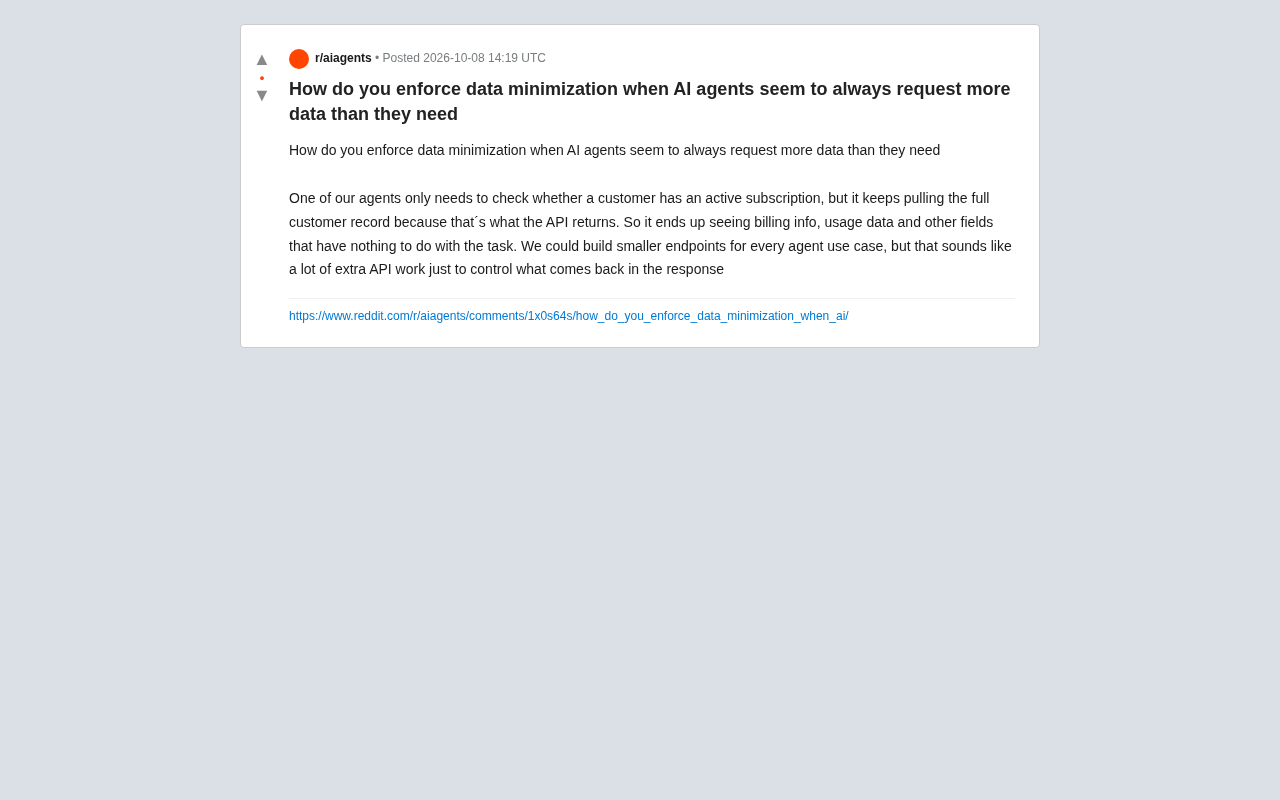
A Reddit user shared a classic example: they had an agent whose only job was to check whether a customer has an active subscription. In theory, a single boolean (yes/no) is all it needs. But because the backend API was designed to return a full customer record, the agent ended up "seeing" billing information, usage data, and other fields completely irrelevant to the task.
This isn't an isolated engineering detail — it cuts to a core principle of data governance: Data Minimization. This principle requires that a system only collect, process, and expose the minimum data necessary to complete a specific task. Under privacy regulations like GDPR, data minimization is an explicit compliance requirement. And when AI agents enter the picture, enforcing this principle becomes significantly harder.
Why AI Agents Make Data Minimization Harder
In traditional applications, developers have precise control over data flow: the code knows exactly which fields it needs and processes only those. AI agents introduce a new variable.
Agents typically fetch "context" through general-purpose APIs, then let the large language model decide how to use that information. The problem is simple: whatever the model receives, it "knows." Even if the task is just validating subscription status, once a full customer record enters the model's context window, sensitive fields like billing details and spending habits are already exposed in the reasoning chain — they may be written to logs, influence model outputs, or get inadvertently referenced across conversation turns.
In other words, the "minimum necessary" boundary for AI agents is far blurrier than it is for traditional programs. Models naturally tend toward "more is better," and coarse-grained API designs keep feeding them excess data.
The context window mechanism of large language models is key to understanding this problem. During inference, the model brings all input — system prompts, tool call responses, conversation history — into its attention scope. This means that once a full customer record appears in the context as JSON, the model can theoretically reference any field when generating a response, and developers often can't precisely predict which fields the model will "notice" and use. Furthermore, many agent frameworks write the complete reasoning chain (including raw tool call responses) to run logs for debugging purposes, which further expands the actual footprint of sensitive data. Unlike traditional code where variable scopes are strictly isolated, a model's "perceptual boundary" perfectly overlaps with its data input boundary — this is the fundamental reason AI agents are inherently harder to govern than traditional programs.
Is Building a Dedicated Endpoint for Every Use Case Worth It?
The original post proposed the most direct solution: build smaller, more purpose-specific API endpoints for each agent use case. For example, a dedicated check-subscription-status endpoint that returns only a boolean.
This approach is the most thorough from a data minimization standpoint — it prevents excess data from leaving the backend in the first place. But as the poster noted, this means significant additional API development work. Every new agent task may require a corresponding new endpoint, which over time leads to interface sprawl and maintenance burden.
The Trade-offs of Dedicated Endpoints
- Pros: Data never leaves the trusted boundary, strongest compliance posture, smallest attack surface.
- Cons: High development and maintenance cost, number of endpoints grows linearly with use cases, low flexibility.
For high-sensitivity, high-frequency core scenarios, dedicated endpoints remain the safest choice. But building them for every long-tail use case simply isn't cost-effective.
More Pragmatic Middle-Ground Approaches
Beyond "building a custom endpoint for every use case," there are several practical compromise approaches that can reduce data exposure without rewriting every API.
1. Response-Layer Field Filtering
Add a "field allowlist" filter at the API gateway or middleware layer. The original API still returns the full record, but a proxy layer strips out task-irrelevant fields before the data reaches the agent. GraphQL's client-specified field queries are a natural fit for this approach — callers declare only the fields they need, and the server returns only those fields.
Beyond GraphQL, the BFF (Backend for Frontend) pattern is another common architectural choice for response-layer field filtering. A BFF layer is purpose-built to tailor backend data for a specific type of client or use case — it aggregates responses from multiple microservices and exposes only necessary fields upstream, essentially acting as a programmable data-slimming proxy. For teams with existing REST architectures, API gateways (such as Kong or Nginx) can be configured with response transformation plugins that use JSON Path rules to strip sensitive fields at the traffic layer, without modifying backend services. The advantage of these "data corridor" approaches is relatively low retrofit cost and centralized auditability — but it's worth noting that field filtering rules must be kept in sync with business changes, or newly added fields may silently pass through the filter undetected.
2. Role/Task-Based Data Access Control
Assign different data access scopes to different agent tasks. A subscription-check agent is only granted read access to the subscription status field; even if it calls a general-purpose endpoint, the permission layer intercepts and masks any out-of-scope fields. This shifts control logic from "API design" to "access policy," making it easier to manage centrally.
3. Data Masking and Derived Fields
Before handing data to a model, replace raw sensitive data with derived values. For example, instead of passing complete billing details, pass a computed field like has_active_subscription: true. The model receives the conclusion the task requires, rather than raw details that could be misused.
Core Takeaway: Move Data Minimization Upstream to the Architecture Layer
The real value of this discussion is the reminder that data governance in the AI agent era cannot rely on a model's "good judgment" — it must be enforced at the architecture level.
Models will never voluntarily relinquish data they have access to. The real control point must therefore come before data leaves the trusted backend — whether through dedicated endpoints, gateway filtering, permission scopes, or field derivation. Rather than letting an agent "see it and then decide not to use it," it's far better to ensure it "can't see it in the first place."
For teams actively deploying AI agents, this means answering a question at design time: exactly which field does this agent need to complete its task? Codifying that answer into an interface or policy is the only truly executable path to data minimization.
From a compliance perspective, GDPR Article 5(1)(c) explicitly lists data minimization as a fundamental principle for processing personal data, requiring that data be "adequate, relevant and limited to what is necessary in relation to the purposes for which they are processed." In AI agent scenarios, once a model incorporates sensitive fields into its reasoning or logs, regulators may consider this to constitute "processing" of that data — even if the developer's intent was otherwise. Architectural enforcement is therefore not just an engineering best practice, but a necessary measure for mitigating compliance risk. Some organizations have already started including a "list of fields actually passed into context" dimension in AI agent data access audit reports to demonstrate compliance with data minimization requirements — which itself illustrates that relying on the assumption that "the model won't actively use it" is far from sufficient to withstand regulatory scrutiny.
Related articles

Python 3.15 New Feature: Is the sentinel Type Better Than None?
Python 3.15 adds the sentinel type, using named unique sentinel objects to replace None and bare object(), resolving confusion among missing values, explicit emptiness, and invalid input while avoiding type hint failures.

Deep Learning's Three Architectures and the Universal Approximation Theorem: A Complete Guide to MLPs, CNNs, and Transformers
Explaining the inductive bias differences among MLP, CNN, and Transformer, the existence meaning of the Universal Approximation Theorem (UAT), and the role of Taylor expansion in approximation analysis, while clearing up common misconceptions.

GitLab Emergency Patch Release: Analysis of Critical Security Fixes
GitLab releases critical patch 19.5.1, sparking 355 points of discussion on Hacker News. This article analyzes the background, upgrade steps for self-hosted instances, and verification points to help DevOps teams respond quickly to security updates.