AI Agents Are Becoming Your Operating System: Three Major Evolution Paths for 2027

AI Agents are evolving from isolated tools into an OS layer handling storage, interaction, and interfaces.
The article argues that discussion of AI Agents is shifting from task capability to system positioning: Agents are becoming an operating system that schedules resources, manages state, and hosts interactions. A leaked roadmap breaks this into three turns: Agents running on a shared cloud file system to form persistent public memory, shifting orchestration from prompt chains to state management; replacing raw logs with an inbox to provide a scalable attention interface for multi-Agent scenarios; and Agents instantly generating mini-apps on demand, making the interface itself the deliverable and turning software from a long-term asset into a temporary artifact. These correspond to the storage, interaction, and presentation layers, forming the prototype of an Agent OS.
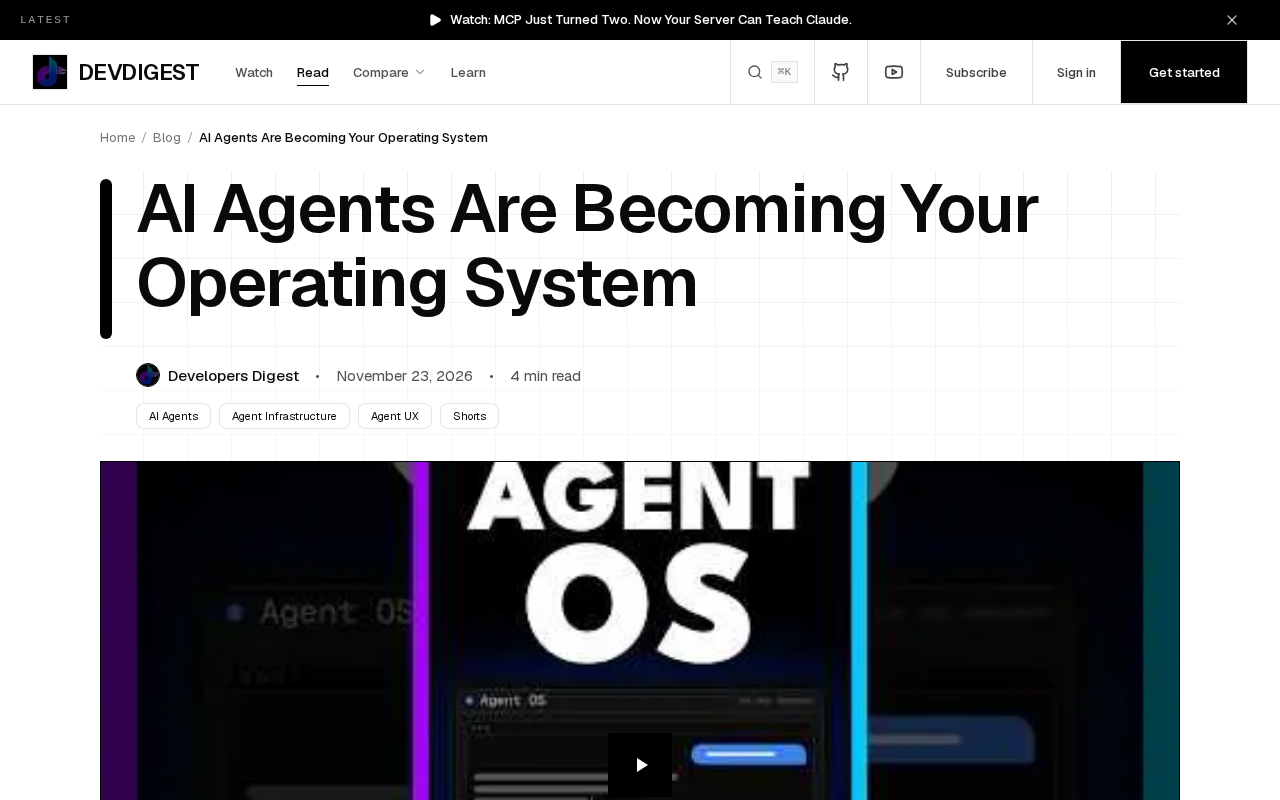
Discussion around AI Agents has long remained at the level of "what tasks can it complete," but a more fundamental shift is taking place: Agents are no longer just tools—they are gradually taking on the role of an operating system, scheduling resources, managing state, and hosting interactions. A recently leaked roadmap breaks this trend down into three concrete turns: from isolated individuals to collaboration on a shared cloud file system, from raw logs to an inbox, and to instantly generated custom mini-apps. These turns all point to the same judgment: Agents are becoming a new "OS" layer between users and computing resources.
From Isolated Individuals to Collaborative Entities on a Shared File System
Most current Agent products take the form of "isolated individuals": each task starts a session, context dissipates when the session ends, and there is no shared state layer between Agents. The first shift proposed in the roadmap is to run multiple Agents on top of a shared cloud file system.
The implication of this design is not just "file sharing." A shared file system effectively provides Agents with a persistent public memory: intermediate results written by one Agent can be read and further processed directly by another; task outputs are no longer trapped in conversation history but settle into addressable files. This is closer to the relationship between processes and the file system in traditional operating systems—processes are temporary, the file system is persistent, and only a persistent storage layer makes complex collaboration possible.
From an engineering perspective, this also means the center of gravity for Agent orchestration will shift from "prompt chains" to "state management." Who writes, who reads, how versions conflict, how permissions are isolated—these problems that originally belonged to distributed systems will become core issues of Agent infrastructure.
The history of the file system as a core operating system abstraction is worth comparing. Unix's "everything is a file" design unified devices, pipes, and sockets under the same naming and read/write semantics, enabling different processes to share and pass data in a consistent way. The idea of Agents sharing a file system is similar: what it provides is not a specific feature but a general contract—any Agent that follows the file read/write interface can collaborate with other Agents without pre-agreeing on private protocols. This also explains why a shared storage layer is better suited to multi-Agent scenarios than a shared message queue: messages are transient, while files are addressable, traceable, and consumable by Agents that join at any time.
Inbox Replaces Raw Logs: Redesigning the Interaction Layer
The second turn concerns the output form of Agents. Currently, most Agent outputs are presented as raw logs, terminal output, or long conversation streams, and users must extract signal from noise themselves. The roadmap advocates replacing raw logs with an "inbox."
The key to the inbox metaphor is that it is designed for human attention. Each message has a clear source, state (read/unread/pending), and priority, and users can process in batches, defer, or hand off. As the number of Agents grows from single digits to dozens, raw logs will quickly overwhelm users, whereas the inbox provides a scalable attention interface.
This shift is isomorphic to the notification mechanisms of operating systems. Desktop OSes use notification centers to aggregate events from various applications, and Agent systems need a similar aggregation layer that unifies the progress, requests, and exceptions of multiple Agents into a human-consumable message stream. In a sense, the inbox is the "notification hub" of the Agent OS, and its design quality directly determines whether a multi-Agent system is usable.
There are design paradigms worth referencing behind the "attention interface." The notification center and the inbox model in human-computer interaction share the same assumption: human attention is a scarce resource, and the system should proactively aggregate, deduplicate, and prioritize rather than throwing raw event streams directly at users. Gmail's Priority Inbox, Slack's unread channels, and GitHub's Notification Inbox are all practices of this idea. For Agent systems, the difficulty lies in defining state semantics: when a message counts as "pending," when it counts as "taken over by an Agent," and how it returns to the queue after failure—these state machine designs determine whether the inbox can truly reduce rather than shift cognitive burden.
Instantly Generated Mini-apps: The Interface Becomes the Agent's Output
The third turn is the most imaginative: Agents no longer return only text but instantly build custom mini-apps according to task needs.
In the traditional model, the user makes a request and the Agent returns an answer; in the mini-app model, the Agent returns an interactive mini-interface—perhaps a data dashboard, a form, an approval flow, or a one-off tool for a specific task. The interface itself becomes the Agent's deliverable, and users no longer need to clarify repeatedly in conversation but can operate directly on the generated interface.
This essentially compresses "application development" into the Agent's execution process. A small tool that previously required a team days to complete can now be instantly generated, used, and discarded within a single task. Software shifts from "a long-term maintained asset" to "a temporary artifact consumed on demand," and the impact on software lifecycles and development processes deserves continued observation.
Technically, "instant interface generation" relies on Generative UI capabilities: the model outputs not just text but a structured interface description (such as a component tree, JSON schema, or directly renderable code), which is then instantiated into an interactive interface by a runtime environment. This contrasts with the traditional approach where "the model outputs text and the frontend has pre-written fixed interfaces." The key challenge is not generation but security and state: dynamically generated interfaces need sandbox isolation, user operations on the interface need to be written back to Agent-readable state, and the interface itself needs version management. These are exactly the infrastructure problems that must be solved when incorporating one-off interfaces into the scope of an "operating system."
The Common Logic Behind the Three Turns
Viewed together, the three turns jointly outline the prototype of an Agent OS: the shared file system is the storage layer, the inbox is the interaction layer, and the mini-app is the presentation layer. Stacked together, the Agent system acquires the typical structure of an operating system—managing persistent state, aggregating asynchronous events, and presenting interfaces on demand.
This also explains why "Agents becoming an operating system" is not just rhetoric. When Agents begin to take on responsibilities for resource scheduling, state persistence, and human-computer interfaces, the boundary between them and an OS blurs. For developers, the focus of competition may shift from "model capability" to "system design": whoever does well in the state layer, attention layer, and interface layer will control the next-generation entry point.
It should be noted that the above roadmap is currently only a directional description, lacking specific implementation details and validation data, and the pace and priority of the three turns remain to be observed. But in terms of trend judgment, Agents moving from isolated tools to systematic infrastructure is one of the most noteworthy directions of evolution today.
One-line Summary
AI Agents are evolving from isolated tools into an operating system layer responsible for storage, interaction, and interface.
Paragraph Summary
The article points out that discussion of AI Agents is shifting from "what tasks can it complete" to a more fundamental system positioning: Agents are gradually playing the role of an operating system, scheduling resources, managing state, and hosting interactions. A leaked roadmap breaks this into three turns: multiple Agents running on a shared cloud file system, forming persistent public memory and shifting the orchestration focus from prompt chains to state management; replacing raw logs with an inbox to provide a scalable attention interface for multi-Agent scenarios; and Agents instantly generating mini-apps on demand, making the interface itself the deliverable and turning software from a long-term asset into a temporary artifact. These correspond respectively to the storage layer, interaction layer, and presentation layer, together forming the prototype of an Agent OS, with the focus of competition possibly shifting from model capability to system design. The author also cautions that the roadmap is only a directional description, and the pace of implementation remains to be observed.
Related articles

Nothing CMF Buds 2A Drops to $17.89 on Black Friday: A New Low for ANC Earbuds
Nothing CMF Buds 2A wireless earbuds Black Friday deal: just $17.89 on Amazon, about $11 off retail and a record low. ANC earbuds at an entry-level price.

When AI Creation Gets Accused of "Spitting": Hacker News Heats Up Over the Glaude Controversy
A Hacker News post, "Spitting in the Face of Glaude," sparks debate on AI creation transparency and attribution ethics. This analysis examines the blurred creator identity behind the controversy and offers practical advice for AI content production.

Akai Embraces Custom Firmware: MPC Sample 1.4 Lets Users AI-Program Their Sampler
Akai embraces the modding community with MPC Sample 1.4 firmware, supporting vibe-coded custom firmware and effects. We analyze the impact of this open strategy on music hardware and AI-assisted programming.