AI Agents Automating JS Reverse Engineering: A Deep Dive into the New Paradigm for Web Scraping

How AI agents automate JS reverse engineering end-to-end, and what it means for web scraping engineers.
AI agents are transforming JS reverse engineering from a weeks-long manual process into a streamlined, largely automated workflow. By combining LLM reasoning with built-in tools for packet capture, WASM analysis, and environment patching, these agents can crack complex encrypted parameters in hours. This article examines two operating modes, prompt engineering best practices, and why deep technical expertise remains essential in the AI era.
Introduction: When Web Scraping Meets AI Agents
In the world of data collection, JS reverse engineering has long been a formidable barrier for developers. JS reverse engineering refers to the technical process of analyzing and reconstructing the encryption and obfuscation algorithms embedded in a website's front-end JavaScript code, in order to obtain the parameters needed for data collection. Modern websites typically employ multiple layers of protection: parameter signing (e.g., sign, token), dynamic encryption (where keys change with each request), code obfuscation (e.g., OB obfuscation, AST transformations), and environment fingerprinting (TLS fingerprints, Canvas fingerprints, WebGL characteristics). "Environment patching" — simulating browser APIs (such as window, document, navigator) in non-browser environments like Node.js so that encrypted code can run correctly — is a particularly tedious step that often requires engineers to track down dozens or even hundreds of missing or abnormal browser properties one by one. In the traditional workflow, engineers must manually analyze encrypted parameters, trace call stacks, and patch the browser environment. A complex website can take anywhere from two weeks to a full month to crack. With the maturation of AI Agent technology, all of this is being fundamentally transformed.
An AI Agent is an autonomous task-execution system built on top of a large language model (LLM). Its core strength lies in combining the LLM's reasoning capabilities with external tool use. Unlike a purely conversational AI, an Agent can perceive its environment, formulate a plan, invoke tools (such as browser control, code execution, and file I/O), and iteratively act based on feedback — forming a closed loop of "perceive → plan → act → feedback." ReAct (Reasoning + Acting) is currently the dominant Agent architecture paradigm, and it's this paradigm that underpins the practical deployment of automated JS reverse engineering tools.
As demonstrated by Bilibili creator Luoge in a hands-on walkthrough, an AI agent integrated with a scraping tool chain can achieve "one-sentence project kickoff" — the user simply provides a website URL and data collection requirements, and the Agent automatically handles the entire pipeline: page analysis, packet capture, parameter location, algorithm reconstruction, and code generation. This article will draw on his e-commerce platform demo to deeply unpack the working logic and industry significance of this new paradigm.
The Core Capabilities of AI Agents: A Built-in Tool Chain That Covers the Full Reverse Engineering Workflow
Traditional AI-assisted reverse engineering approaches — such as GPT paired with the CDP protocol and MCP tools — typically require developers to connect an external browser themselves and handle communication issues, resulting in a steep configuration overhead. Here, CDP (Chrome DevTools Protocol) is the low-level debugging protocol exposed by Chrome that allows external programs to control page navigation, intercept network requests, inject JavaScript, and more; it serves as the foundation for automation tools like Puppeteer and Playwright. MCP (Model Context Protocol), proposed by Anthropic, is a standardized protocol that defines the communication interface between AI models and external tools, enabling different tools to be invoked by an LLM in a unified way. Traditional approaches require developers to set up a CDP service and write an MCP adapter layer themselves, which is quite complex. The standout feature of this particular agent is that it comes with a complete tool set built in — ready to use right out of the box, with no need to connect any external devices.
Its built-in capabilities cover the critical stages of JS reverse engineering:
- Page reconnaissance and analysis: Automatically reads the DOM structure and JS code in the browser
- Packet capture and API endpoint identification: Precisely identifies the many API requests loaded by a page
- JS/WASM analysis: Can inject JavaScript and analyze WebAssembly modules
- Automatic environment patching: Handles common web fingerprinting checks
- Proxy, packet capture, and instrumentation debugging and other auxiliary functions
The WebAssembly (WASM) analysis capability deserves special mention. WASM is a high-performance binary instruction format that allows code compiled from C/C++, Rust, and other languages to run in the browser at near-native speed. In the anti-scraping space, an increasing number of websites compile their core encryption algorithms into WASM modules to make them difficult to read — unlike JS code, which can be formatted and read directly, WASM's binary format requires specialized tools (such as wasm2wat or Ghidra plugins) for reverse analysis. Having WASM analysis built into the AI Agent means it can automate this traditionally extremely time-consuming aspect of reverse engineering.
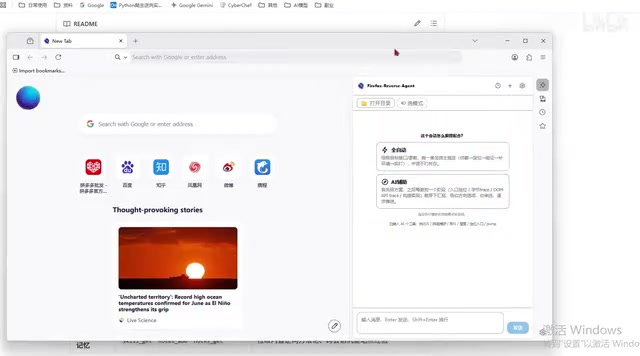
Notably, this Agent has strong compatibility with major LLMs, supporting DeepSeek, Zhipu, Kimi, OpenAI, Claude, and other mainstream models. The demo used the lower-cost DeepSeek for testing, which highlights an important point: the choice of model directly affects task completion quality and token consumption, and different models show meaningful performance differences on reverse engineering tasks.
Two Operating Modes: Fully Automatic vs. AI-Assisted — Which Should You Choose?
The agent offers two distinctly different operating modes, and understanding the difference between them is key to using it effectively.
Fully Automatic Mode
Fully automatic mode is "hands-off" — after the user submits a request, the Agent independently completes all analysis and code generation. This mode has the lowest barrier to entry, but the trade-off is that analysis time may be longer and token consumption is relatively higher.
AI-Assisted Mode
AI-assisted mode functions more like a "human-machine collaboration": the Agent pauses after completing each phase, reports its progress to the user, and requests instructions for the next step. By leveraging the user's expertise to narrow the analysis path, this mode can often significantly reduce time and token costs.
For engineers with a solid foundation in JS reverse engineering, the AI-assisted mode is actually the more economical and controllable choice — which reinforces a core insight: AI doesn't replace human thinking; it amplifies the value of human expertise.
E-Commerce Platform Demo: High-Quality Prompts Are the Key to Success
In the live demonstration, Luoge used a major e-commerce platform (known for its large volume of reviews) as a case study to show how to write high-quality prompts. The importance of prompt engineering in complex technical tasks far exceeds that in ordinary conversational scenarios — research shows that with the same model, the task success rate difference between a professional prompt and a vague one can be several times over, with similarly significant differences in token consumption. For specialized tasks like JS reverse engineering, a high-quality prompt needs to provide sufficient contextual constraints: a precise scope (to prevent the Agent from wasting computation on unrelated endpoints), clear verification criteria (how to determine that reconstruction was successful), and output format requirements (programming language, file structure). The precision of your prompt directly determines both whether the task succeeds and how much it costs — the experience shared here is highly instructive.
A well-structured JS reverse engineering prompt should include the following elements:
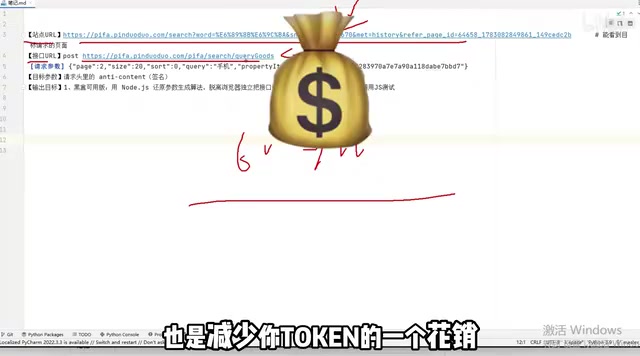
- A specific target URL: Tell the Agent exactly which page to collect
- Precise API endpoint identification: A single website may load 60 to 100 API endpoints; proactively specifying the target endpoint can dramatically narrow the analysis scope and reduce token waste
- Request parameter description: Provide the parameter structure of the endpoint
- Core encrypted value specification: Clearly identify the key parameters that need to be reconstructed (e.g., an
anti-content-style parameter in the request headers) - Execution and verification requirements: Request that the algorithm be reconstructed in Node.js, executed in the browser, and validated with a data end-to-end test in Python or JS
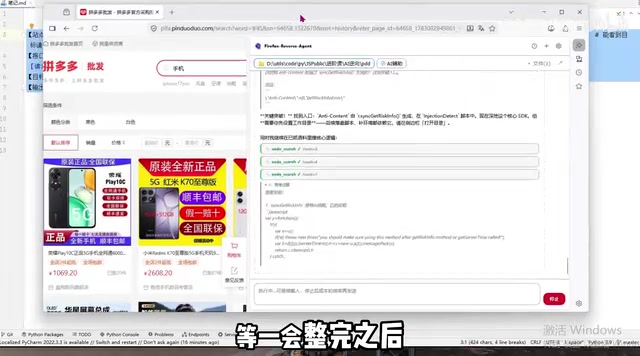
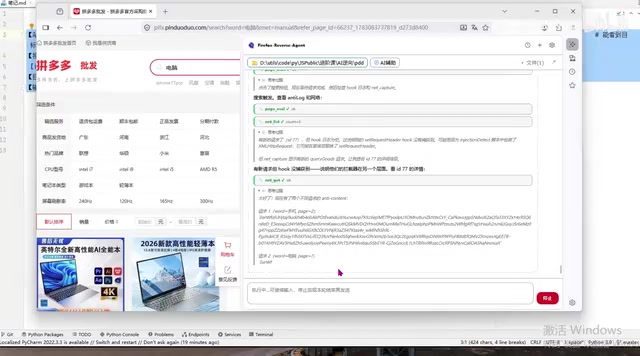
In the actual test, the Agent automatically opened the target website, performed pagination clicks, then precisely captured the encrypted parameter value named anti-content and located the JS script responsible for generating it. The entire packet capture and parameter extraction process was fully automated — something that traditionally requires engineers to manually trace the call stack for hours.
From Code Generation to Database Insertion: Full End-to-End Automation
After completing its analysis, the Agent saves the generated code to the user's specified working directory. This step is non-negotiable — if no path is specified, the generated code has nowhere to go.
Going further, the agent doesn't just produce runnable scraping code — it can also extend its automation capabilities on demand: writing database interfaces, constructing SQL statements, and inserting collected data directly into a database, achieving full "collect → store" pipeline automation.
Luoge used an apt analogy: it's like self-driving — you just tell the car where you want to go, and it starts up and takes you there. He also mentioned that a peer had used this type of agent to successfully crack the Akamai risk control system, which is renowned for its strict protection. Akamai is a leading global CDN and cybersecurity company, and its Bot Manager product is widely considered one of the most rigorous anti-scraping systems in the industry — implementing multi-dimensional protection through TLS fingerprinting, HTTP/2 fingerprinting, deep browser environment inspection (checking the authenticity of hundreds of JS properties), mouse trajectory modeling, and dynamically encrypted sensor data (where the sensor_data parameter updates its encryption logic every few hours). Successfully cracking Akamai typically represents a top-tier level of technical ability in the JS reverse engineering field, which speaks to the impressive upper ceiling of what these agents can achieve.
That said, it's worth maintaining a balanced perspective: demonstrations like this tend to showcase successful cases. In real engineering work, the reconstruction success rate for complex risk control systems (such as dynamic encryption and behavioral verification), as well as the stability and maintainability of the generated code, still need to be validated repeatedly in real-world projects.
A Moment of Reflection: Will AI Replace Web Scraping Engineers?
Given such powerful automation capabilities, the question everyone in the field is asking is: Will AI replace web scraping developers?
Luoge offered several thoughtful observations worth considering:
First, AI always requires technically knowledgeable people to drive it. Someone who doesn't understand code won't know how to write precise prompts, nor will they be able to debug and maintain the code when it throws errors. As discussed earlier, prompt quality is highly correlated with the user's depth of technical knowledge — someone who knows nothing about Akamai's sensor data structure cannot give the Agent effective analytical guidance. The technical barrier hasn't disappeared; it has simply shifted to "how to direct AI effectively."
Second, increased efficiency amplifies value rather than eliminating jobs. Where cracking a website used to take two weeks to a month, it might now take just one or two days. This efficiency gain drives business expansion for companies, which in turn benefits the practitioners involved. As long as the business is growing, the position of core technical talent remains secure.
Third, the industry will accelerate its polarization. Engineers who truly understand JS reverse engineering and anti-scraping mechanisms will have increasingly strong career prospects, because they possess the professional judgment needed to effectively direct AI. Those without a solid technical foundation risk being marginalized.
This logic carries a universal lesson: The widespread adoption of AI tools will not diminish the importance of technical expertise — it will actually widen the gap between professionals and amateurs. The more powerful the tool, the more it demands sound judgment and domain depth from its user.
Conclusion: Technical Expertise Is the Eternal Foundation for Mastering AI
AI agents are transforming JS reverse engineering from "manual labor" into "the art of command." They dramatically compress the time cost of reverse engineering, freeing engineers to focus their energy on higher-level architectural design and business judgment.
But as this article has repeatedly emphasized: technical expertise is always the foundation of all of this. Whether it's writing precise prompts, debugging problematic code, or developing a macro-level understanding of risk control mechanisms — from Akamai's sensor data to WASM encryption modules — none of it is possible without a solid professional grounding. For web scraping practitioners, rather than worrying about being replaced by AI, the better path is to proactively embrace these tools, deepen your technical skills, and become the person who is capable of "commanding the AI."
Key Takeaways
Related articles

The Truth Behind Codex 'Build a Website in 5 Minutes': AI Isn't Creating Sites—It's Helping You Copy Them
Exposing the truth behind viral Codex 5-minute website videos: creators aren't building original sites with AI—they're copying shared prompts or scraping others' work. Learn AI coding tools' real limits.

Getting Started with AI Agent Development: A Complete Guide from Concept to Practice
A comprehensive guide to AI Agent architecture and development, covering automated marketing, intelligent customer service, and investment analysis scenarios with single and multi-agent collaboration.

The Truth Behind Codex 'Build a Website in 5 Minutes': AI Isn't Creating Sites — It's Helping You Copy Them
Exposing the truth behind viral Codex 5-minute website videos: creators aren't building original sites with AI — they're copying shared prompts or scraping others' work.