AI Agents Autonomously Manage Kanban Boards: A New Paradigm for Multi-Agent Collaboration

AI agent teams use Kanban to achieve autonomous collaboration, with orchestrator review gates and dynamic structures completing a quality loop.
This article introduces a multi-agent collaboration demo: AI agents autonomously claim tasks and update statuses on a shared Kanban board, while an "orchestrator" agent running on a top-tier model handles review and rollback. Tasks must pass a review gate to enter the Done column, forming an "execute-review-feedback-revise" quality loop. The board structure is not hard-coded but dynamically generated at runtime, requiring agents to have planning capabilities. This pattern mimics human agile teams, using board state to drive agent behavior and review gates to ensure output quality, pointing to the evolution of multi-agent systems from single-point tools to self-organizing teams.
From Human Kanban to Agent Autonomy
Kanban has long been a classic tool for human teams to manage task flow, and now it is being taken over by AI agents. A recent YouTube demo showed that multiple AI agents can, like human teams, autonomously claim tasks, advance statuses, and even complete reviews and acceptance on a shared Kanban board. The entire process requires no manual intervention—the board itself becomes the core hub for coordination among agents.
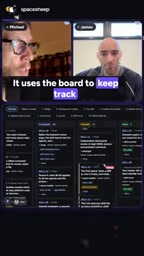
The demo mentioned that agents update the board in real time while working to track the "complete plan." This design keeps task status transparent both inside and outside the system—humans can check progress at any time, and agents can decide their next actions based on board state.
Kanban originated in the Toyota Production System, with its core idea of optimizing flow efficiency by visualizing workflows and limiting work in progress (WIP). In software and agile development, Kanban typically appears as columns such as "To Do, In Progress, Review, Done," with each card representing a task. Its essence is a shared state machine: the movement of cards between columns defines the lifecycle of a task. When agents take over the board, this state machine becomes a "public blackboard" for coordination among agents—each agent reads column states to decide behavior and writes states to inform others of progress. This decentralized coordination approach avoids the complexity of direct communication between agents, making the system easier to scale and observe.
Orchestrator and Review Gate: Who Controls the Rhythm
The key role in this system is an agent called the "orchestrator," which runs on what the presenter calls the "current best model" (the original quote mentions fable 5.2). The orchestrator does not directly execute specific tasks but acts as a project manager: waiting for task cards to enter the "Review" queue, reviewing outputs one by one, giving feedback, and when necessary returning cards to the "In Progress" state.

Only when a task passes the orchestrator's review gate is it moved to the "Done" column. This two-level structure—execution agents producing output and the orchestrator ensuring quality—mirrors the division of labor between developers and reviewers in human teams. The presenter emphasized that this process is "very similar" to how humans use Kanban, "just with agents instead."
Orchestrator is a coordination role in multi-agent systems responsible for scheduling tasks, allocating resources, monitoring progress, and handling exceptions. Unlike execution agents, the orchestrator does not directly produce work outputs but ensures overall goals are achieved by managing task flow. In this scenario, the orchestrator uses the board's "Review" column as a trigger signal to actively pull tasks awaiting review, reflecting an event-driven design pattern. This separation of responsibilities (decoupling execution from coordination) reduces the cognitive load on individual agents and makes it easier to optimize orchestration strategies independently. The orchestrator typically runs on a more capable model to handle complex judgment and feedback generation.
Review and Rollback: The Quality Loop of an AI Team
The review stage is not a formality. The orchestrator checks each output, and if problems are found, sends the task back to "In Progress" with feedback so the execution agent can rework it. This forms a closed loop: execute → review → feedback → revise → re-review.

The significance of this mechanism is that AI output is no longer a one-off black-box result but an iterative product that passes through internal quality gates. For automated workflows that require reliability, this is far more robust than direct output from a single agent. The presenter described this collaboration rhythm as "just like humans using Kanban," indicating that the design approach directly draws on agile development practices.
Review Gate is a quality checkpoint in a workflow; only tasks that pass inspection can move to the next stage. In human agile teams, code review is a typical example, aimed at finding defects, sharing knowledge, and ensuring consistency. In AI agent systems, the review gate is automatically executed by the orchestrator agent, and its judgment may be based on conformity to the task description, correctness of output format, runnability of code, and so on. The rollback mechanism (sending tasks back with feedback) constitutes closed-loop feedback, enabling agents to iteratively improve based on feedback. This design draws on the feedback loop concept in cybernetics, improving system reliability by continuously correcting deviations and avoiding the uncertainty of single-pass generation.
Dynamically Generated Board Structure
A striking detail is that the entire board structure is not hard-coded in advance but is "created on the fly" during runtime. In other words, agents dynamically generate columns and cards according to task needs rather than relying on fixed templates.

This dynamism allows the system to adapt to different project shapes, but it also places higher demands on agents' planning capabilities—they need to decide for themselves how to organize the workflow. The presenter's assessment was "pretty crazy," revealing surprise at the progress of current AI orchestration capabilities.
Dynamic structure generation refers to the system creating or adjusting workflow components (such as columns, cards, and dependencies) on the fly at runtime according to task requirements, rather than relying on predefined templates. This requires agents to have planning capabilities: understanding task goals, decomposing subtasks, and deciding the required stages and their order. In traditional workflow engines, processes are usually designed in advance by humans; dynamic generation hands design authority to agents, enabling them to flexibly adapt to different project shapes. But this also brings challenges: how can we ensure the generated structure is reasonable, consistent, and maintainable? Common strategies include introducing constraints (such as requiring a "Review" column) or having the orchestrator audit structural changes. This capability is a key step toward true autonomy in multi-agent systems.
Signals of Multi-Agent Collaboration
Although the demo is brief, it points to a clear trend: AI agents are evolving from single-point tools into teams capable of self-organization. Here, Kanban is not just a visual interface but a shared state machine and coordination protocol for agents. When orchestrator, executor, and review logic are encoded into the same set of Kanban rules, multi-agent systems gain autonomy similar to human teams.
For practitioners focused on AI programming and automated workflows, this case offers a pattern worth borrowing: use board state to drive agent behavior, use review gates to ensure output quality, and use dynamic structures to handle task changes. The next things worth observing are the stability of this pattern in more complex projects and how humans can retain meaningful intervention points within it.
Related articles

RePlan-VLA: Progress-Aware Replanning Breakthrough for Long-Horizon Robotic Manipulation
The RePlan-VLA framework converts VLA models' short-horizon capabilities into reliable long-horizon execution through progress-aware adaptive replanning, improving success rates by 21.9% and 10.4% on RoboCasa365 and CALVIN, and validating real-world deployment on a Franka Research 3 robot.

Geometric Bridge Flow Matching: A New Breakthrough in Blind Rigid Motion Correction
Geometric bridge flow matching enables blind rigid motion correction in head CBCT, achieving 37.1 dB PSNR and 0.27 mm RPE on simulated data in ~9.1 minutes, outperforming existing methods.

Google Releases Gemini 4 Hydrogen: 2.5x Faster Without Sacrificing Intelligence
Google releases the lightweight Gemini 4 Hydrogen: 2.5x faster task completion, AA Intelligence Index of 54 beating its flagship sibling, 7.3s single-step on Agent Arena faster than Claude and GPT rivals, four thinking levels with pay-as-you-need pricing, now available across AI Studio and more.