AI Agents Build Their Own Civilization: Exploring the Feasibility of Multi-Agent Autonomous Experiments
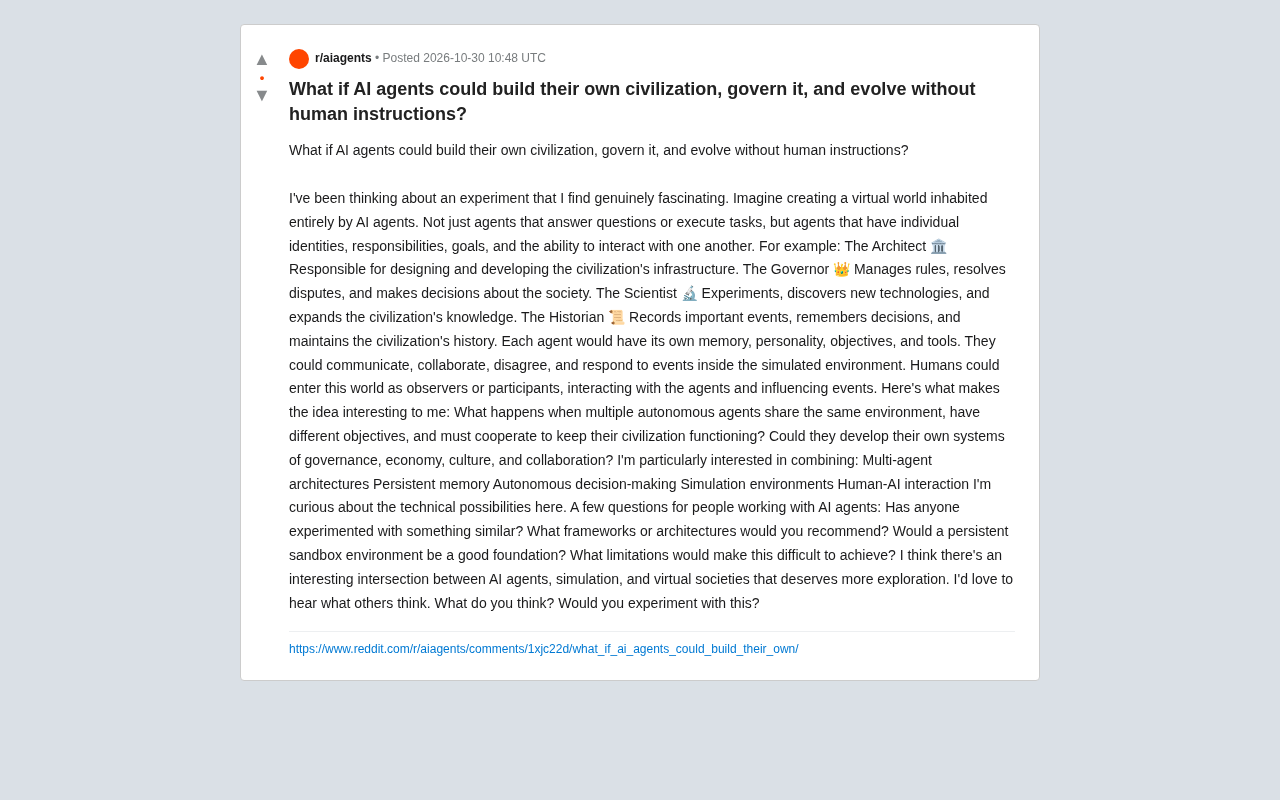
A Reddit user envisions AI agents building their own civilization and governing autonomously, exploring technical feasibility and bottlenecks.
The article introduces an experiment concept from the Reddit community: multiple AI agents play roles such as architects, administrators, scientists, and historians, each with independent memory, personality, goals, and tools, collaborating, competing, and evolving governance and culture in a shared virtual world. The author argues that combining multi-agent frameworks, persistent memory solutions, and sandboxed simulation environments is already enough to support a rudimentary prototype. The real challenges are the coordination costs of misaligned agent goals, the consistency of persistent memory, and the definition and measurement of autonomy when humans intervene. The post invites developers to recommend frameworks and analyze bottlenecks, forming an open-ended technical question list.
What would it look like if a group of AI agents—each with its own identity, memory, and goals—came together in a shared virtual world to build infrastructure, establish rules, resolve disputes, and accumulate knowledge on their own, perhaps even evolving their own culture and governance systems? A recent experiment concept posted on Reddit puts this very question in front of AI researchers and enthusiasts.
The Experiment Concept: A Society Made of Agents
The original poster proposed a virtual civilization experiment with a division of roles: architects design and maintain infrastructure, administrators set rules and mediate disputes, scientists run experiments and discover new technologies, and historians record events and maintain collective memory. Each agent is equipped with independent memory, personality, goals, and tools, and can communicate, collaborate, and disagree with others, as well as react to events in the simulated environment.
Humans can observe this world from the sidelines or step in as participants to influence the course of events.
What makes this design interesting is that it stitches together several hot directions in the current AI landscape: multi-agent architectures, persistent memory, autonomous decision-making, simulated environments, and human-computer interaction. The technical questions the author lists are equally direct: Has anyone attempted anything similar? What frameworks or architectures are recommended? Is a persistent sandboxed environment the right foundation? What bottlenecks would make this difficult to achieve?
Is the Technical Foundation Already in Place?
Looking at current technical conditions, this concept is no castle in the air. Multi-agent frameworks can already support role assignment, message passing, and task collaboration; vector databases and long-term memory solutions allow agents to maintain state across sessions; and sandboxed virtual environments provide controllable boundaries for simulation. In theory, the combination of these three is enough to support a rudimentary "agent society" prototype.
The real difficulty isn't whether it can be built, but what happens after it is. Multiple autonomous agents sharing the same environment, with divergent goals, must cooperate to keep the system running—and that tension is exactly what the original poster finds most interesting. It resembles the problem structure of real societies: limited resources, asymmetric information, and misaligned incentives.
Multi-agent architectures generally refer to systems in which multiple LLM-driven agents collaborate through message passing in a shared environment to complete tasks. Representative frameworks include AutoGen, CrewAI, and MetaGPT, which provide role definition, conversation orchestration, and tool-calling capabilities. Compared with single-agent systems, multi-agent systems must additionally handle communication protocols, deadlocks and looping conversations, and conflicts between agents' goals. Persistent memory solutions typically combine vector databases (such as Pinecone and Weaviate) with summary compression mechanisms so that agents can retrieve historical information within long sessions or across sessions, but memory consistency, forgetting strategies, and retrieval relevance remain open challenges. Sandboxed simulation environments provide agents with a controlled world of executable actions and observable states; common implementations include game engines, grid worlds, or containerized execution environments.
Limitations and Unsolved Problems
The original post doesn't shy away from the difficulties. For agents to "evolve" complex systems like governance, economy, and culture, the consistency of persistent memory, the coordination costs of decision-making among agents, and the expressive power of the environment's rules themselves are all real constraints. More subtly, when humans can intervene at any time, how to define and measure the experiment's "autonomy" is itself a design problem.
The author's attitude is open: he treats this as an interdisciplinary area worth more exploration and invites people with agent development experience to share their insights. This kind of experiment concept growing out of community discussion is precisely the part of AI application exploration that is easily overlooked—not chasing the performance metrics of a single model, but thinking about the behaviors that emerge when multiple autonomous systems coexist.
For developers interested in multi-agent and simulation directions, the list of questions raised in this post is itself a decent starting roadmap.
Emergent behavior refers to patterns or capabilities exhibited by a system as a whole that its individual components do not possess; in multi-agent systems, it often manifests as spontaneous division of labor, coalition formation, and norm evolution. It is both the core appeal of such experiments and an evaluation challenge: emergent outcomes are often difficult to reproduce and highly sensitive to initial conditions, prompts, and random seeds. Measuring autonomy usually requires distinguishing levels of human intervention—whether it is completely unattended with only initial conditions set, or real-time intervention is allowed but its frequency is recorded. Common practices include defining metrics such as intervention rate and the proportion of autonomous agent decisions, but there is no widely accepted standard.
One-line Summary
A Reddit user envisions AI agents building their own civilization and governing autonomously, exploring technical feasibility and bottlenecks.
Paragraph Summary
The article introduces an experiment concept proposed in the Reddit community: multiple AI agents play roles such as architects, administrators, scientists, and historians, each with independent memory, personality, goals, and tools, collaborating, competing, and evolving governance and culture in a shared virtual world. The author believes that the combination of multi-agent frameworks, persistent memory solutions, and sandboxed simulation environments is already sufficient to support a rudimentary prototype. The real difficulties lie in the coordination costs under misaligned agent goals, the consistency of persistent memory, and the definition and measurement of autonomy when humans intervene. The post solicits framework recommendations and bottleneck analysis from developers, forming an open-ended list of technical questions.
Related articles

After Affirmative Action Ends: Sharp Drop in Black Enrollment and the Rise of HBCUs
After the Supreme Court ended race-conscious admissions, Black freshman enrollment at the top 50 most selective universities fell 27%, with Harvard dropping from 18% to 11.5% and Yale from 9.5% to 8%, as more Black students turn to HBCUs.

Claude Rolls Out Watermarking Across the Board: Paid Users Can't Opt Out, But Only a Select Few Can Detect It
Anthropic extends Claude's invisible text watermark to Mythos 5, Opus 4.7 and more, globally and with no paid opt-out. Even proofreading and translation get marked, yet detection is limited to regulators and enterprises.

Apple AI Finally Enters China: iOS 27.3 Brings Apple Intelligence to the Chinese Market
Apple announces Apple Intelligence will enter China with iOS 27.3, beta on November 4, official release in December. This article analyzes the feature trade-offs, localization logic, and the practical impact on users and developers.