AI Agents in Action: A Complete Breakdown of Automated Vendor Onboarding

AI agents eliminate cross-department coordination overhead in vendor onboarding by automating the gaps between tasks.
Enterprise vendor onboarding spans 5–8 departments and can take weeks — not because tasks are slow, but because handoffs stall in inboxes. This article breaks down how AI agents orchestrate the full onboarding workflow: assessing documents, routing approvals, triggering system integrations, and keeping humans in control of high-stakes decisions. The result is a faster, more auditable process with far less coordination overhead for PMO teams.
The Overlooked Enterprise Pain Point: It's Not Slow Tasks — It's Long Waits
In large enterprise PMOs (Project Management Offices), coordinating procurement, legal, finance, IT, and operations to onboard a new vendor into the supply chain is one of the most frequent yet least efficient tasks in the organization. The PMO is the internal function responsible for setting project management standards and overseeing execution — and the cost of coordination is far greater than most people intuit. According to PMI's Pulse of the Profession report, for every $1 billion invested in projects globally, $135 million is lost due to poor project performance, with a significant portion attributed to cross-departmental information silos. McKinsey research shows that executives spend 60% of their time on internal coordination and communication — not core business decisions. PMI further found that knowledge workers spend an average of 28% of their working hours on email, and another 19% on information tracking and coordination. The most frustrating part for teams is rarely any single task — it's the hidden cost of waiting that runs through the entire vendor onboarding chain. Vendor onboarding typically involves 5–8 functional departments, 10–30 approval nodes, and an average cycle time of 2–6 weeks, making it one of the most concentrated examples of cross-departmental coordination overhead.
Interestingly, the problem doesn't lie with the people doing the work. Team members are capable, and process documentation is thorough: there are checklists, responsible teams, approval steps, and clear ownership across procurement, legal, finance, IT, and operations. Yet the entire system never quite operates as a connected whole.
"Individual tasks don't take weeks. What slows everything down is the waiting between tasks."
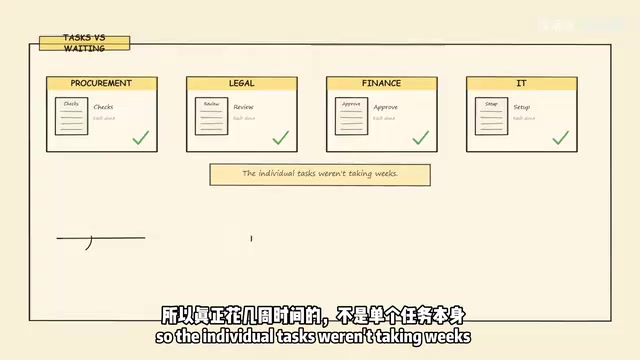
This observation cuts to the core of the problem. After procurement completes its review and hands materials to legal, that handoff becomes just another email sitting in an inbox. Finance is waiting on an approval but can't tell where things are stuck. IT often doesn't find out a new vendor is coming until late in the process — by which time everyone else has already assumed the systems are ready. As a result, the PMO's workload becomes the coordination itself: scheduling meetings, chasing follow-ups, updating trackers, and pulling everyone into the same room to align.
This coordination layer — the mechanism between task execution and decision approval — is exactly where AI agents excel. The coordination layer is the information-passing and status-synchronization infrastructure that sits between "doing the work" and "approving a decision." Traditional enterprises rely on email, instant messaging, and meetings to handle this layer. As the number of departments and process complexity grows, coordination costs rise exponentially. Earlier BPM (Business Process Management) systems and ERP platforms attempted to solve this, but lacked flexibility. AI agents bring the ability to understand context and handle unstructured information, upgrading the coordination layer from rule-driven to reasoning-capable and adaptive.
The Agent Operating Model: AI Assesses, Automation Orchestrates, Systems Execute, Humans Decide
The following is a demonstration case reconstructing a real-world scenario using today's tools. The vendor, timeline, and workflow have been simplified — in practice, vendors at different risk levels follow different paths, and some steps run in parallel. But the operational model is real and deployable:
- AI assesses information (Assess)
- Workflow automation orchestrates the entire process (Coordinate)
- System integrations handle controlled checks (Control)
- Humans approve the decisions that truly matter (Approve)
At the architectural level, these systems typically consist of four core components: an LLM-powered assessment module for parsing unstructured documents; a workflow orchestration engine managing task dependencies and state machines; a system integration layer communicating with enterprise systems like ERP and CRM via APIs; and a human-in-the-loop interface that triggers manual approvals at critical decision points.
Choosing the right workflow orchestration engine is critical for enterprise deployment. Temporal is currently one of the most prominent orchestration engines for enterprise use cases — built by former Uber engineers, its core advantage is Durable Execution: even if a service crashes or restarts, workflow state is automatically recovered, making it a natural fit for long-running processes that span days or weeks of human approval cycles. Prefect and Apache Airflow are better suited to data pipeline scenarios. For organizations with limited technical resources, low-code platforms like n8n and Make offer more accessible alternatives, though they have performance ceilings in complex state management and high-concurrency situations. This hybrid architecture of AI + workflow orchestration + system integration + human oversight is the dominant enterprise AI deployment pattern today — known in the industry as the Human-in-the-Loop (HITL) design pattern.
HITL is not merely a technical architecture choice — it is a core requirement of global AI governance frameworks. The EU AI Act classifies applications involving legal and financial matters as "high-risk AI systems," mandating that human review mechanisms be retained, with non-compliance penalties of up to €30 million or 6% of global revenue. China's Interim Measures for the Management of Generative AI Services similarly requires human review mechanisms in AI applications touching finance and law. Keeping final control over high-risk decision nodes in human hands is therefore not just an engineering best practice — it is a compliance necessity.
This division of responsibility clearly defines the boundary between AI and humans: agents don't replace accountable teams — they replace the coordination overhead between those teams.
Full Process Breakdown: From Document Review to Welcome Email
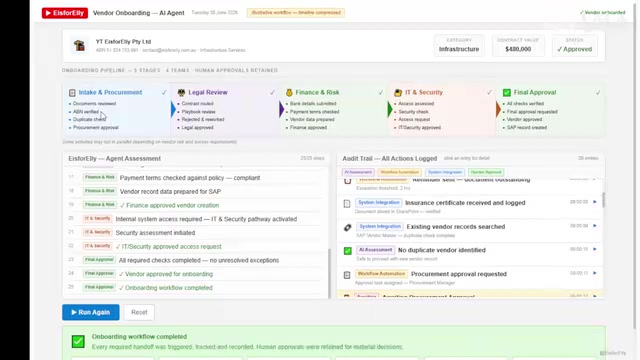
Once the workflow is triggered, the agent moves step by step through the process, with every action visible in real time through an activity feed.
Step 1: Document Review and Automated Follow-Up
The agent first reviews the vendor's submitted information and checks for document completeness. Upon discovering that proof of insurance is missing, the workflow automatically pauses, sends the vendor a request to submit the missing document, and sets a rule: "If no response within 2 hours, send a reminder." Once all documents are received, they are locked and the process continues.
This detail is worth noting: the follow-up nudge — the single most energy-draining task for any PMO — has been rule-ified and automated, requiring zero human intervention.
Step 2: System Verification and Duplicate Vendor Check
The verification step uses ABN (Australian Business Number) lookup as an example. An ABN is the unique 11-digit identifier assigned to businesses by the Australian Tax Office (ATO) — similar to China's Unified Social Credit Code — and can be used in real time via the ABN Lookup system to confirm a vendor's registration status, GST registration, and entity type. It's important to note that this is not an AI judgment call — it's a system integration. This distinction is critical in an enterprise compliance context: the probabilistic outputs of large language models are not appropriate as legal or audit-grade evidence, whereas results obtained by calling authoritative external systems via API are traceable and legally valid. The agent's role is simply to record and confirm that the information matches. Simultaneously, it runs a duplicate vendor check against the existing vendor database to prevent redundant entries from the start.
Step 3: Procurement Approval and Legal Exception Handling
Once the onboarding checks are complete, the agent requests procurement approval. The system simultaneously logs the approver's identity and timestamp, creating a full audit trail.
When the process reaches the legal stage, the agent flags a "non-standard liability clause." This reflects a deliberate design restraint — one that aligns closely with global AI governance trends. Both the EU AI Act and China's Interim Measures for the Management of Generative AI Services explicitly require human review in high-risk AI applications involving legal and financial matters. So the agent does not attempt to resolve the issue itself or try to persuade legal — it assigns a "legal exception review" to the appropriate owner and waits for a decision. Legal responds with a rejection and lists two specific issues.

The agent immediately routes the task back to procurement, initiating renegotiation with the vendor. Once the revised contract is returned, the agent re-checks it against the terms playbook. Both clauses now fall within standard ranges, and legal approves.
Step 4: Compliance, Finance Approval, and SAP Vendor Record Creation
Compliance screening runs through controlled systems. Finance completes a controlled service verification of banking information and approves. Only after finance approval does the agent proceed to contract signing and create the vendor record in SAP.
SAP is the world's most widely used ERP system — over 77% of global transaction revenue is processed through SAP systems. At the technical level, SAP integration is typically achieved through middleware layers (such as MuleSoft or Dell Boomi) or SAP Integration Suite, which shield downstream systems from underlying API version differences while providing unified error handling and audit logs. Creating a SAP vendor record is the key action that formally brings a vendor into the enterprise's financial and procurement ecosystem. It doesn't just write data — it activates a series of business rules, including payment terms configuration, purchasing limit settings, and tax code mapping. These downstream effects are precisely why all compliance verification must be completed before record creation. The agent uses API integration to automate this step, eliminating the delay and error risk of manual data entry, while enforcing the business rule that record creation is only triggered after finance approval. This strict dependency design ensures that critical control points cannot be accidentally bypassed.
Step 5: Conditional IT and Security Path
The IT and security phase uses a conditional trigger mechanism: the agent first evaluates whether the vendor requires access to internal systems. Unlike traditional BPM systems that rely on predefined structured rules, AI agents can dynamically determine the path based on semantic understanding of unstructured contract text — a capability known as Semantic Routing, which is one of the core value propositions of LLM-enabled workflow automation.
Traditional RPA (Robotic Process Automation) depends on predefined structured rules and requires human intervention whenever something falls outside those rules. LLM-powered semantic routing can understand the implied risk signals within contract clauses rather than simply matching keywords. According to Gartner, by 2025, over 50% of newly deployed RPA implementations will incorporate AI capabilities to enable this kind of dynamic routing — marking a paradigm shift in process automation from "rule-driven" to "semantically-driven." In this case, the answer is "yes, system access is needed," so the IT path activates — running a security assessment, preparing and assigning an access request, and waiting for IT approval. If the vendor doesn't require system access, this path is automatically skipped, avoiding unnecessary process overhead.
Step 6: Final Approval and Onboarding Completion
Once all preceding stages are confirmed complete, the system sends a final approval request to the project director. After approval, a welcome email is automatically sent and the workflow is marked as "onboarding complete."

What Would Have Changed If We'd Had This Earlier?
From a PMO practitioner's perspective, introducing AI agents would bring three substantive changes:
First, wait times collapse dramatically. Not because individual tasks become faster — legal still reviews contracts, finance still goes through approvals — but because the gaps between tasks disappear. The bottleneck was never task execution; it was task handoff.
Second, how PMO time is structured changes. The shift is from "chasing progress" to "doing oversight" — fewer follow-up nudges, and more energy directed toward genuinely valuable decisions and risk management.
Third, cross-departmental friction drops significantly. A large portion of internal friction comes from information desynchronization: "We didn't know it was ready," "When did they respond?" "Where did this task go?" The agent doesn't replace accountable teams — it replaces the coordination overhead between them.
Three Core Principles for Enterprise AI Agent Deployment
The value of this case isn't in the sophistication of the technology — it's in clearly demonstrating the appropriate role of AI agents in enterprise processes:
Principle 1: AI does not make unauthorized judgments. Decisions involving liability and risk (legal rejection, finance approval) are always made by humans. The agent handles routing and waiting — not adjudication. This principle is fully aligned with Human-in-the-Loop (HITL) AI governance philosophy, ensuring humans retain final control in high-risk decision scenarios. Both the EU AI Act and relevant Chinese regulations mandate this design at the legislative level, elevating it from an engineering choice to a compliance obligation.
Principle 2: Deterministic tasks belong to system integrations. Verification, deduplication, and similar steps should not rely on a large language model to "figure it out" — they should call reliable external systems, whose results carry credibility in legal and audit contexts. The boundary between the probabilistic outputs of large language models (statistical predictions based on Transformer architecture) and the traceable results from authoritative external systems is a core consideration in enterprise AI compliance — the former is suited for understanding and routing, the latter for verification and record-keeping.
Principle 3: The core value of AI agents is orchestration and handoff. Turning the scattered waits sitting in various departmental inboxes into a real-time, visible, rule-driven automated pipeline — that is the most direct business value AI agents deliver in enterprise process automation. The "Durable Execution" capability of workflow orchestration engines ensures that this pipeline can automatically recover from any failure scenario, providing the technical guarantee of enterprise-grade reliability.
For any organization suffering under the weight of cross-departmental coordination, vendor onboarding is just one example. The real question worth asking is: in your business processes, how much time is consumed between tasks rather than on the tasks themselves? That may be exactly where AI agents should be deployed first.
Key Takeaways
Related articles
LangGraph Crash Course: Building Enterprise-Grade AI Agents and Workflows from Scratch
LangGraph crash course: learn its independence from LangChain, MIT license, FastAPI high-concurrency deployment, human approval, and memory storage for enterprise AI agents.
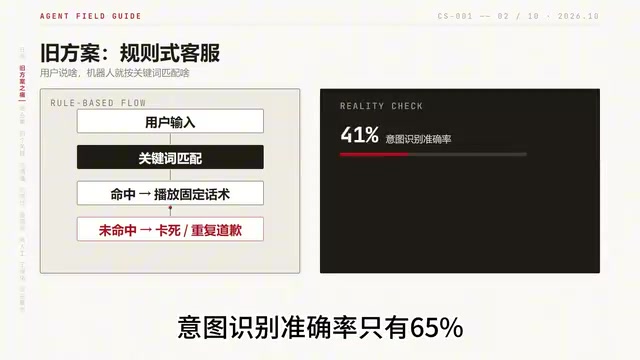
Building an AI Customer Service Agent from Scratch: A 92% Intent Recognition Case Study
A Bilibili case study: building an AI customer service agent from scratch with BERT intent recognition, dialogue state tracking, hybrid vector retrieval, and a weighted handoff model—raising intent accuracy from 65% to 92%, 78% conversation completion, handling 100K conversations daily.
Loop Engineering: An Engineering Paradigm for AI That Writes Code and Merges PRs Autonomously
Loop Engineering is transforming AI development pipelines: Stripe's Minions system merges over 1,300 machine-generated PRs weekly. This article breaks down Loop Engineering's five core actions, six components, five failure modes, and three safety disciplines, explaining why independent evaluators, state files, and budget caps matter more than full automation.