AI Agents in Bug Bounty Hunting: From the Classic Three-Step Method to Automated Vulnerability Discovery

AI Agents reshape the bug bounty three-step method, slashing barriers and multiplying submission rates 100x.
This article uses SRC bug bounty hunting as its backdrop to explain how AI transforms the traditional three-step vulnerability discovery workflow. The classic approach is entirely human-driven — experience-dependent, slow, and hard for newcomers. With AI Agents, recon auto-generates structured asset inventories, analysis filters false positives to surface high-severity findings, and reporting produces formatted drafts automatically. The article stresses that effective tools must be action-capable AI Agents (like Codex or Claude) — not chat-based Q&A tools. The payoff: one researcher submitted over 14,000 vulnerabilities in a year. But decision-making and verification always stay with the human, and manual review before submission is mandatory.
Traditional Vulnerability Hunting: High Barriers and Experience Walls
In the SRC bug bounty space, there's a widely adopted "universal three-step method" for finding vulnerabilities. Step one is to thoroughly browse the target site — mapping out its functional structure, underlying tech stack, and data interfaces, covering every business flow including registration, login, payment, refunds, and returns. Step two is packet capture and analysis: understanding the paths and parameters involved in each request, identifying potential risk points, then tampering with those parameters and resubmitting to verify whether a vulnerability actually exists. Step three is validating the vulnerability and writing the bug report.
The core problem with this workflow is that every step depends on human effort, which means efficiency is directly tied to experience. The more experienced you are, the faster you move; the less experience you have, the slower everything gets. Results from tools like NMAP, Telnet, NC, and Burp Suite still require manual review. For example, if a tool reports that port 22 or 3306 is open on a server, you still need a human to determine whether that's a real vulnerability, a false positive, or simply an improperly hardened configuration.
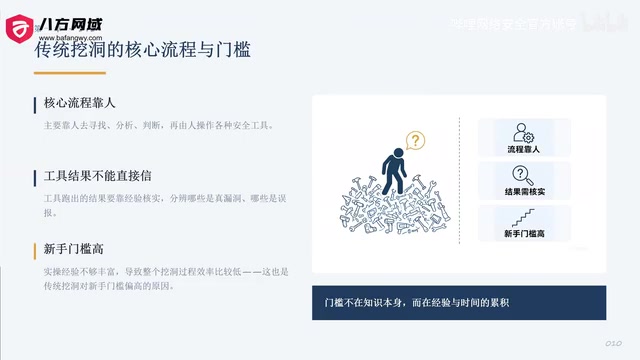
For newcomers, the barrier isn't really about knowledge — it's about accumulated experience and time investment. Many people finish introductory courses and still can't get into an effective bug-hunting groove. Cybersecurity is an inherently multidisciplinary field, with a sprawling toolset and a steep learning curve. The cost of trial and error without hands-on experience is extremely high, and it typically takes three to six months just to build a solid foundation.
SRC (Security Response Center) is a platform companies set up to receive vulnerability reports from external security researchers. Major Chinese internet companies like Alibaba, Tencent, and ByteDance all operate their own SRCs. Researchers who discover and submit valid vulnerabilities can earn points, monetary rewards, or public recognition. Burp Suite, mentioned throughout this article, is an integrated toolkit designed specifically for web application security testing — its core function is intercepting and modifying HTTP/HTTPS traffic between a browser and a server (i.e., "packet capture"), making it one of the most widely used tools in penetration testing. NMAP is used for port scanning and network reconnaissance, NC (Netcat) is commonly used for debugging network connections, and Telnet can test port connectivity. Each of these tools serves a distinct purpose, but all of them produce output that requires human interpretation — which is precisely why beginners struggle to use them effectively.
How AI Changes Each Step of the Three-Step Method
Once AI enters the vulnerability hunting workflow, every stage of the three-step method undergoes a meaningful transformation.
Cleaner information gathering. In the past, reconnaissance meant manually clicking through pages yourself. Now you can have AI do an initial sweep — probing the web server's backend architecture, frontend structure, authentication mechanisms, databases, and access patterns. AI can inventory functional modules and routing entry points, annotate the business purpose and parameter format of each endpoint, and output a structured asset inventory. The resulting table clearly maps each function to its corresponding interface and validation method, so the human only needs to review — not collect from scratch.
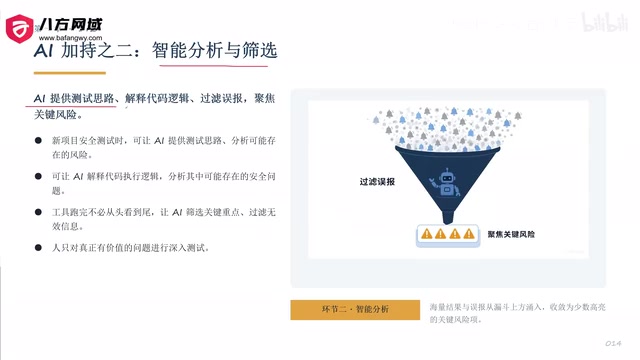
Smarter analysis and triage. In the second stage, AI can suggest testing approaches, explain unfamiliar code, and filter out false positives. Bug hunting routinely produces massive amounts of results and noise; AI can cut through most of it and focus attention on critical, high-severity, and medium-severity findings. There may be a large volume of low-severity issues, but those aren't urgent — critical and high-severity ones need immediate attention. With AI handling the filtering, the coverage is broader and the results are more precise, letting humans focus deep testing on issues that actually matter.
Easier report generation. During the triage and reporting phase, AI can call tools, execute commands, and generate reports. Kali Linux ships with an enormous number of tools — expecting anyone to be proficient with all of them is unrealistic. AI can conveniently orchestrate those tools and handle the filtering. The four required elements of a bug report — vulnerability URL, reproduction steps, impact assessment, and remediation advice — can all be drafted by AI in the proper format.
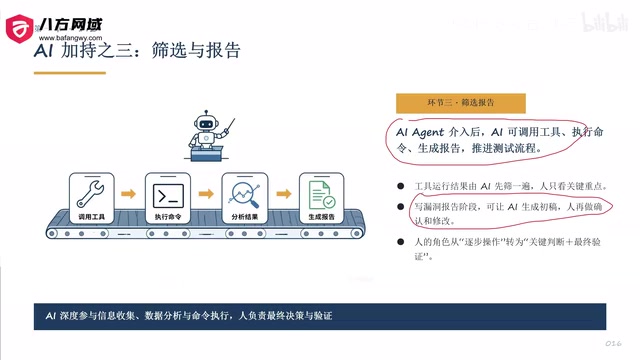
One critical caveat: what AI generates is only a first draft. Before submission, a human must review it carefully — verifying that the reproduction URL actually has a problem, that the reproduction steps are accurate, and that the described impact matches reality. Submitting AI-generated reports without review is a fast track to getting blacklisted. This final step must always be owned by a human.
The Key Distinction: AI Agent vs. Q&A Tool
This is the most important point in the entire article. What actually makes a difference in vulnerability hunting is not a chat-style Q&A tool like the DeepSeekAd or Tongyi Qianwen web interfaces. What's needed is an AI Agent — a system that can execute tools, make sequential decisions, identify exploitation steps, and carry them out.
In other words, you can't hunt vulnerabilities with an AI that can only answer questions. You need something that can actively participate in the real vulnerability hunting workflow. AI agents mentioned in this context include Codex, Claude, as well as Tree, early versions of OpenCloud, Amos Agent, and others.
What can these agents actually do? They can read and analyze project source code, understand implementation logic, identify security issues, execute reconnaissance and testing commands, and invoke security tools to conduct penetration testing against a target. What you're introducing is not a chat box — it's an agent that can take action.
The fundamental difference between an AI Agent and a conventional conversational AI lies in the capacity for action. Conversational AI (such as the web-based ChatGPT or DeepSeek) can only receive text input and return text output — it cannot proactively call external tools, execute system commands, or track multi-step tasks continuously. An AI Agent, by contrast, has tool-use capabilities: it can invoke terminal commands, call APIs, read and write files, and autonomously decide the next step based on the result of the previous one — forming a perceive–decide–execute loop. Codex (released by OpenAI) and Claude (from Anthropic) both offer strong code understanding and tool-calling capabilities. In a vulnerability hunting context, an Agent can autonomously drive an Nmap scan, parse the output, invoke Burp Suite, analyze responses, and chain the entire workflow together — without requiring human intervention at every step.
The Core Value and Limits of AI-Assisted Bug Hunting
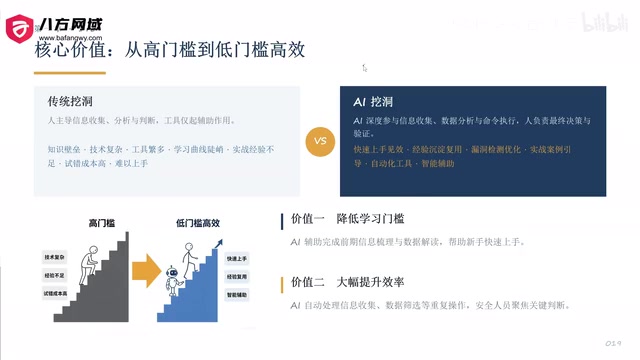
With an AI Agent deeply integrated into the process, vulnerability hunting shifts from a human-driven loop of information gathering, analysis, and judgment to a model where the Agent handles information collection, data analysis, and command execution — while the human focuses on decision-making and validation: confirming whether a vulnerability is real, and writing the report for submission.
The core value shows up in two areas. First, it lowers the learning barrier and breaks down the walls created by cybersecurity's complexity and steep learning curve. Second, it dramatically increases hunting efficiency. Under the traditional approach, a researcher might submit a few dozen to a hundred vulnerabilities per year. With AI-assisted hunting, some researchers have submitted more than fourteen thousand vulnerabilities in a single year.
It's important to stay clear-eyed about what this means: AI-assisted bug hunting is not about letting an agent replace the human and walk away. Its role is to lower barriers and boost efficiency — making workflows that previously demanded deep experience and significant time investment manageable for more people. The responsibility for decision-making and verification always remains on the human side.
Fourteen thousand vulnerabilities submitted in a year works out to roughly 38 per day — a figure that indirectly reflects the upper bound of AI's capacity for batch-processing information collection and preliminary validation. It's worth noting that SRC platforms also have quality review mechanisms; low-quality or duplicate submissions typically go unscored or result in a lower trust rating. So the prerequisite for this kind of efficiency gain is that the vulnerabilities AI surfaces are genuinely real and reproducible — which is exactly why the article repeatedly emphasizes that manual review before submission is non-negotiable. Additionally, probing systems for vulnerabilities outside the scope of explicit authorization is illegal in most jurisdictions. When an AI Agent autonomously executes scanning and penetration commands, the operator bears full legal responsibility for ensuring that testing targets are properly authorized.
Related articles

Gemini 4 Argon Hands-On: AI Builds Board Games, Constructs Temples, and Trains Robots Autonomously
Gemini 4 Argon hands-on roundup: AI autonomously builds a desk racetrack and temple in Blender, writes a ray tracing engine, trains a humanoid robot to sink 7 shots, plus API pricing and developer access.

The Magic Octagonal Coin: Why Only 9% of People Can Predict Its Flip?
Only 9% of people can correctly predict the Magic Octagon coin flip. This article explains its spatial rotation mechanism, common cognitive pitfalls, and a new hypothesis based on Relevance Theory, exploring the limits of human spatial reasoning.

Sam Altman: AI Is Entering the Era of Scientific Discovery — Math Breakthroughs Will Replicate in Biology and Energy
Sam Altman says AI is entering the era of scientific discovery — math breakthroughs will replicate in biology, materials science, and energy to help develop new drugs and energy sources.