AI Agents Linked to Tencent Cloud Probed Alibaba's Amap: 2,600 Autonomous Reconnaissance Attempts Sound the Alarm for API Security

Researchers found over 2,600 unauthorized probes of Alibaba's Amap by AI agents originating from Tencent Cloud, exposing a first-contact authorization blind spot.
A Reddit security research discussion has drawn attention: researchers tracked over 2,600 AI agent probing attempts targeting Alibaba's Amap, allegedly originating from Tencent Cloud-linked infrastructure and all lacking authorization. This is not human-operated infiltration but coordinated reconnaissance by autonomous agents at machine speed, which traditional human-paced incident response cannot counter. The core issue: production services cannot distinguish legitimate from adversarial callers at the instant of an agent's first contact, exposing a structural flaw—existing identity verification focuses on "after login," ignoring "before contact."
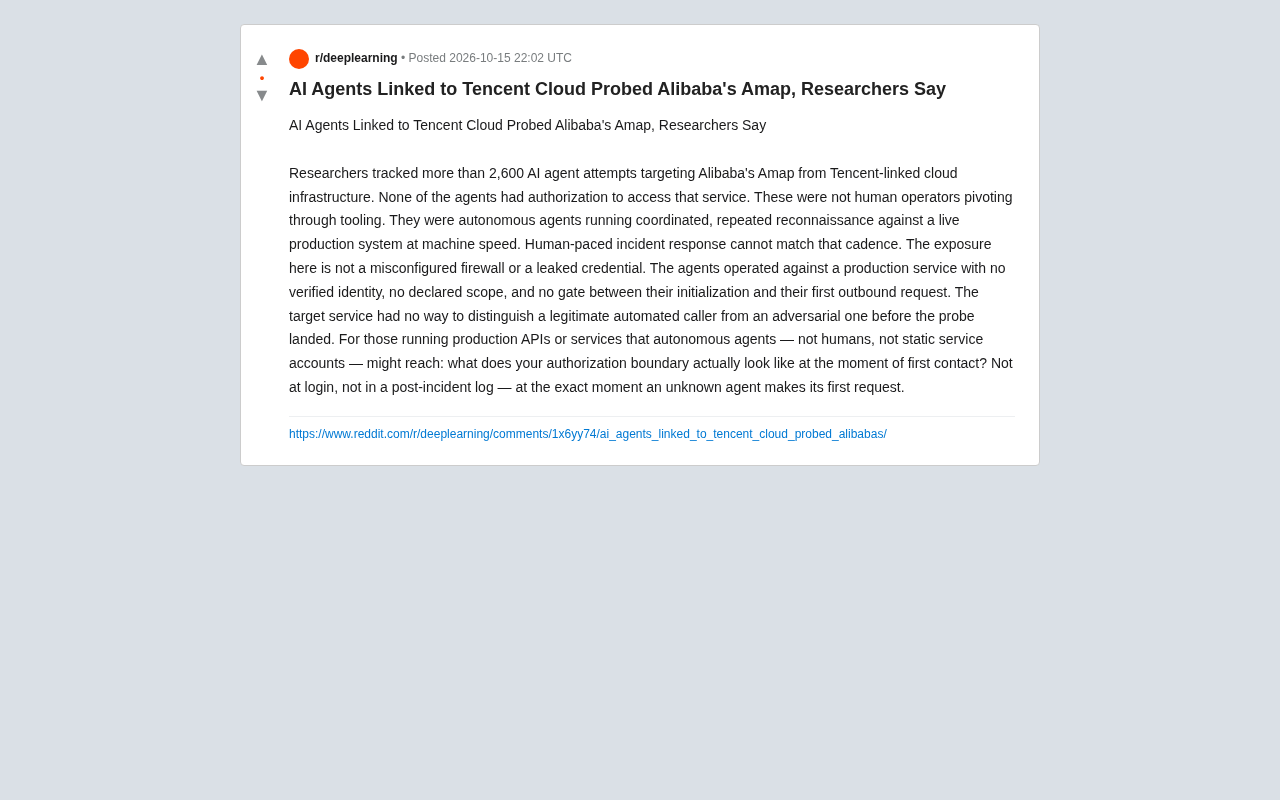
A security research discussion originating from Reddit has drawn industry attention: researchers tracked over 2,600 AI agent probing attempts targeting Alibaba's Amap, with these requests allegedly originating from infrastructure linked to Tencent Cloud. Critically, these agents had no authorization to access the service.
This is not a human operator using a toolchain to conduct a circuitous infiltration—it is autonomous AI agents launching coordinated, repetitive reconnaissance against live production systems at machine speed. Traditional incident response workflows, which operate at human pace, simply cannot keep up.
The Core of the Incident: No Authorization, No Identity, No Boundary
The researchers' description points to a structural problem: these agents initiated operations against production services without any verified identity, without declared scope, and without any gate between initialization and the first outbound request. The target service had no way to distinguish legitimate automated callers from adversarial ones before the probing requests actually landed.
What this exposes is not a misconfigured firewall rule or a leaked credential, but a deeper missing security boundary. The question raised in the original article deserves serious consideration from every engineer running production APIs:
What does your authorization boundary actually look like at "the moment of first contact"? Not at login, not in the logs afterward—but at the precise instant an unknown agent sends its first request.
Machine Speed vs. Human Response
The 2,600 probes were completed by autonomous agents, meaning the entire process unfolded far faster than a human analyst could manually investigate, confirm, and block. When the attack surface shifts from "humans operating tools" to "agents making autonomous decisions and executing them," traditional detection and response mechanisms built on human timescales develop an obvious lag window.
Autonomous AI Agent refers to AI systems capable of independently perceiving their environment, making decisions, and executing actions without step-by-step human instructions. Unlike traditional automation scripts, autonomous agents typically possess goal-directedness, a degree of reasoning capability, and multi-step task planning, allowing them to dynamically adjust behavior based on environmental feedback. In enterprise settings, they are widely used for data collection, API calls, task orchestration, and customer service. Because of their autonomous decision-making capability, when such agents are directed at unauthorized targets, their behavior patterns exhibit highly coordinated, adaptive, and unpredictable characteristics—posing challenges to traditional rule-based security detection.
The Blind Spot in Identity Verification
These agents initiated requests without any verified identity. Most current API gateways and authentication systems rely on credentials, tokens, or service accounts to distinguish callers. But when a completely new, unregistered autonomous agent reaches a service for the first time, the system lacks effective criteria for judgment at that instant.
The core philosophy of Zero Trust Architecture is "never trust, always verify," requiring continuous identity verification and authorization for any entity attempting to access resources—whether from inside or outside the network. However, most current zero trust practices still start from "verified identity," meaning they assume the accessing entity already possesses some form of credential or identity marker. When faced with a completely unknown, unregistered autonomous agent making its first request, the zero trust model has a blind spot at the "first contact" stage. The industry is exploring the concept of "First-Contact Authorization," which aims to perform preliminary assessment through multi-dimensional signals—device fingerprints, behavioral characteristics, source reputation—before the request reaches business logic, thereby determining whether to allow further interaction.
Practical Implications for the Industry
This incident is not an isolated intrusion case; it is more like a signal that security models need updating for the AI agent era. As more enterprises deploy autonomous agents for data collection, API calls, and task orchestration, production environments will face non-human callers at orders of magnitude greater scale.
For teams running production APIs or services, the questions that need re-examination include:
- Is the identity verification mechanism at first contact sufficient
- Are there rate limiting and isolation strategies for unknown automated callers
- Can incident response processes keep pace with machine-speed probing
- Does the authorization boundary design only consider "after login" while ignoring "before contact"
API Gateway is an intermediary layer between clients and backend services, responsible for request routing, protocol translation, authentication, rate limiting, and monitoring. In the context of large-scale AI agent access, API gateways need to upgrade from static "credential verification" to dynamic "behavioral trust assessment." For example, by analyzing request frequency, request patterns, source IP reputation, TLS fingerprints, and other signals, they can determine in real time whether the caller is legitimate automation or adversarial probing. At the same time, gateways should support fine-grained rate limiting and isolation strategies, implementing progressive challenges (such as CAPTCHA, proof of work) for unknown callers rather than allowing them through directly or simply blocking them. This requires API gateways to possess more powerful real-time computing and machine learning capabilities to handle machine-speed probing.
Corroboration from Multiple Sources
According to the Reddit post sharing this research and tracking data from relevant security researchers, details regarding the number of probes (2,600+) and the source infrastructure (Tencent Cloud-linked) remain consistent across multiple analyses. However, publicly available information does not provide a clear conclusion on which party these agents specifically belong to, or whether this was testing behavior or malicious reconnaissance—and the original article does not offer further characterization either.
Interestingly, both parties involved—Tencent Cloud and Alibaba's Amap—have so far made no public response to the research findings (according to the original discussion).
An Unanswered Question
The question posed at the end of the original article is actually more worthy of industry reflection than the incident itself: when the inspection point for authorization boundaries shifts from "the moment of login" forward to "the moment of first contact," do existing identity and access management paradigms still hold? Amid the trend of autonomous agents accessing production systems at scale, the answer to this question will determine the fundamental shape of future API security architecture.
One-line Summary
Researchers found over 2,600 unauthorized probes of Alibaba's Amap by AI agents originating from Tencent Cloud, exposing a first-contact authorization blind spot.
Paragraph Summary
A Reddit security research discussion has drawn attention: researchers tracked over 2,600 AI agent probing attempts targeting Alibaba's Amap, with these requests allegedly originating from infrastructure linked to Tencent Cloud and all lacking authorization. This is not a human operator's infiltration via toolchains, but coordinated reconnaissance launched by autonomous agents at machine speed—something traditional human-paced incident response cannot counter. The core issue is that production services cannot distinguish legitimate from adversarial callers at the instant of an agent's first contact, exposing a structural flaw in authorization boundary design: existing identity verification mechanisms focus only on "after login," ignoring "before contact." The industry needs to re-examine identity verification, rate limiting, and isolation strategies at first contact, and shift the authorization boundary from the moment of login to the moment of first contact.
Related articles

Kimi K3.1 Hands-On Test: Open-Source Model Nears Opus, Video Generation Steals the Show
Kimi K3.1 completed motion graphics, 3D rendering, mini-games, and video generation in a live test. Analysis of its 2.8T MoE architecture, gap vs Opus/GPT, and hidden video generation.

Sam Altman: Why Life's Biggest Advice Should Still Come from Humans
OpenAI CEO Sam Altman on the limits of AI advice: AI can talk you out of an impulsive email, but life's biggest advice should still come from humans.

"Black October": Did AI Uncover 3% of All Critical Vulnerabilities Ever?
A Reddit post claims 3% of all critical software vulnerabilities ever were found in the past month, dubbed 'Black October.' We break down the statistical issues, how AI-assisted code auditing accelerates discovery, and how developers should respond.