AI Agents Powering the Full Research Pipeline: A Practical Guide to Automation from Topic Selection to Publication

A practical guide to building an AI Agent-driven research automation pipeline from topic selection to publication.
This article breaks down how to chain dozens of AI tools into a complete research automation system—covering model selection, RAG-based literature research with NotebookLM, LLM-powered data analysis, LaTeX writing, scientific illustration, N8N workflows, and local deployment with Ollama—turning AI from a chat tool into a true research collaborator.
From "Chat Box" to "Research Productivity System"
Amid the AI wave, most researchers still remain at the simple conversational usage stage—treating large models as smarter search engines, asking a question and getting an answer. Yet the real challenge in research has never been "whether there is an answer," but rather how to efficiently integrate massive amounts of information, continuously generate high-quality research IDEAs, and rapidly transform research ideas into publishable results.
This article builds on the practical full-research-pipeline course shared by Bilibili creator "AI上研修," outlining how to link dozens of AI tools into a complete research automation system. Its core philosophy can be summarized in three progressive levels: Tool → Productivity Agent → Research Collaborator. Behind this lies a five-layer engineering logic of "prompt, context, skill, scaffolding, and closed loop," which distills scattered tools into reusable research AI assets.
Step One: Choose Your Model Based on the Task
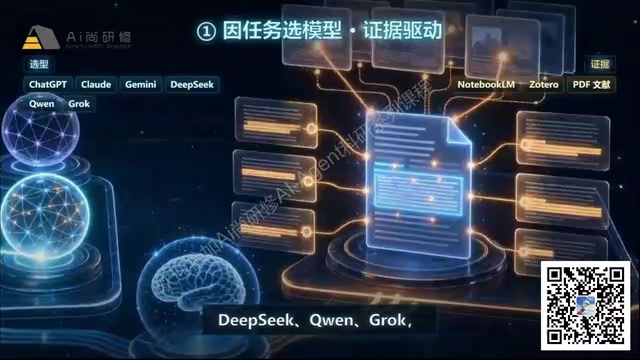
Different large models each have their own specialties, and the starting point of a research workflow is to "choose the model based on the task." ChatGPT, Claude, Gemini, DeepSeekAd, Qwen, and Grok each play their respective roles at different stages: some excel at logical reasoning, some at long-text processing, and some at code generation.
This divergence is not accidental but stems from fundamental differences in each model's architecture design, training data, and optimization objectives. To understand these differences, you need to grasp two core variables of modern large language models: the composition of the pretraining corpus and the post-training alignment strategy. The pretraining phase determines the model's knowledge boundaries—DeepSeek and Qwen used a large proportion of Chinese and code corpora, giving them a structural advantage in Chinese logical expression and programming tasks; whereas Claude's training data contains a large amount of long documents and academic text, combined with its "Constitutional AI" alignment method (having the model self-critique and revise based on a set of principles), making it stand out in tasks requiring careful reading and detailed analysis. The RLHF (Reinforcement Learning from Human Feedback) strategy in post-training shapes a model's "personality"—the GPT-4 series invested substantial optimization resources into balanced instruction-following, making it a reliable baseline for general-purpose scenarios. In addition, the context window size is a key technical metric in research scenarios: Claude's context window can reach 200K tokens, meaning dozens of full papers can be input at once for joint analysis—a capability that was entirely impossible in the era of traditional 4K or 8K windows. Researchers who master this "task-model" mapping logic can often obtain higher-quality output at lower cost.
Particularly noteworthy is NotebookLM's traceable reasoning capability. Traditional AI literature reviews are prone to "hallucinations," whereas NotebookLM can reason based on user-uploaded literature and provide conclusions with citation annotations, truly achieving "evidence-driven, hallucination-free" results.
Behind NotebookLM's capability lies the support of the RAG (Retrieval-Augmented Generation) technical architecture. Unlike traditional large models that rely purely on parametric memory, a RAG system first retrieves relevant snippets from the user-provided document library when generating an answer, then injects the retrieved results as context into the generation process. To deeply understand how RAG works, you need to grasp its "indexing-retrieval-generation" three-stage pipeline: in the indexing stage, the system splits input documents into fixed-size text chunks, converts each chunk into a high-dimensional vector via an embedding model, and stores it in a vector database; in the retrieval stage, the user's query is likewise converted into a vector, and the system finds the semantically closest document snippets in the vector space using cosine similarity or approximate nearest neighbor algorithms; in the generation stage, these retrieved original snippets are concatenated into the prompt as "grounding evidence," guiding the large model to answer based on real literature rather than training memory. This mechanism fundamentally changes the model's knowledge source—from "what the model remembers" to "what the documents say"—so every conclusion can be precisely traced back to specific paragraphs in the original literature, mechanistically eliminating the "hallucination" problem of fabricating content out of thin air. Combined with Zotero to manage every piece of literature evidence, this achieves a leap from "storing papers" to "a reasoning-capable research system with literature as the core evidence."
Automating Literature Research
NotebookLM can automatically compare viewpoints across literature, identify consensus and disagreement between different studies, and generate research summaries with citation annotations. This mechanistically eliminates the problem of AI literature hallucination, making research reviews both efficient and reliable. Notably, Zotero, as the "foundation" of literature management, has an open API and plugin ecosystem (such as Better BibTeX and ZotFile) that enables seamless integration with RAG systems—researchers can use their Zotero library directly as the knowledge source for NotebookLM or a self-built RAG system, forming an integrated "collection-management-reasoning" literature processing pipeline.
Data Analysis: Enabling Non-Coders to Produce Results
Processing research data is a pain point for many researchers. A viable solution is to connect the entire data analysis workflow using LLM + Excel + Python.
Control Excel with natural language, letting AI automatically generate complex formulas, complete data cleaning and anomaly detection, automatically interpret statistical results, and finally generate the "Results" section of a paper with one click. For more complex analyses, AI can automatically generate scripts for data reading, cleaning, statistical analysis, and visualization, helping researchers complete the full pipeline from experimental data to paper figures—turning Python into research productivity even for those who can't code.

The significance of this stage lies in dramatically lowering the technical barrier. From a technical perspective, the breakthrough of current mainstream large models in code generation tasks comes from the large-scale injection of code pretraining corpora: public GitHub repositories, Stack Overflow Q&A, and programming tutorials constitute tens of billions of tokens of code corpus, enabling models to acquire the ability to "translate" natural language requirements into executable code. For research data analysis, this means researchers can use a natural language description like "help me perform a two-sample t-test on this dataset and determine whether the assumption of homogeneity of variance is met" to directly obtain a complete Python script including a Levene test, t-test, and result interpretation. In the past, data analysis often required a specialized programming or statistics background; with AI's natural language interface, researchers can focus more energy on the scientific questions themselves rather than tool operation. It is worth noting that AI-generated code and formulas still require researcher verification, especially in the choice of statistical methods and interpretation of results—domain expertise is indispensable.
Paper Writing and Scientific Illustration
The writing stage is key to translating research into concrete outcomes. It's recommended to make paper writing "process-oriented": AI first generates the paper structure, then writes drafts section by section, combining Overleaf, LaTeX, and OpenAI Prism to handle mathematical formulas and citations, significantly improving writing efficiency.
Overleaf, as a cloud-based LaTeX collaboration platform, plays the role of the "writing terminal" in this workflow. The core value of LaTeX lies in its design philosophy of separating content from formatting—researchers focus on content input, while the typesetting style is automatically handled by the journal-provided .cls or .sty template files. This aligns closely with the "raw material output" logic of AI-generated text. AI-generated text content can be directly filled in as parameters to LaTeX commands, and structured elements such as mathematical formulas, reference citations, and figure/table labels all have standardized markup language expressions, making them naturally suited for programmatic processing. Combining AI writing with the LaTeX workflow essentially decomposes research writing into two independent layers—"semantic generation" (handled by AI) and "format rendering" (handled by LaTeX)—each doing its own job without interfering with the other.

A Picture Worth a Thousand Words: AI-Assisted Scientific Illustration
Scientific illustration also has a new solution. Use tools like NanoBanana and ChatGPT Image to generate mechanism and concept diagrams, generate 3D scientific images through Codex, and then process them into submission-ready vector graphics with Adobe Illustrator—even those who aren't good at drawing can produce "Nature-level" scientific expression. This workflow covers the complete needs from first draft to journal submission standards. It's worth knowing that top-tier journals (such as Nature, Science, and Cell) have strict technical specifications for images: resolution is typically required to be 300-600 DPI, the color mode must comply with the CMYK printing standard, and lines and text must be saved in vector format to ensure clarity when scaled. AI-generated first drafts are usually in raster format; they need to be converted to vector format using Adobe Illustrator's "Image Trace" feature, and then have fonts, color schemes, and line weights unified, to meet the publication standards for journal submission.
N8N-Powered Research Automation Workflows
If the earlier stages were still "human-machine collaboration," then the N8N workflow pushes collaboration toward an "automated assembly line."
N8N is an open-source workflow automation platform, positioned similarly to Zapier or Make (formerly Integromat), but supporting self-hosted deployment, which is friendlier to research data privacy. Its core logic is to connect different applications and APIs through "Nodes," linking trigger events, data processing, and action responses into a visual automated process. Understanding N8N's technical architecture requires grasping several key concepts: Webhook triggers allow external events (such as new literature entering the database or scheduled tasks) to automatically launch workflows; HTTP Request nodes enable N8N to call any RESTful API, including large model interfaces such as OpenAI and DeepSeek; Code nodes support embedded JavaScript or Python logic to handle complex data transformation needs; and the credential encryption storage mechanism ensures the security of sensitive information such as API keys. In research scenarios, N8N can act as the "central nervous system," seamlessly connecting heterogeneous tools such as literature databases (like PubMed API and arXiv API), LLM APIs, notification systems (email/Slack), and cloud storage, enabling a fully automated pipeline from "input research keyword" to "output literature summary report and push it to a designated inbox," without manually switching and copy-pasting between multiple software.
By linking LLMs through N8N, you can achieve automatic multi-software coordination and build a full-process research automation system. A typical case: create a fully automated research literature search and summary system through DeepSeek—input a research direction and it automatically retrieves, filters, and summarizes relevant literature.

Going further, OpenClaude and Agent Skill can build automated writing agents that require no manual intervention. Here we need to understand the essential difference between AI Agents and traditional LLM calls: traditional large model calls are a single-turn or multi-turn "Q&A" mode, where the process terminates after the answer; whereas AI Agents introduce a "perception-planning-action-feedback" loop mechanism, whose underlying foundation is usually based on the ReAct (Reasoning + Acting) framework—at each step, the model explicitly outputs a "Thought → Action → Observation" triplet, interacts with the external environment through tool calls (Function Calling), updates its reasoning state based on observation results, and decides the next action. The key innovation of this paradigm lies in the standardized interface for tool calling: the "tools" an Agent can call can be any external capability such as web search, code execution, file reading/writing, or API requests—the model only needs to learn when to call which tool and how to parse the returned results. The "Stanford Paper Review Agent" is precisely an embodiment of this paradigm—it can not only generate review comments but also feed those comments back to the writing module, triggering revisions, then reviewing again, forming an automatic optimization loop that requires no human involvement, upgrading AI from a passive tool to an active executor.
Local Deployment: Protecting the Privacy and Security of Research IDEAs
Research outcomes involve intellectual property, and the risk of IDEA leakage is a concern that makes many researchers reluctant to deeply use cloud-based AI. The solution is local deployment: run models like DeepSeek locally through Ollama, combine them with Zotero and a private knowledge base to build a dedicated AI assistant that runs without VPN access, fundamentally safeguarding data privacy and research security.
Ollama's technical core is quantization compression of model weights (such as INT4 and INT8 quantization), which significantly reduces VRAM and memory requirements within an acceptable range of precision loss, allowing ordinary consumer-grade GPUs or even CPUs to run mainstream open-source large models. To understand the principle of quantization: standard large model weights are stored in FP32 (32-bit floating point) or FP16 (16-bit floating point) format, and the FP16 weights of a 7B-parameter model require about 14GB of VRAM. INT4 quantization compresses each weight from 16 bits to 4 bits, theoretically reducing the VRAM requirement to about 3.5GB, enabling it to run on consumer-grade graphics cards (such as the RTX 3060) or even a pure CPU environment. The cost of quantization is a slight decline in precision, but research shows that for text understanding and generation tasks, the performance loss of INT4 quantized models is usually within an acceptable 5%. Ollama further encapsulates the entire process of model downloading, format conversion, and inference serving, reducing the technical barrier of local deployment to the level of a single command. For research users, local deployment means all data processing is done on the local machine—research hypotheses, experimental data, and unpublished results never pass through any third-party servers, fundamentally avoiding the risk of intellectual property leakage while also solving the network access barriers to cloud AI services in some regions.
From Papers to Science Popularization Videos: Visualized Dissemination of Results
The endpoint of the research workflow is disseminating results. With video generation tools such as Kling (Cdance) 2.0, Codex, and Hyperframes, you can automatically transform a paper into a 60-to-90-second science popularization video: input the paper PDF, automatically generate a storyboard script, subtitles, and voiceover, and complete the MP4 rendering, achieving visualized dissemination of research results. The technical chain of this stage involves the coordination of multimodal AI: a text summarization model compresses the paper into a narrative script, a text-to-video model (such as Kling's video generation architecture based on diffusion models) transforms the key concepts in the script into dynamic visuals, a TTS (text-to-speech) model generates professional voiceover, and finally a video editing API completes the merged rendering. This workflow extends the dissemination form of research results from "PDF files" to "short video content," meeting the dissemination needs of academic science popularization in the social media era.
Conclusion: Turning AI into a True Research Collaborator
The value of this full-research-pipeline solution lies not in the power of any single tool, but in linking dozens of stages—topic selection, literature, data, writing, illustration, review, and dissemination—into a closed-loop system. When these processes are distilled into reusable research AI assets, AI evolves from a passively responding "chat box" into a true "collaborator" that genuinely participates in the entire research process.
Of course, no matter how powerful the tools are, they cannot replace scientific judgment and critical thinking. The real challenge lies in how to strike a balance between automation and academic rigor—while using AI to improve efficiency, always maintain scrutiny and verification of the results. This is perhaps the correct way to embrace "AI Agent-driven research."
Key Takeaways
Related articles

Black Forager Alexis Nelson: From Foraging to Publishing, Happy Snacking, Don't Die
Black Forager Alexis Nikole Nelson visits Talks at Google, sharing her journey from childhood plant walks with her mother to publishing the cookbook Happy Snacking, Don't Die!, revealing the racial and land history behind foraging's rise and fall in America.

How to Present Your Ideas Effectively: Three Types of Revelation Talks
Revelation talks are the most direct way to convey ideas. This article breaks down three types — Wonder Walk, Dynamic Demo, and DreamScape — with classic examples from David Gayo, Michael Pritchard, and Sylvia Earle.

Modern Web Guidance: Letting AI Write Native Declarative Dialog Popovers
Google's Modern Web Guidance makes AI coding assistants prefer native declarative dialog capabilities over repetitive JavaScript event listeners, measurably cutting boilerplate code.