AI Agents Reshaping Software Testing: A Hands-On Beginner's Guide to Claude Code
A practical guide to using Claude Code AI Agent for automated software testing.
This article explores how AI Agents differ from traditional LLMs and demonstrates how Claude Code — Anthropic's command-line programming agent — is transforming software testing. It covers the agent's three core capabilities (task planning, memory, and tool use), presents a three-day hands-on learning path from environment setup to Web automation testing, and discusses integration with Allure reports and unattended execution modes.
A New Inflection Point in Software Testing: From Large Models to Intelligent Agents
The software testing industry is undergoing a paradigm shift. In the past, the skill stack for testing roles revolved around functional testing, API testing, test automation, and performance testing. But with the maturation of AI Agent technology, a brand-new direction — AI Testing — is rapidly becoming an industry standard.
According to a veteran testing instructor on Bilibili (with 13 years of IT experience spanning development and testing), the core competitive advantage in software testing is shifting from traditional manual testing and script writing toward AI Agent-driven Web and API test automation. The key tool at the center of this shift is Claude Code — a programming agent with a command-line interface.
Claude Code is a command-line programming agent developed by Anthropic, built on the Claude large language model. Unlike traditional IDE plugins, Claude Code runs directly in the terminal, capable of reading an entire project's file structure and code content, understanding dependencies between code modules, and directly creating, modifying, and deleting files in the local file system. It supports completing tasks such as code writing, refactoring, debugging, and test generation through natural language instructions. Because its core interaction interface is the command line, it naturally integrates with CI/CD pipelines, Shell scripts, and other DevOps toolchains, giving it a unique advantage in test automation scenarios.
This article draws on the course content to clarify the fundamental differences between agents and traditional large models, and analyzes how AI Agents can boost testing efficiency by more than tenfold.
Large Models vs. Agents: The Core Difference Between Brain and Limbs
To understand AI testing, you first need to clear up a common misconception: Claude Code is not a large model — it's an agent.
The tools we use daily, such as DeepSeek and Tongyi Qianwen, are essentially Large Language Models (LLMs). LLMs are deep learning models built on the Transformer architecture and trained on massive text datasets, typically with parameters ranging from billions to trillions. Their core capability is generating coherent natural language output by predicting the next token. Their interaction mode is "question-and-answer" — you open a dialog box, type a question, and it returns a response. This paradigm is powerful for information retrieval, but has clear limitations: at its core, an LLM is a probabilistic reasoning engine. It has no file system access, no ability to make network requests, and no means of interacting with the external environment. All its output is confined to text generation.
The instructor used an elegant analogy to illustrate this:
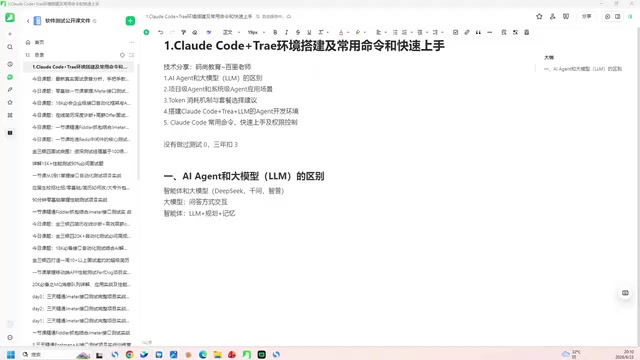
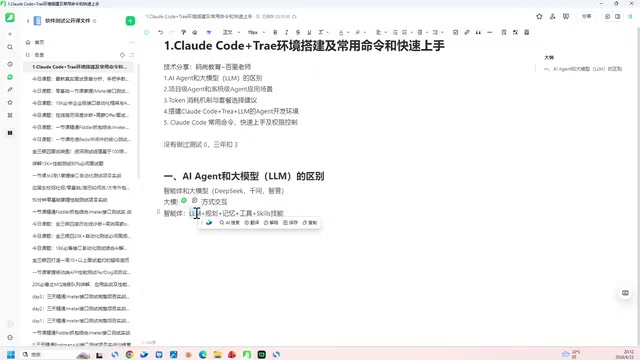
If the large model is the "brain of the human body," then the agent is "the brain plus the limbs."
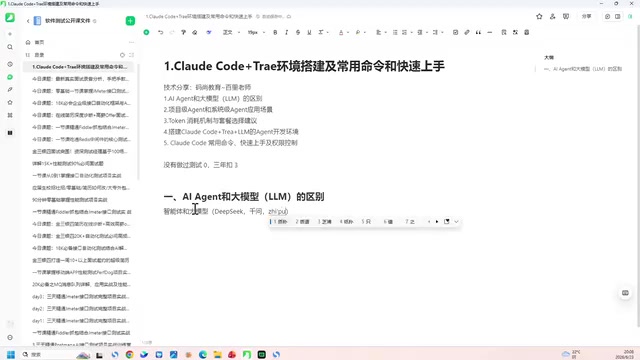
The brain can think. It can tell you that "1+1=2" or help you write a test case. But if you ask it to output that test case directly as an Excel file or generate a Word document, a pure large model simply can't do it — it can only "think," not "do."
Agents are different. Beyond the large model "brain," they possess three key capabilities:
- Task Planning: Given a goal, the agent can autonomously decompose it and plan execution steps. Technically, the planning module often employs prompt engineering paradigms such as ReAct (Reasoning + Acting) or Chain-of-Thought, enabling the Agent to break complex tasks into executable sub-step sequences.
- Memory: It records your previous operations and context as a basis for subsequent interactions, preventing information loss. The memory module is divided into short-term memory (the current session's context window) and long-term memory (historical interaction information stored via vector databases), ensuring the Agent maintains consistent understanding across multi-turn tasks.
- Tool Use: It can automatically invoke external tools to actually complete tasks, such as generating files, executing scripts, or operating browsers. The Tool Use / Function Calling mechanism allows the Agent to dynamically select and invoke external APIs, command-line tools, or browser automation frameworks based on task requirements, transforming the large model's "thinking" into actual "action."
It's precisely this "brain + limbs" combination that enables agents to truly land across various testing scenarios — whether generating test cases, writing Web automation scripts, or handling API testing scenarios.
How AI Agents Are Restructuring the Testing Workflow
In the era of large models alone, AI's empowerment of testing work was actually quite limited. You could ask it to write a few test cases or explain an error message, but you couldn't form an end-to-end automation loop.
The rise of agents has fundamentally changed this landscape. The instructor stated explicitly:
In today's testing work, AI testing is something you "must embrace." Previously it was functional testing, API testing, test automation, and performance testing. Now it's a comprehensive shift toward automation + AI testing.
In other words, AI Agents are no longer nice-to-have auxiliary tools — they are about to become a baseline skill requirement for test engineers. This poses new learning demands for both career changers starting from scratch and veterans with years of experience.
The Difference Between Project-Level and System-Level Agents
There are numerous agents on the market today. The instructor broadly categorizes them into two types:
- Project-Level Agents: Focused on code and tasks within a specific project, such as Claude Code. These agents excel at code generation, unit test writing, bug fixing, and other day-to-day developer tasks, with their scope limited to the context of a single code repository or project.
- System-Level Agents: Operating at a broader scope, covering system-wide automated collaboration. Examples include automatically orchestrating integration tests across microservices, change impact analysis across multiple code repositories, or coordinating multiple Agents to collaboratively complete end-to-end testing.
Industry exploration of system-level agents is still in its early stages, with few mature commercial products. Meanwhile, project-level agents represented by Claude Code, Cursor, and GitHub Copilot Workspace have already achieved a high degree of maturity and practicality. For testing practitioners, project-level agents are the most direct entry point — they can reside within your testing project, understand code context, and automatically generate and execute test scripts.
Three-Day Hands-On Path: From Environment Setup to Project Deployment
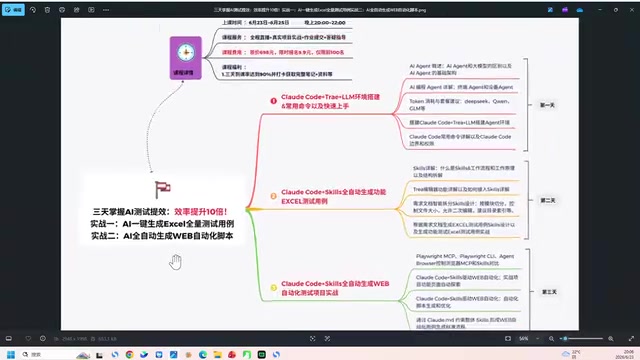
According to the course plan, the complete AI testing onboarding path is broken down into three progressive stages:
Day 1: Claude Code Environment Setup and Quick Start
The focus is on configuring the Claude Code + Tree environment, including installation, mastering common CLI commands, and basic interaction operations. CLI (Command Line Interface) is an interaction method contrasting with graphical interfaces, where users control programs by typing text commands in the terminal. Claude Code chose CLI as its primary interface because the command line naturally supports scripting and automated invocation, enabling seamless integration with testing frameworks and continuous integration tools. The Tree command displays a project's directory and file hierarchy in a tree structure, helping the Agent quickly understand the overall code structure. This is the foundation for all subsequent hands-on work.
Day 2: Fully Automated Functional Test Case Generation
Combining Claude Code + Kiosk to achieve fully automated generation of Excel test cases from requirements. This step hands off the traditionally time-consuming and labor-intensive work of test case writing to the agent. The conventional test case writing process typically requires test engineers to read requirement documents line by line, design test scenarios, write expected results, and fill in templates — a moderately complex functional module often takes hours or even days. An Agent can directly parse requirement documents, apply test design methods like equivalence partitioning and boundary value analysis to automatically generate structured test case sets, and write them to Excel files — the entire process can be completed in minutes.
Day 3: Web Automation Testing Project Practice
Still using Claude Code + Kiosk as the core, this stage completes a full hands-on project for automatically generating Web-based test cases. This is the critical leap from "tool usage" to "engineering deployment." Web automation testing traditionally relies on browser automation frameworks like Selenium and Playwright, requiring test engineers to manually write page element locators, interaction operations, and assertion logic. With an AI Agent, this process can be dramatically simplified: the Agent can automatically select appropriate locating strategies, generate complete test scripts, and invoke the browser for actual execution and verification based on test scenarios described in natural language.
The entire course revolves around two real-world project exercises, claiming to achieve "a tenfold efficiency boost" — and the instructor believes the actual improvement goes far beyond ten times.
Integrating Allure Reports and Unattended Mode
Beyond test case generation and script writing, the complete AI testing loop also includes result visualization and automated execution.
Allure Report is an open-source test report generation framework, originally developed by Qameta Software, supporting mainstream testing frameworks across multiple languages including Java, Python, and JavaScript (such as pytest, JUnit, TestNG, Mocha, etc.). It collects structured data produced during test execution (including test steps, attachments, screenshots, logs, etc.) and generates interactive HTML reports. Reports include test suite overviews, pass rate trend charts, detailed stack traces for failed cases, and defect distribution categorized by functional module or severity — providing teams with visually appealing and well-structured test result presentations. In CI/CD pipelines, Allure is commonly integrated with Jenkins, GitLab CI, and similar tools to automatically generate and publish test reports after each build, making it one of the standard practices in enterprise-level test operations.
Unattended Mode enables the entire testing process to execute automatically, generating reports without human intervention. At the technical implementation level, it typically relies on scheduled task dispatching (such as cron jobs or CI/CD Pipeline scheduled triggers), exception self-healing mechanisms in test scripts (such as retry strategies when element location fails), and notification mechanisms upon completion (email, DingTalk/Feishu webhooks, etc.). Combined with AI Agents, unattended mode reaches an even higher level of intelligence — the Agent can not only execute preset scripts but also dynamically adjust testing strategies based on runtime exceptions, such as automatically skipping untestable cases caused by environment failures or automatically expanding regression test scope when new defects are discovered. This is an extension of the "limbs" capability at the test operations level.
When an Agent can autonomously plan testing tasks, invoke browsers to execute scripts, generate Allure reports, and run continuously in unattended mode, the role of test engineers transforms accordingly — from "executors" to "designers and supervisors."
The Window for Test Engineers to Level Up Their Skills
From large models to agents, the rise of AI testing presents both challenges and opportunities. For career changers starting from zero, it lowers the coding barrier to test automation — you no longer need to master Python or Java testing framework syntax; instead, you can describe testing requirements to the Agent in natural language. For seasoned veterans, it provides a lever for efficiency gains — delegating repetitive script writing and test case maintenance to the Agent while focusing on higher-value work such as test strategy design and quality system architecture.
It's worth noting that the adoption of AI Agents in testing also faces some practical challenges. For example, Agent-generated test scripts still require human review for coverage and accuracy; for scenarios involving complex business logic, the Agent's depth of understanding may fall short; additionally, Agent operational costs (API call fees) and data security concerns (whether code is uploaded to the cloud) are factors that need evaluation for enterprise-level applications.
Interestingly, this article's content is based on a single training livestream source, and promotional claims like "tenfold efficiency improvement" carry a degree of marketing flavor — readers should approach them rationally. What is undeniable, however, is that mastering Agent tools like Claude Code is becoming one of the core competitive advantages for test engineers. Those who can first complete the mindset shift from "Q&A-style usage" to "agent-driven thinking" will gain a head start in this wave of technological transformation.
Key Takeaways
Related articles
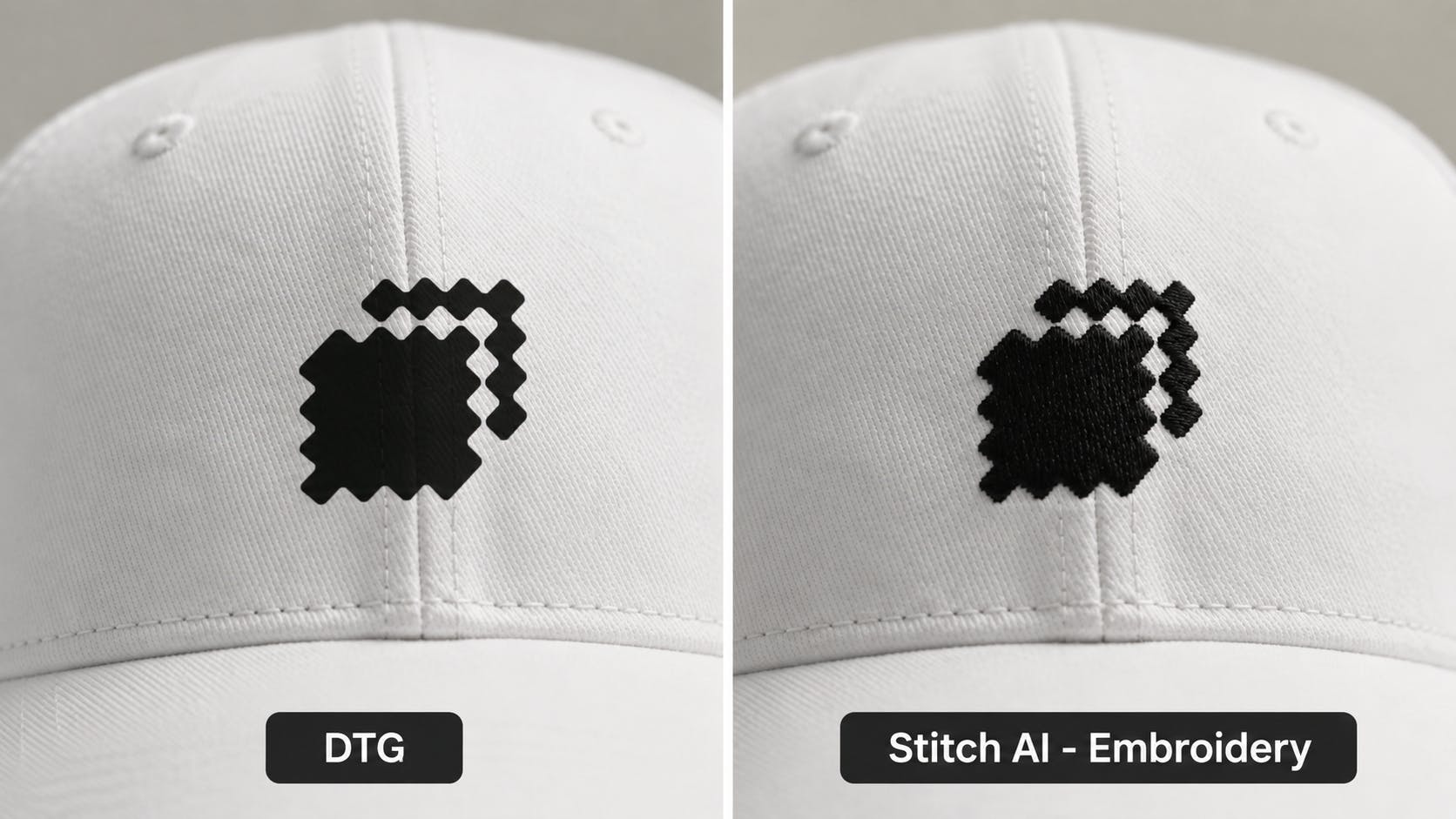
Stitch AI: An Embroidery Digitizing AI Agent That Generates Production-Ready Machine Files in 15 Seconds
Stitch AI is the first embroidery digitizing AI agent that reads artwork like a pro digitizer, auto-planning stitch direction, density, and pull compensation to generate DST/PES machine files, production sheets, and mockups in 15 seconds.
Claude Fable 5.1 Deep Dive: Anthropic's Most Powerful AI Model for Coding and Knowledge Work
Claude Fable 5.1 is Anthropic's most advanced coding and knowledge work model, built on the Claude 5 Mythos architecture. This deep dive covers its core capabilities, differences from Mythos 5.1, and deployment options.
deepeye: A Free Tool for Real-Time Deepfake Detection Right in Your Browser
deepeye is a free Chrome extension that detects deepfakes in real time—AI-generated photos, video calls, and voice messages—without uploading files.