AI Agents Running a Solo Company: One Person Handles the Entire Weekly AI Newsletter Workflow

How one person runs a 27,000-subscriber AI newsletter entirely with a team of collaborating AI Agents.
A Bilibili creator built a near-complete 'solo company' using AI Agents to automate a weekly AI newsletter—research, drafting, review, scheduling, and distribution—for a 27,000-subscriber audience. Using the EximWork platform, monthly costs dropped from $1,500 to $19, though human editorial judgment still handles the last mile.
A New Paradigm for the Solo Company: AI Agent Teams Replace Human Employees
A weekly AI newsletter with 27,000 subscribers—no writers, no editors, no social media managers, not even dedicated operations staff. Just the creator and a group of AI Agents. This is a real-world practice shared by a Bilibili creator: he built a nearly complete "solo company" operation using AI Agents, handling almost every step automatically—from content research, drafting, and review to scheduling and subscriber management.
What makes this case worth attention isn't how sci-fi it sounds, but its replicability. The entire system took just an hour and a half to set up, at a cost of about $16 to $17 in platform credits. It represents an emerging trend: AI Agents are evolving from single-task assistants into collaborative "virtual teams."

Full Newsletter Automation: From Research to Publishing
The Automated Content Production Chain
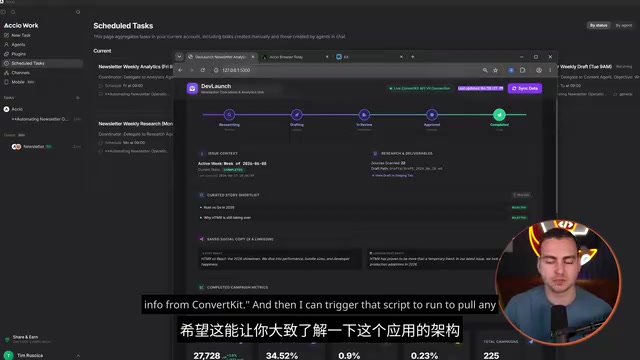
At the core of the system is a complete Newsletter operations dashboard that clearly displays each stage of content production. The workflow roughly goes like this: first, a research Agent conducts broad research and drafts a proposed newsletter; then it moves into review, where an editor Agent and the creator jointly vet the content; once approved, the content enters scheduling and is finally pushed to newsletter platforms like ConvertKit for publishing.
The system doesn't just generate the newsletter body—it also automatically integrates multiple short stories into a single issue and generates matching social media copy based on that issue's theme. This is exactly the "content distribution" work that previously required dedicated staff. The dashboard also displays real operational data at a glance: 27,000 subscribers, open rate, click rate, unsubscribe rate, and performance tracking for both Twitter and LinkedIn.
Division of Labor Among Multiple Specialized Agents
Behind the scenes, a collaborative team of Agents with clearly defined roles handles the work, including a research Agent, content Agent, social Agent, and analytics Agent. Each Agent is assigned clear responsibilities and tool permissions: the analytics Agent connects to LinkedIn and Twitter plugins to pull data directly, while the research Agent retrieves external information in real time.

In the live demo, the research Agent spent about a minute browsing platforms like GitHub, Node.js, and Microsoft Azure to retrieve the latest updates, filtering out five tech news items with reference links attached. The main Agent handles overall task delegation, assigning research tasks to the research Agent and then aggregating the results for feedback. This "manager + specialist" hierarchical structure is precisely what sets it apart from an ordinary chatbot.
The Tools Behind It: An Agent Coordination Platform Built for Business Scenarios
24/7 Virtual Desktop and Mobile Remote Coordination
The tool the creator uses is EximWork, a multi-Agent coordination platform designed for business and e-commerce scenarios, with a large number of ready-made Agents and Skills built in. Its core feature is running a round-the-clock virtual desktop—even when the creator steps away from their workstation, the Agent team continues executing tasks in the background.
The platform supports integration with instant messaging tools like Telegram and Discord. After connecting Telegram, the creator can issue commands to Agents, receive notifications, and approve tasks anytime from a phone. The ability to "remotely run an entire business from mobile" makes truly anytime-anywhere operation possible for the solo company.
Flexible Model Selection and Plugin Ecosystem
Each Agent can internally choose a different underlying model, such as Gemini, OpenAI, or Claude—capabilities already included in the subscription plan. The platform offers a rich set of Connectors and Skills, covering business tools like Apollo and Instantly.
For services the platform doesn't yet have a built-in connector for (such as ConvertKit), Agents can even write their own code to complete the API integration. The creator had a Coder Agent write a script to pull data from ConvertKit and set it to refresh automatically every day, with no manual intervention needed. This "build whatever's missing" capability dramatically expands the boundaries of automation.
Live Demo: A Complete Loop from Research to Tweeting
During the demo, the creator used WhisperFlow voice input to issue commands to the system, simulating the full operational workflow. After the research Agent finished its research, he further requested a Twitter post based on an interesting news item, which was published after review. The system offered multiple copy options; he selected the first one and approved it—and 24 seconds later, the content actually appeared on X (Twitter).

The Agent can also pull engagement data from the tweet and sync it to the dashboard. This closed-loop demo vividly illustrates that the entire chain—from content production and distribution to data collection—can now flow automatically within a single system.
Cost Comparison: AI Agents vs. Human Outsourcing
The creator did a clear cost calculation. Previously, he paid around $1,500 per month for people to write content, do data analysis, and manage two or three social platforms—exactly the work Agents now replace.
After using EximWork, setting up the entire system consumed only about 3,200 of the plan's 4,000 credits, equivalent to $16 to $17. The paid plan is $19 per month, with credits refreshing daily. Once the setup was complete, day-to-day operations consumed hardly any credits, since the main cost was concentrated in the initial setup phase. Monthly cost dropped from $1,500 to $19—a reduction of over 98%.
A Level-Headed Look: What AI Agents Still Can't Replace
Despite the impressive results, the creator was candid about the limitations. The system is not perfect—it still requires human editorial judgment, every post must be personally reviewed before publishing, and the quality of newsletter drafts varies, often needing manual editing and polishing.
In other words, the AI Agents here play the role of an "efficient execution team," while the human remains the "editor-in-chief" who steers direction and vets quality. This reveals the true state of AI Agent applications today: they dramatically lower execution costs and compress workflow time, but the "last mile" of judgment remains firmly in human hands.
For developers, independent creators, and small startup founders who want to automate their business with AI, the takeaway from this case is direct: rather than waiting for a perfect fully-automated solution, start now with a mature Agent platform, hand off repetitive research, drafting, and distribution work, and free yourself to focus on judgment and decision-making. This may well be the signal that the era of the "solo company" has truly arrived.
Related articles

Disaster and Glory of the Apollo Program: The History We Must Revisit Before Returning to the Moon
From the fatal Apollo 1 fire to Apollo 8's daring lunar orbit to Apollo 11's successful landing—revisiting the disasters, fears, and compromises of the Apollo program and their lessons for today's return to the Moon.

Netflix Trust Exercise Turns Into Firing Trap: Where Are the Boundaries of Corporate Trust?
A Netflix employee was fired after sharing private info in a trust exercise. We analyze the risks of corporate trust exercises and how employees can protect themselves.

AMD CDNA5 Architecture Deep Dive: Technical Evolution and the AI Computing Competition Landscape
Deep analysis of AMD's CDNA5 architecture covering Chiplet packaging upgrades, HBM memory evolution, and low-precision compute optimization, examining how AMD challenges NVIDIA's AI chip dominance.